
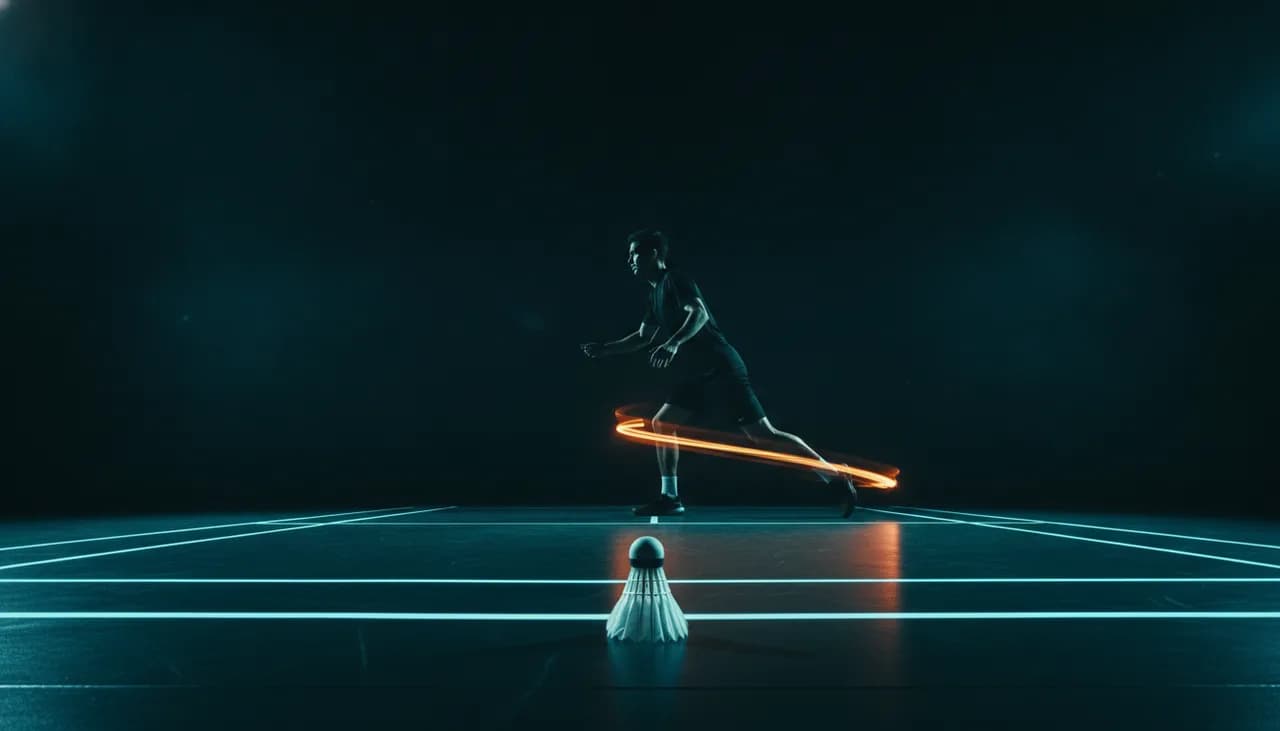
Shadow Badminton: Improve Without a Shuttlecock or Partner
Shadow badminton is repeating footwork and strokes without a shuttlecock or partner: why it works, routines by level, and mistakes to avoid.
Shadow badminton involves repeating your footwork and strokes on the court without a shuttlecock or partner, solely in the "shadow" of the shot you want to master. It's the most underutilized training method by club players, even though it costs nothing and can be practiced anywhere: an empty gym, your living room, a patch of parking lot. Done well, a ten-minute session three times a week transforms your footwork faster than an hour of messy match play. Here's why it works, how to structure your routines, and the mistakes to avoid.
The Essentials:
- Shadow badminton is about repeating your footwork and strokes without a shuttlecock: you automate footwork without the pressure of an incoming shuttle.
- It costs nothing and can be practiced anywhere – the only prerequisite is space to move and a mental map of the court.
- Progression in four stages: touring the six corners, chasse-lunge cycles, adding the racket and full swing, then rhythm constraints.
- Winning frequency: short and regular (10-15 min, 3-4 times a week) rather than long and rare.
- Three mistakes kill a session: bending over instead of bending your legs, skipping the return to base, maintaining a constant rhythm.
Why Shadow Badminton Helps You Improve
When you play a match, your brain manages about ten tasks simultaneously: reading the trajectory, choosing a shot, gauging your stroke, anticipating the response, managing the score. In this chaos, your footwork takes a backseat, and you reproduce your old habits, good or bad. Shadow badminton removes the shuttlecock from the equation: only the movement and the stroke remain, which you repeat slowly, cleanly, identically, until the correct pattern becomes your default reaction.
This is exactly the mechanism described by motor learning: a skill moves from a cognitive stage, where you think about each step, to an autonomous stage, where you execute without thinking, with almost no mental cost. This autonomous stage is only reached through the repetition of a correct movement. Repeating a shaky movement in a match ingrains the shaky movement; repeating the correct movement in slow motion in shadow ingrains the correct movement. The quality of repetition takes precedence over quantity.
The second argument is that footwork becomes the real limiting factor beyond a certain level. Your smash might be excellent, but if you arrive late under the shuttle, you'll hit it off-balance. Look at An Se Young or Akane Yamaguchi: they don't run faster than their opponents; they move less and better. This efficiency is built when you're fresh, away from match pressure, and shadow is the tool that isolates this work. For the footwork theory you'll be ingraining, the article on badminton movement details the patterns and step techniques.
Finally, the logistical argument: shadow requires no shuttlecock, no partner, and no reserved court. It's the only badminton training you can fit in on a Tuesday evening in your living room when the gym is closed. Zero friction, zero excuses.
How Shadow Badminton Works in Practice
The principle is simple: you stand at your base and play an imaginary match. For each fictitious shuttlecock, you move to a zone, mimic the stroke, then return to your base. No shuttlecock, so you control everything: speed, the trajectory of your footwork, the exact moment of your split-step.
The reference mental map is the court divided into six corners: two at the net, two in the mid-court, two at the back. Each movement connects your base to one of these points. You don't need a real court to start, but training on real lines helps to calibrate distances – the official court dimensions serve as your grid.
A complete repetition always follows the same sequence: split-step, movement to the corner, preparation and mimicry of the stroke, recovery steps, return to base. This four-beat sequence is the building block of all subsequent routines. Do it in slow motion at first: the beginner's mistake is wanting to go fast immediately, chaining messy movements and ingraining flaws. Only speed up when the pattern is automatic.
Two fundamentals deserve special attention because they condition everything else. First, the split-step: that small bounce at the moment the imaginary opponent hits, which pre-tensions your legs to start faster. The split-step and synchronization course specifically works on this timing. Second, the recovery steps: how your hitting foot replants to send you back to base. The hitting foot and recovery steps course isolates this movement, often the weak link for club players.
Shadow Badminton Routines by Level
Good progression in shadow badminton follows your automatisms, not your desires. As long as one stage isn't clean, you don't move to the next. Here are three levels of routines to stack.
Beginner: The Six-Corner Tour
You start from the base, move to a first corner – forehand net, for example – mimic the corresponding stroke, a net shot at the net or a clear to the back, then return before moving to the next corner. Tour the six corners in a fixed order, slowly, paying attention to each return to the center. The goal is not speed but cleanliness: systematic split-step, never crossing your feet, complete return. Three to five tours are sufficient. Associate each corner with a precise stroke to review your stroke technique.
Intermediate: Chasse-Lunge Cycles
Once the corner tour is fluid, you work on transitions by step families. A typical cycle: lateral chasses to the right mid-court and back, backward chasses plus lunge to the backhand rear and back, forward chasses plus lunge to the net and back. You chain the same movement-lunge pairs in sets of ten, gradually increasing intensity. The goal is to make the lunge stable and repeatable: knee aligned with the foot, torso straight, strong push to return. This is where you gain the explosiveness you lack at the end of a set.
Advanced: Random Sequences and Endurance
At the advanced level, you remove the fixed order: a partner points a random direction, or an audio signal app announces the corners, and you react without anticipating. Add endurance: maintain a low position throughout the sequence, longer sets, short recovery. You get closer to match constraints, where movement must remain clean even under fatigue.
Adding the Racket and Full Swing
Shadow without a racket ingrains footwork. Shadow with a racket adds upper-lower body coordination and the full stroke motion. This is the stage that truly brings your dry training closer to the match feeling.
Take your racket and repeat the same movements, with a full swing for each imaginary stroke. For a clear or a smash at the back, this means the high preparation, shoulder and forearm rotation, pronation at the fictitious contact, then relaxation. You're not looking for power – there's no shuttlecock – but full amplitude and synchronization between your footwork's arrival and the arm's initiation. The key point: the stroke starts when your hitting foot plants, not before, not after. For details on the movement you're reproducing, the complete smash guide describes the preparation-rotation-pronation chain to follow.
The weight of the racket also changes the physical demands: repeating a hundred full swings stresses the shoulder and forearm in a way that bare-handed shadow does not. It's good specific strengthening, provided you warm up your shoulder beforehand – the rotator cuff doesn't like explosive movements when cold.
You can also slip feints into your sequences: mimic a smash preparation then play a net shot, or turn a clear into a drop shot. Repeating these deceptions dry fixes the common stroke initiation that makes a feint credible: the opponent must read the same start as on the real shot. Shadow is the ideal place to build this vocabulary without the risk of missing the shuttlecock.
Playing with Rhythm: Constraints and Intensity
The final stage of shadow badminton is rhythm. In a match, the tempo is never constant: slow build-up phases, sudden accelerations, emergency returns. A fixed-speed session trains you at a rhythm that doesn't exist on the court.
The simplest constraint to impose is a metronome. A BPM app beats at regular intervals, and you must touch a corner with each beat. Start wide, about one beat every two seconds, then tighten the interval to force yourself to accelerate without losing the cleanliness of your footwork. You can also play with intensity blocks: thirty seconds of fast movements followed by the same amount in slow motion, alternating. This interval format much better reflects the reality of a rally than a smooth rhythm.
This work ties into your physical preparation and endurance: an intense shadow session is excellent specific cardio, with real badminton patterns rather than generic jogging. Many players also use it as a recovery session on days without court access.
Be careful not to confuse two uses. Warm-up shadow, short and progressive, activates footwork and split-step before playing: it's part of a good warm-up routine. Training shadow, longer and more demanding, ingrains patterns and builds stamina. You don't perform them at the same intensity, but the rule remains: short and regular beats long and rare.
Mistakes That Ruin a Shadow Badminton Session
Shadow has a flaw: without a shuttlecock or opponent to penalize you, nothing prevents you from repeating sloppy movements. A poorly done session ingrains flaws as effectively as a good session ingrains qualities. Here are the mistakes to look out for.
Bending over instead of bending your legs. To reach a net corner, the reflex is to bend your torso forward while extending your arm. This is wrong: you must descend by bending your legs, torso relatively straight, to keep your center of gravity low and stable. Bending over unbalances you and breaks your return to base. This point relates to all work on balance and stability: good shadow play involves bent legs, not a curved back.
Skipping the return to base. This is the most frequent and serious mistake. Without a shuttlecock to play, one is tempted to chain movements without returning to the center. However, it is precisely the return to base that you want to automate. Strict rule: after each mimed stroke, you return completely to the center before moving again. If you cheat in shadow, you will cheat in a match.
Maintaining a constant rhythm. Repeating the same comfortable tempo does not prepare you for match accelerations. Alternate intensities, impose emergency returns, vary distances.
Going too fast too soon. Speed without cleanliness ingrains nothing good, and moving without using your arms creates unnecessary dissociation: even without a racket, mimic the preparation. To spot these flaws, nothing beats video – this is where shadow reveals its value, as it does for all movement work.
Measuring Your Progress by Filming Yourself
Shadow badminton has a blind spot: focused on execution, you don't see your own flaws. You think you're bending your legs when you're bending over, you think you're returning to base when you stop halfway. The only reliable way to know is to film yourself.
Place your phone on one side of the court, hip-height, with an angle that captures your feet and torso. Film for two to three minutes, then watch with a critical eye. Three questions suffice: Is the split-step present at every return? Is the return to base complete? Does the position remain low, legs bent, without the torso collapsing forward? Note only one priority flaw per session and focus the next one on it, as our guide to improving in badminton reminds us.
This is what BadmintonPeak automates: you upload your shadow or match video, and the analysis dissects your footwork frame by frame to tell you where the problem lies – missing split-step, incomplete replacement, imbalance on arrival. Instead of guessing, you get a precise diagnosis. To see what it offers, take a look at the video analysis features or the details of how it works.
Frequently Asked Questions
Does shadow badminton really work without a shuttlecock?
Yes, because what you're working on – footwork and stroke automation – doesn't depend on the shuttlecock. The shuttlecock even adds noise: it occupies your attention and prevents you from concentrating on your footwork. By removing it, you isolate the movement and repeat it cleanly, which is the condition for it to become automatic. Shadow doesn't replace real play; it complements it.
How long and how often should I practice shadow?
Short and regular beats long and rare. Aim for 10 to 15 minutes, three to four times a week, rather than one big weekly session. Regularity ingrains automatisms, and short sessions keep you focused on quality, which quickly drops with fatigue.
Do I need a racket for shadow badminton?
Not at first. Start without a racket to focus entirely on footwork and movement. Add it once your footwork is clean, to work on the full swing and upper-lower body coordination. Both versions are useful and complement each other.
Can shadow replace a court session?
No, but it complements it and can temporarily replace it when you have neither a court nor a partner. Shadow does not reproduce trajectory reading, opponent pressure, or exact timing on a real shuttlecock. It's a fundamental tool for movement and stroke, not a substitute for playing.
How do I know if my shadow is effective?
Film yourself and check three points: systematic split-step, complete return to base, low position with bent legs. If these three markers remain clean when you speed up, your session is effective. Otherwise, slow down and correct one flaw at a time before increasing intensity.
Shadow teaches you the correct movement, but only an outside eye tells you if you're truly doing it. If you want to know what your movement really looks like, analyze a video of your play on BadmintonPeak: the AI dissects your footwork frame by frame and points out the flaw to correct first.