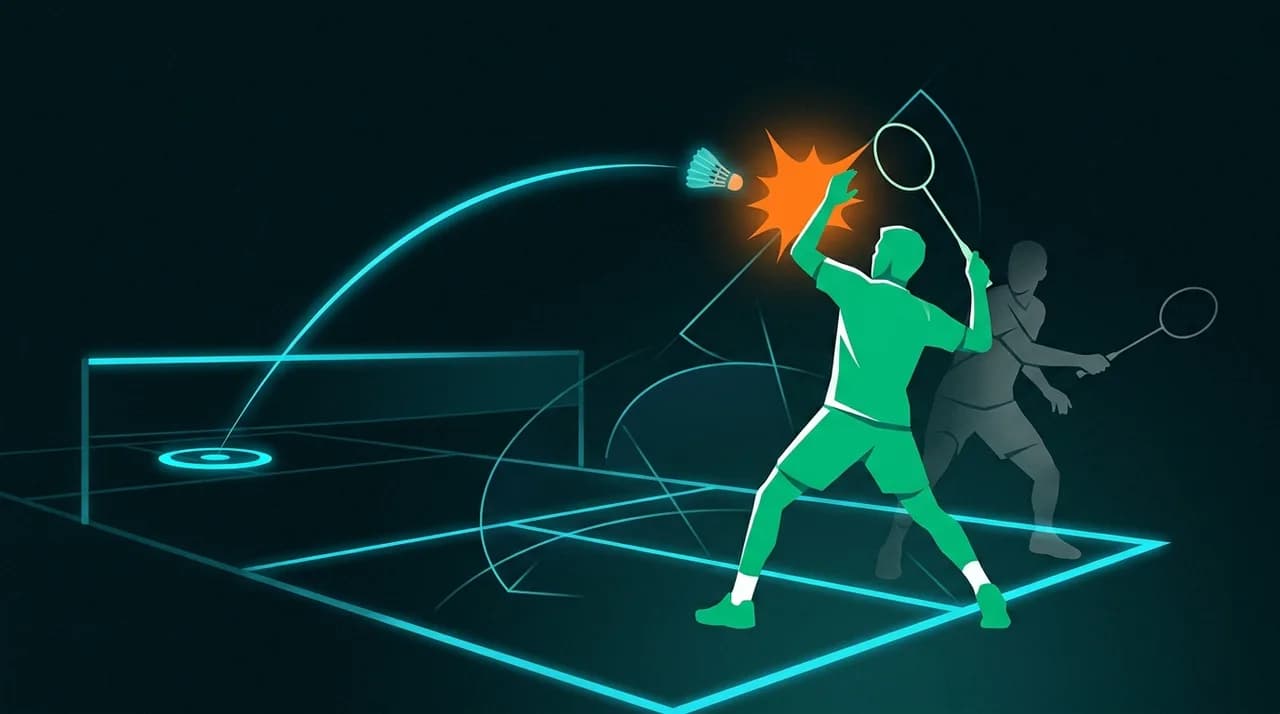
What the backhand is and why it scares people
The backhand refers to any shot played on the opposite side of your racquet hand, with your back or shoulder turned toward the net. At the net and in the mid-court, it comes naturally. The problem arises in the rear court, when the shuttlecock is behind you on your backhand side: the shot demands a different grip, a reverse rotation, and tighter timing, and the slightest mistake produces a weak shuttle in the middle of the court. Many players run around the shuttle to play a overhead forehand, which works until the opponent targets that corner repeatedly. A rear-court backhand does not need to be powerful to be useful: a backhand clear that reaches the baseline, or a tight backhand drop shot, is enough to get you out of pressure. Power comes later, and only with pronation.
The grip and the stroke
Everything starts with the grip. The thumb rests flat on the wide bevel of the handle, sometimes on the ridge, and the other fingers relax: it is the thumb that pushes, not the wrist that snaps. The elbow rises and points toward the shuttle, the racquet is loaded behind the forearm, head down. At the moment of contact, the forearm rotates outward, supination, and the arm extends toward the shuttle. Contact is made as high as possible, slightly in front of the shoulder, not directly above the head. The legs do the rest: the racquet foot plants toward the corner, the body turns back to the net, and the stroke triggers off the leg extension. After the shot, the torso returns to face the net before any movement, otherwise you move off backward.
The three mistakes seen most often on video
The first is keeping a forehand grip. The thumb is not on the handle, the racquet face comes in at an angle, and the shuttle goes into an unintentional slice, short and without height. On video, you spot it by the position of the thumb and the racquet face at impact. The second is a low elbow. The arm strikes at shoulder height, contact is taken behind the body, and the shuttle goes flat toward the opponent's mid-court, right where the attack is waiting. The elbow must precede the racquet and point at the shuttle before the hit. The third is systematic running around the shuttle. The player backs up around the shuttle to play it forehand, arrives late, hits off-balance, and leaves the entire forehand side of the court wide open. On a match sequence, you see it in the player's position after the shot, often a meter outside the lines.
How to practice it
Start without footwork. Position yourself in the backhand corner, a partner or feeder sends you high and moderately deep shuttles, and you play backhand clears aiming for the thirty-centimeter strip in front of the opponent's baseline, thumb on the handle, elbow high. Count out of ten how many clear the rear double service line. Once you reach seven, add footwork from the center, turning your back to the net, then alternate between a backhand clear and a drop shot using the same preparation. Film from the side, at hip height, to see the position of the elbow and the contact height. The "Backhand: Stop Running Away from This Side" program covers this progression step by step, with a score on every set you submit.
What video analysis gives you on a backhand
You send a rally, a drill, or a match sequence, filmed from the side or behind. The analysis identifies your backhands, timestamps them, and describes what it sees at every contact: grip, elbow height, point of impact relative to the shoulder, foot orientation, and resulting trajectory. It gives you a correction for each detected flaw, with the exact moment to watch it in your video. On a training set, it counts the repetitions and tells you what you do differently on your best ones. All you need is a stable framing that shows your entire body and the shuttle.