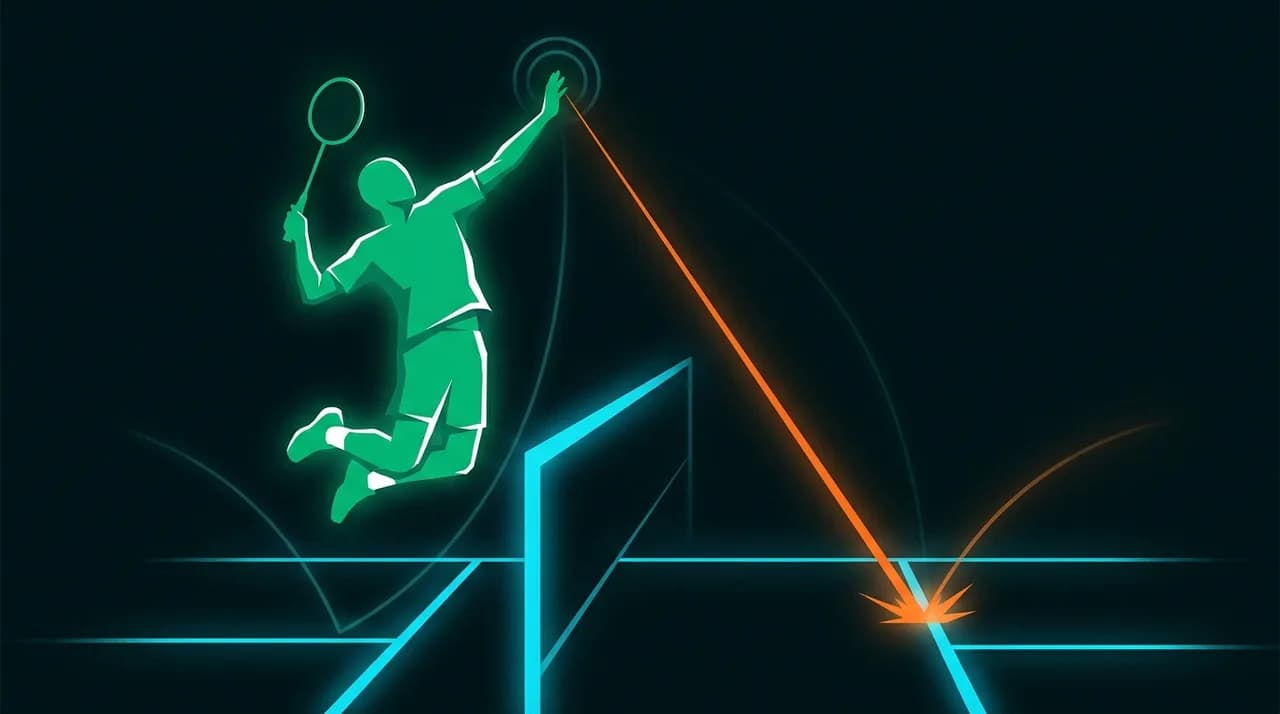
What a smash is and what it must do
The smash is a downward overhead shot played on a high shuttlecock. Its mission can be summed up in one sentence: get the shuttle to hit the floor on the other side before your opponent can return it cleanly. Speed matters, but angle matters more. A smash at 250 km/h that arrives flat at waist height is returned effortlessly; a slower smash that steeps toward the feet forces a low return, often a lift, and gives you back the initiative. The movement chains a trunk rotation, an arm extension, and a forearm pronation at impact, with contact made in front of the body and as high as possible. Nearly all the flaws described below lack one of these two words, in front or high.
When to smash, and when to hold back
A good smash is played from the front half of the rear court, on a shuttle that leaves you enough time to get behind it. From the back of the court, off balance, or late, the shuttle often goes flat and out long, or exposes you to a drive counterattack that you will not be able to follow up. In that case, a clear or a drop shot keeps the rally open and lets you return to the center. The smash is also chosen based on your opponent's position. Against an opponent who is already low and leaning forward, a full shot straight at the body or racket shoulder is hard to defend. Against an opponent who is well placed and balanced, smashing straight into their racket will backfire. Look at where they are before triggering your shot, not just where the shuttle is.
The three errors that video shows most often
The first flaw is the elbow staying below the shoulder at impact. The arm then hits using only the forearm, the shuttle goes flat, and the speed caps out no matter how much force you put into it. On the freeze frame at impact, the arm should be at least horizontal to the shoulder, with the elbow level with the ear or higher. The second flaw is making contact behind the head. The player arrived late under the shuttle, hitting behind themselves, resulting in a smash that goes up before coming down, making it easy to counter. On video, you can see it upon landing: the racket side foot lands behind the other instead of stepping through. The third flaw is the lack of rotation. The feet stay parallel facing the net, the hips do not rotate, and the shoulder does not pull back before the hit. The arm does all the work, the shoulder tires, and the shuttle lacks weight. These three flaws should be fixed separately, in the order they are listed.
How to practice it
Start with footwork and positioning, without looking for speed. A partner or feeder sends high shuttles to the middle of the rear court. You position yourself behind the shuttle, feet aligned with the net, and hit at half power aiming for the floor between the short service line and the middle of the opponent's court. Count your shuttles: out of ten, how many hit the floor before the mid court line? Once you get seven, add rotation by starting with your shoulders side-on, and only then add power. Film the series from the side, at hip height, to check your elbow angle and the position of your racket foot upon landing. The "Smash: sharp downward angle" program follows this exact exercise, step by step, and scores every set you send based on the same criterion, the downward angle.
What video analysis gives you on a smash
You upload a rally, an exercise, or a match sequence, filmed with a phone placed on the side of the court or behind it. The analysis detects your smashes in the sequence, timestamps them, and describes what it sees at each impact: contact height, elbow position, feet alignment, downward angle of the shuttle, and what happens on the next shot. It then gives you a correction for each detected flaw, with the exact timestamp to watch in your video. On a practice set, it counts the reps and spots the best and worst ones, telling you what you do differently when it works. You do not need slow motion or special equipment, just a stable frame showing your full body and the shuttle.