What a clear is and what it should do
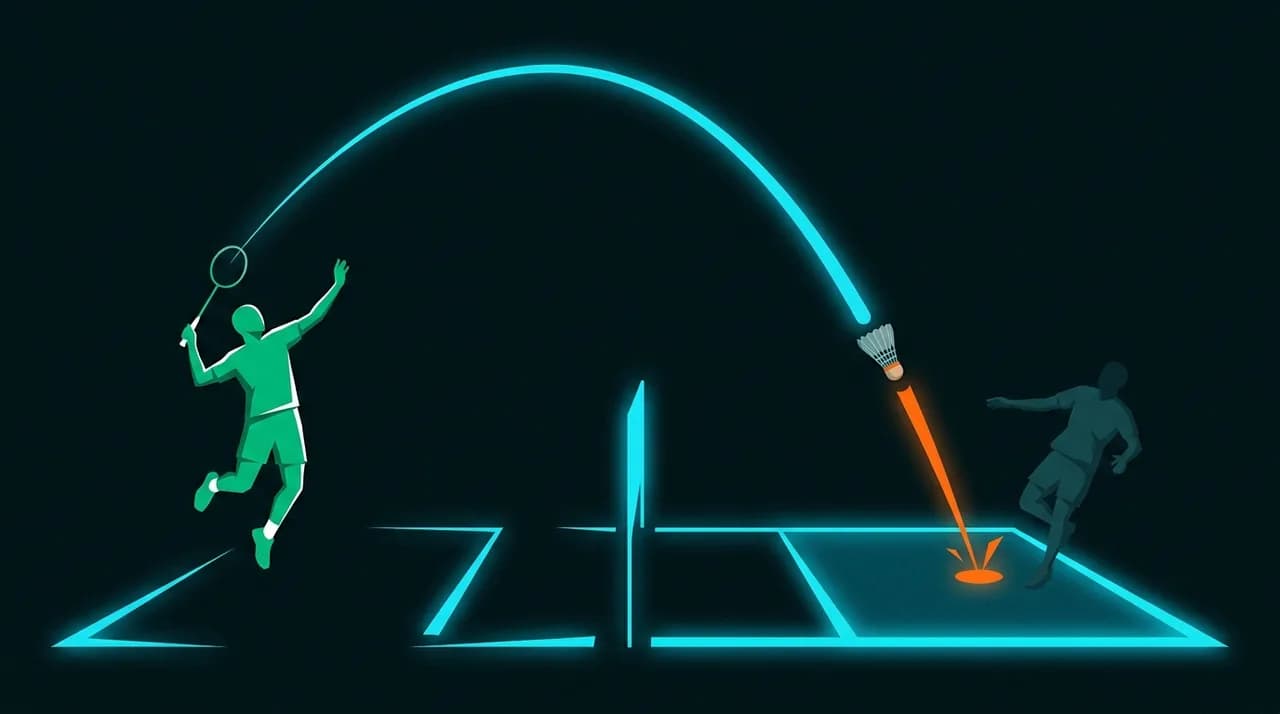
The clear, also known as the lob or deep shot, is an overhead stroke played from the backcourt that sends the shuttlecock high and deep, all the way to the opponent's baseline. It comes in two versions. The defensive clear goes very high: it buys you time to recover to the center when you are under pressure, and makes the shuttle drop almost vertically, which makes an opponent's attack difficult. The attacking clear, which is flatter, travels fast and passes just over the opponent's racket: it catches the opponent off guard when they are slightly advanced. In both cases, depth is the key criterion. A clear that lands in the midcourt is a free shuttle: the opponent will smash it without even having to move back. It is the most played shot in badminton and the one whose quality is most easily measured, simply by where the shuttle lands.
When to use it
The defensive clear is played when you are late, off balance, or too far from the center to attack: it buys time. The attacking clear is played when the opponent is advanced, after a drop shot or net play, or when they are expecting a drop shot and leaning forward. In singles, chaining two deep clears to the backhand shoulder wears the opponent down and opens up the net; in doubles, the clear is rare because it hands the attack over to the opposing pair, except to escape pressure on a low shuttle. Choosing between the two depends on your position at the moment of hitting: behind the shuttle, in balance, you can hit it flat; running late, hit high and recover. Deciding before hitting avoids the worst clear, the half-clear, which is neither high nor flat, and lands in the midcourt.
The three errors that video shows most often
The first is making contact behind the head. The player arrived late under the shuttle, hitting backward and upward; the clear goes up but lacks depth. On video, the racket foot lands behind the other foot upon landing instead of stepping forward. The second is the lack of rotation. The feet stay facing the net, the hips do not rotate, everything comes from the arm, and the shuttle stops three meters short of the baseline. The third is an excessively open racket face, often out of fear of hitting out: the shuttle goes almost straight up and drops short, turning the defensive clear into an easy ball. These three flaws can be read on a single frame, the impact frame, where you can see the foot position, shoulder orientation, and racket angle.
How to practice it
Mark out or imagine a one-meter strip in front of the opponent's baseline. A partner or feeder sends high shuttles to your backcourt. You play ten defensive clears aiming for this strip, getting behind each shuttle with your shoulders in profile before hitting, then ten attacking clears aiming for the same zone with a flatter trajectory. Count those that land inside the strip. Once you can consistently get seven out of ten for both versions, add a recovery to the center between each stroke. Film from the side, at hip height, to observe the rotation and foot position upon landing. The training path "Clear: high and deep" covers this drill step by step and tracks every set you send based on the depth achieved.
What video analysis gives you on a clear
You send a rally, a drill, or a match sequence, filmed from the side or behind. The analysis identifies your clears, timestamps them, and describes what it sees: contact height, shoulder rotation, racket foot position, depth achieved, and what the opponent did with it on the next stroke. It gives you a correction for each detected flaw, with the exact timestamp to watch it. On a training set, it counts repetitions and identifies those that reach the baseline and those that fall short, along with what changes in the movement.