
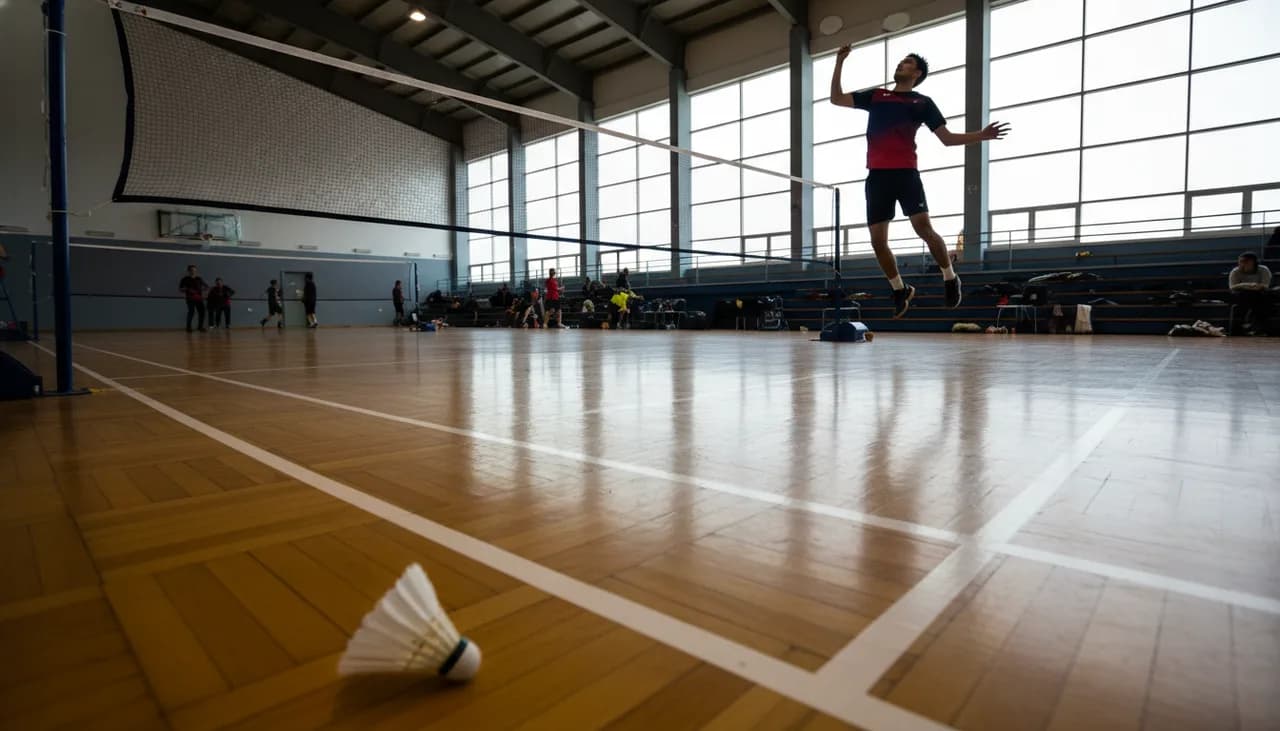
Badminton Stroke Technique: The 5 Fundamental Shots
Badminton hitting technique consists of 5 shots: smash, clear, drop, drive, lob. Key points, common errors, and drills to improve.
Badminton hitting technique consists of five fundamental shots: the smash, the clear, the drop, the drive, and the lob. Mastering these five shots means having the complete vocabulary to build a point, get out of a bad situation, and finish when an opening appears. Everything else—feints, slice, reverse, jump smashes—are variations of these five families. This article gives you the technical benchmarks, the most frequent errors, and the drills to film to improve each shot.
What to Remember
- The five badminton shots are distinguished by the trajectory produced and the tactical intention, not by the isolated gesture.
- Good hitting technique consists of four stages: grip, footwork platform, point of contact, and follow-through.
- The smash and the clear share 80% of the same shoulder movement—it's the racket angle at contact that changes everything.
- The drop is the most undertrained shot in clubs, yet it decides the majority of points for players under 12 and remains central in mixed doubles.
- Filming a 30-second session per shot is enough to identify 80% of stroke flaws. You can do it with a phone on a bag.
Why Badminton Hitting Technique Makes a Difference in the Score
Badminton is the racket sport that demands the widest range of shots. You play at over 50 meters per second on a pro competition smash and place drops at less than 5 km/h in the same second of play. No other racket sport has this tempo difference.
This amplitude requires one thing: a versatile stroke that adapts at contact. If you completely change your grip and movement between each shot, you telegraph your intention to your opponent from the preparation. Players above 1700 points (N1-N2 federal) hide their intentions until the last 1/10th of a second thanks to a common framework: same starting posture, same attack towards the shuttlecock, divergence in the follow-through. This framework is what the mental grid below synthesizes.
Regarding impact on the score, the majority of points in amateur play end on unforced errors—hitting into the net, shuttlecock out of bounds, bad point of contact—not on an opponent's winning shot. Working on your badminton hitting technique is primarily about stopping giving points to the opponent before trying to score them.
The Mental Grid: Grip, Platform, Contact, Follow-through
Before dissecting each shot, here is the common framework for all five shots. It's the same logic for the smash and the lob—only the adjustment changes.
1. The grip. Forehand (universal grip) for almost all overhead shots. Backhand (thumb grip) for everything on the left for a right-handed player. The grip tightens at contact, not before. If your arm is tense when raising the racket, you lose 30% of head speed.
2. The footwork platform. The back foot (right for a right-handed player) supports 70% of the weight just before the hit. The heel of the front foot lifts off the ground as the racket accelerates. If you hit with parallel feet or feet together, you will never be able to transmit the force chain: legs → pelvis → shoulder → wrist.
3. The point of contact. In front of the body, 30-40 cm in front of the hitting shoulder, racket extended. This is non-negotiable. Contact behind the head cuts off any possibility of a smash and leaves you only with a defensive clear. Contact too low (below the ear) closes the downward angle.
4. The follow-through. After contact, the racket finishes downwards and outwards (pronation for the forehand). It's pronation that gives speed—not arm strength. Coaches will all tell you: if after hitting you find yourself frozen with your arm in the air, you haven't pronated.
This grid applies to all five shots. The foundational module overhead hitting fundamentals course uses exactly this structure and gives you step-by-step drills.
The Smash: The Fastest Badminton Hitting Technique
The smash is the downward shot executed overhead, racket slammed downwards. It's the finishing shot: it aims to end the point, not to build it. On the pro circuit, men's smashes regularly exceed 350 km/h in string exit speed, making it the fastest shot across all racket sports.
The key movement. Maximum pronation at contact. The wrist is relaxed until 30 cm from the shuttlecock, then explodes. The elbow rises before the shoulder, then the shoulder pushes, then the forearm rotates. It's the same sequence as a baseball pitch.
Frequent errors. Hitting "flat" without pronation (you send the shuttlecock mid-court instead of crushing it). Jumping before being positioned (you end up off-balance and miss the recovery). Overplaying the smash at full pace when a drop would have been better (the smash requires 1.5 seconds of recovery, the drop requires 0.5).
How to practice. Multi-shuttle drills from a stationary position first, to anchor pronation and the point of contact. Then add movement (back shuffle + smash + return to base). Film each series of 10 shots: if you see your racket finishing "high" instead of descending to the left (right-handed), you have a pronation deficit. The classic downward angle smash course offers this drill with an observable scoring grid.
To go further on this specific shot, read the complete guide to smash technique which details the biomechanical chain. For inspiration, watch the line smashes of Lakshya Sen or Shi Yu Qi: the same pronation sequence is found frame by frame.
The Clear: The Badminton Hitting Technique to Regain Air
The clear is the high and deep shot that sends the shuttlecock in an arc to the opponent's back line. It exists in two versions:
- The defensive clear: very high, very deep, to gain time when you are in difficulty.
- The offensive clear: flatter, faster, to push the opponent to the back before following up with a smash or a drive.
The key movement. Preparation identical to the smash. At contact, the racket angle opens upwards (instead of slamming downwards) and pronation guides the shuttlecock deep. The follow-through is softer, the arm finishes in full extension forward.
Frequent errors. Not getting high enough (the trajectory becomes mid-court, a gift for the opponent). Contact behind the head instead of in front (depth disappears). Lack of weight transfer—many club players stay on both feet and hit with only their arm, which limits distance to about 3/4 of the court.
How to practice. Back leg pressure drills: a partner sends deep court trajectories, you chain deep clears, 10 repetitions without lowering the trajectory. The classic high deep clear course targets exactly this work with a trajectory evaluation system.
To observe a reference clear—high, deep, seemingly effortless—watch An Se Young's matches. Her gestural economy on this shot is a case study in itself.
The Drop: The Badminton Hitting Technique at the Net
The drop is the overhead shot played softly, so that the shuttlecock falls just behind the opponent's net. It's the disorganizing shot: it forces the opponent to run forward and hit upwards, thus in weakness.
The key movement. Preparation strictly identical to the smash and clear—this is THE point that differentiates a predictable drop from a deceptive one. At the moment of contact, the racket slows down (relaxed wrist, no explosive pronation) and the angle closes slightly towards the net. The trick: continue the arm movement after contact, as if you were going to smash. It's the deceptive follow-through that makes the shot unpredictable.
Three useful variations to know:
- The fast drop: the shuttlecock descends sharply, short but not directly in front of the net. Used to make the opponent run.
- The slow drop (placing): trajectory that dies just 30 cm from the opponent's net. Requires a delicate touch.
- The sliced drop (slice or reverse slice): the racket cuts the shuttlecock tangentially to break the trajectory. The reverse slice (blade passing under the shuttlecock on a backhand to forehand) is the competition version.
Frequent errors. Slowing down the stroke from the preparation (you telegraph it). Hitting too hard (the shuttlecock passes the net and falls mid-court). Tensing the wrist at contact (the shuttlecock bounces and doesn't drop).
How to practice. Multi-shuttle short drop against long drop alternately, to anchor the feeling of touch. Then add a "smash or drop" instruction at the last moment to train decision-making. The classic placing drop behind the net course serves this work.
The drop is also the signature shot of players like Akane Yamaguchi or Chen Yu Fei—their trajectories on this shot repeatedly fall 20-30 cm from the net, which is the mark of world-class touch.
The Drive: The Flat and Fast Badminton Hitting Technique
The drive is a flat shot, played at face or chest height, which passes close to the net and arrives quickly on the opponent's side. It's the central shot in doubles play and the transition shot in singles when the shuttlecock is no longer high enough to smash but not yet at the net.
The key movement. The stroke is compact: no wide backswing, no pronounced back preparation. It's the wrist and forearm that do the work, not the shoulder. The grip tightens firmly at contact to give rigidity to the racket. Pronation remains but shortened.
Frequent errors. Too much backswing (you lose reaction speed when the opponent responds quickly). Contact too low (you finish below net level, the drive becomes an unintentional defensive lob). Wrist tension (the shuttlecock lacks speed, the opponent follows up with a plunging smash).
How to practice. Flat drives alternating between two players, 5-6 meters apart, without letting the shuttlecock drop for 30 seconds. The partner sends the shuttlecock a little higher, a little lower, a little more to the right—you adapt the grip to each shot. The classic defense block lob drive course integrates the drive into a realistic defense → counter-attack sequence.
The Defensive Lob: The Survival Badminton Hitting Technique
The defensive lob is the clear played low, underhand, when you are under pressure from the opponent's racket. You have neither the time nor the position to raise the racket overhead, so you play with force from below to send the shuttlecock deep and regain control.
The key movement. Backhand or forehand grip depending on the side of the shuttlecock. Low contact, in front of the front foot. The wrist "cocked" to the side, then whips upwards at contact. The target is always the same: opponent's back line, as high as possible.
Frequent errors. Not aiming deep enough (you give a mid-court shuttlecock to smash). Hesitating between lob and drive (the stroke becomes half-hearted and the shuttlecock ends up in the net). Hitting while retreating instead of lunging forward—a successful defensive lob is played moving forward, not backward.
How to practice. Two-on-one pressure drills, where the two attackers chain smashes on the defender who must produce deep lobs, alternating forehand and backhand. The goal is not to score, it is to maintain depth for 10, 20, 30 repetitions without letting up.
How to Practice Your Badminton Hitting Technique Independently
You don't need a coach present to improve. Three principles:
1. Film each session. Phone placed on a bag, 3 meters from you, waist height, full frame. You watch yourself in the evening. You see in 30 seconds what you would never have seen during a full session: your elbow dropping, your point of contact behind your head, your front foot not lifting off.
2. Deconstruct before complicating. No matches until the isolated stroke is clean. Multi-shuttle stationary → multi-shuttle moving → directed rally → free play. Each step is only crossed once the previous one is solid. This is exactly the logic of the Intention-Execution-Confirmation (I-E-C) cycle that structures all BadmintonPeak courses.
3. Measure, don't judge. "My smash is terrible" doesn't help. "Out of 10 filmed smashes, 7 contacts are behind the head" indicates exactly what to correct. The rule applies to everything: transform every feeling into an observable metric.
If you want precise feedback on your badminton hitting technique without waiting for the next club session, upload a 30-second video to BadmintonPeak: the AI dissects each shot, assigns a score per observable (grip, platform, contact, follow-through) and tells you exactly which error occurs most often. You can also browse the full features if you want to see what is analyzed.
For the regulatory basis on heights, zones, and serving, the official reference remains the Laws of Badminton of the BWF—useful to reread at least once when starting to compete.
Frequently Asked Questions
What are the 5 fundamental shots in badminton?
The smash, the clear, the drop, the drive, and the defensive lob. All other shots—feints, slice, reverse, net kill—are variations or combinations of these five families. Mastering all five means possessing the complete technical vocabulary of badminton.
Which hitting technique should you work on first when starting out?
The forehand clear. It's the most used shot in real play and the one that makes you work the complete biomechanical chain (legs → pelvis → shoulder → wrist). Once the clear is clean, the smash comes naturally because it's the same motion with a different racket angle. The drop comes third because it requires finesse, and finesse develops on an already established technical base.
Why do my shots lack power even when I hit hard?
In 9 out of 10 cases, it's a lack of pronation. Racket head speed comes from the rotation of the forearm at contact, not from arm strength. If you finish your stroke with the "racket high" instead of "racket finishing to the left and downwards" (right-handed), you haven't pronated. Film your stroke, you'll see immediately.
Do you have to jump to smash correctly?
No, not at first. A well-executed smash with feet on the ground is more powerful than a poorly placed jump smash. The jump serves to gain a downward angle and to gain time on the opponent—not to hit harder. As long as your point of contact is not consistently in front of your body, do not jump.
How long does it take to master the 5 shots at N3-N2 level?
With two sessions per week and structured work (targeted multi-shuttle drills + filming + analysis), count 18-24 months for the five shots to be solid in match conditions. The limiting factor is not effort, it's the quality of feedback: without external observation (coach or video), you install flaws instead of correcting them.