
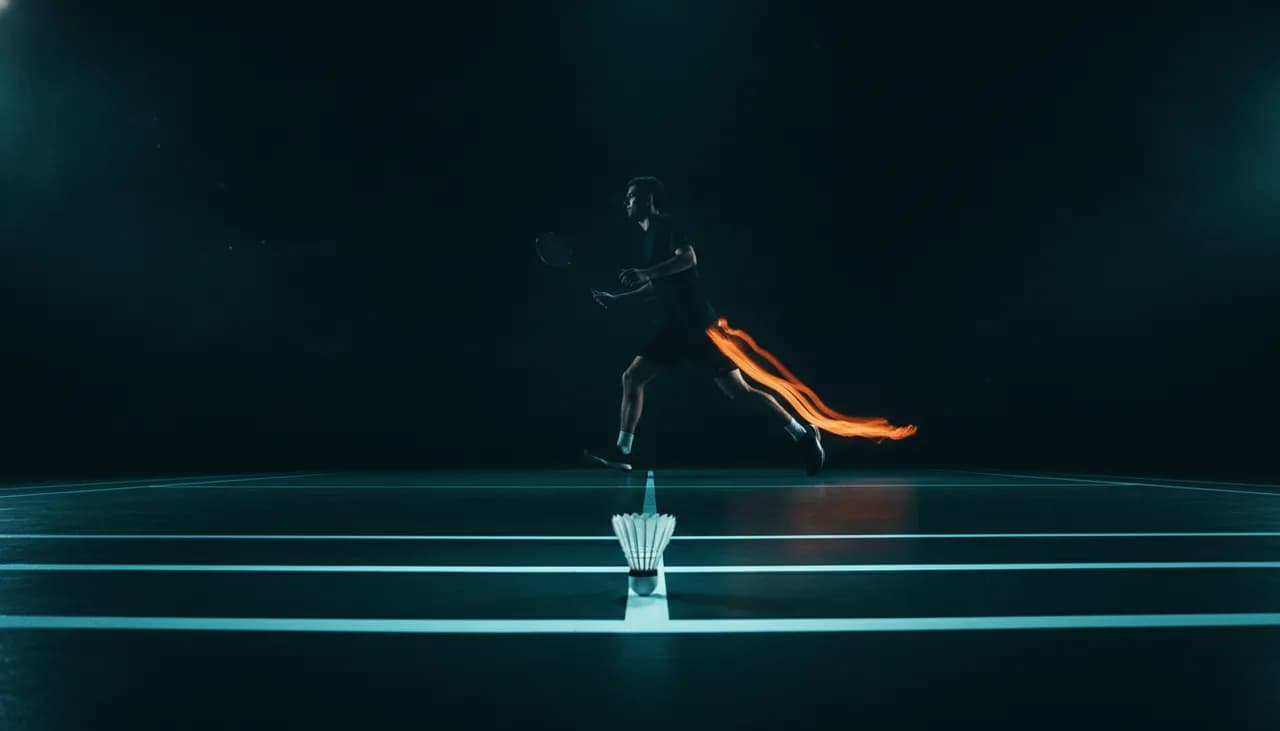
Balance and Stability in Badminton: The Invisible Foundation of All Your Shots
Badminton balance dictates your precision, reaction speed, and defense. Here's how to keep a stable core on mobile legs.
Badminton balance is arguably the most underestimated quality in the game: invisible when you have it, disastrous when you lack it. You can have a sharp smash and a clean net game, but if you hit off-balance, your shuttlecock goes anywhere, and you take half a second too long to recover. Conversely, a player well-rooted on their feet, with a braced core and focused gaze, plays every shot with the same precision, whether comfortable or stretched into a corner. This article breaks down the principle of “mobile legs, stable torso,” footwork, center of gravity, recovery steps, lightening up at the opponent's strike, and core bracing, with a concrete exercise at each stage.
The Essentials
- Balance in badminton relies on one principle: mobile legs under a stable torso. The lower body moves, the upper body remains braced to hit cleanly.
- Stay low constantly: knees bent, center of gravity close to the ground, weight on the balls of your feet. A high center of gravity makes you slow and unstable.
- Lightening up (a small bounce of the feet as the opponent hits) and recovery steps after each shot make your balance dynamic instead of static.
- Core bracing (abs, back, obliques) transmits force from your legs to your racket without your torso twisting. Without it, no clean hit when off-balance.
- Watch the opponent, not just the shuttlecock: reading their intention helps you prepare your footwork before the shuttlecock even leaves their racket.
Why Balance in Badminton Conditions Your Entire Game
Three things directly depend on your balance: precision, reaction speed, and defense. They cover the essence of what decides a point.
First, precision. A badminton shot is a kinetic chain that starts from the ground, moves up through the legs, crosses the torso, and ends in the wrist. If your base moves at the moment of contact, everything upstream is disrupted, and your impact point becomes random. Two identical drop shots, one played in balance, the other while running, never land in the same spot. The repeatability of your stroke depends first on the stability of your base.
Next, reaction speed. A player in an athletic, balanced position, weight distributed on the balls of both feet, can push in any direction without delay. A player off-balance must first recover before starting, and this recovery costs the tenth of a second that puts you late under the shuttlecock. This is the direct link between balance and badminton footwork: without a stable base, no explosive first step.
Finally, defense, especially against smashes. Receiving a shuttlecock at full speed requires you to be low, wide, and braced to absorb and return it without being pushed around. Watch An Se Young play defense: she absorbs powerful smashes while remaining planted on her feet, which allows her to return precisely rather than just lifting the shuttlecock back into the air. At club level, imbalance in defense is the number one escape: we lean back, straighten up, and the opponent's next shuttlecock becomes unmanageable.
“Mobile Legs, Stable Torso”: The Principle of the Mobile Statue
The best mental model for balance in badminton is that of a mobile statue: a base that constantly moves under a head that remains perfectly stable. Think of a camera stabilizer. The base moves, slides, absorbs shocks, while the upper part remains still to film clearly. Your body should function similarly.
Concretely, this means distributing roles. The lower body (ankles, knees, hips) is your suspension: it adjusts, cushions, propels, never completely stops. The torso is your firing platform: it remains braced and oriented so that the arm strikes from a fixed reference point. The paradox of badminton is that it requires you to be extremely mobile and extremely stable at the same time, in different areas of the body.
What breaks this principle is either freezing everything or letting everything move. The player who plants both feet and locks everything is stable but slow; they arrive late and hit stiffly. The player who moves everything, including the torso, is mobile but imprecise; they hit by twisting and lose control of the trajectory. The best players, like Viktor Axelsen despite his large build, constantly maintain a low center of gravity and a calm torso above legs that are constantly readjusting. It is this upper/lower body dissociation that you must train.
Balance Begins in Your Footwork: Low Position and Center of Gravity
Everything starts from the feet. The balanced basic position combines a few simple markers: feet shoulder-width apart or slightly wider, knees bent, torso slightly leaning forward, weight on the balls of your feet (never on your heels), racket in front of you, head ready, neither glued to the body nor hanging. In this posture, your feet are loaded like a spring, and you are ready to move in all six directions of the court.
The key parameter behind all this is the center of gravity. The lower it is and the closer it is to your base of support, the more stable you are and the faster you change direction. A player who straightens up between shots raises their center of gravity, loses stability, and must lower themselves again before each start: a double loss of time. The instruction is constant: stay low, always, even when the shuttlecock seems easy. Widening your stance further increases stability, but too wide slows you down; the right compromise is around shoulder-width, slightly wider in defense against a smash.
At this level, ankles and proprioception also come into play, meaning your body's ability to perceive the position of its joints without looking at them. Your ankles continuously correct micro-imbalances with each step; reactive ankles make for solid balance, lazy ankles lead to sprains. Contact with the ground is therefore extremely important, which ties into choosing your badminton shoes: a grippy sole and good lateral support transform your ability to stabilize yourself during sudden changes in footwork.
Recovery Steps and Lightening Up: Dynamic Balance in Play
Balance in badminton is never static: it plays out in two transitions repeated in every rally. Missing them means playing with a permanent delay.
The first is the initial lightening up. Just as the opponent hits the shuttlecock, you make a micro-bounce in place: your feet lighten, spread apart, knees bent, and you land back in a pre-tensioned athletic position, like a compressed spring. This lightening – the famous split-step – makes you start with your muscles already loaded rather than from a standstill. The timing is precise: it aligns with the opponent's racket-shuttlecock contact, not before, not after. The split-step and synchronization course works exactly on this moment, which is one of the very first movements to automate when you want to improve.
The second is the recovery step after your shot. Once you've played your shot, you don't stay planted where you hit: you re-anchor your feet and return to a base adapted to the shot you just produced. If you hit a short drop shot, your recovery base is not the same as if you clear to the back. This recovery puts your center of gravity in the right place and prepares you for the next lightening up. The hitting foot and recovery steps course precisely sequences arrival, hit, recovery, and replacement.
These two mechanics are most meaningful in defense. When you block a smash and then return it, balance lies in your ability to re-anchor low and wide between each opponent's shot. The block, lob, and drive defense course puts this stability under pressure into practice, when the opponent chains attacks and your only room for maneuver is the quality of your footwork.
Core Bracing: Where Torso Stability Comes From
If the legs are the suspension, core bracing is the chassis. Core bracing refers to your torso's ability – deep abdominals, back muscles, obliques – to remain rigid and resist forces that try to twist it. It is what transmits the power from your legs to your racket without it dissipating in a bending torso.
Specifically, strong core bracing does three things. It transfers energy: the force generated by leg drive passes through a firm torso and arrives intact in the arm. It stabilizes when off-balance: when you reach for a shuttlecock far at the net or return a smash in extension, it's your core bracing that keeps you upright and allows you to hit accurately even when your base isn't ideal. Finally, it protects your back, because a weak torso shifts stress to the lower back. This dimension directly relates to badminton injury prevention, where a strong core is one of the best insurances against back and knee issues.
Core bracing can be worked on both statically and dynamically, and it benefits from being integrated into a broader badminton physical preparation rather than isolated on weekends. Two to three short sessions per week are enough to establish a base. An often-forgotten detail also contributes: breathing. Breathing calmly and regularly during the rally helps maintain abdominal tension and keeps a clear head. A tense player who holds their breath loses stability and lucidity; a relaxed player maintains their footwork better.
Exercises to Work on Your Badminton Balance
Four simple exercises cover the entire chain, from core bracing to dynamic footwork. None require special equipment.
1. Static Core Bracing. Plank and side plank, held for about 20 to 45 seconds depending on your level, two to three sets. Straight back, pelvis neither hollowed nor broken, continuous breathing. When the static version becomes easy, move to dynamic: plank with alternating shoulder taps, which forces you to resist rotation exactly like when hitting.
2. Single-Leg Balance. Stand on one foot, knee slightly bent, the other foot lifted, for about 30 seconds per leg. When stable, close your eyes: you remove visual cues and force your ankles to work on proprioception. Next step, do it on a cushion or unstable surface. This is the foundation of your ankle stability.
3. Shadow with Lightening Up and Recovery. On the court, without a shuttlecock, move to the corners, chaining a lightening up (split-step) and a clean recovery step after each mimed shot. The goal is not speed but the quality of your footwork: low, wide, braced. Film the sequence and see if you straighten up between shots or if you stay low.
4. Guided Low Defense. With a partner attacking, you defend for a few minutes with only one instruction: stay low and re-anchor your feet between each smash, regardless of the quality of your return. You train balance under pressure, the kind that fails you in a match.
To place these routines within your overall training and combine balance, movement, and hitting technique, the BadmintonPeak features page shows how to break down a rally shot by shot and identify where your base betrays you.
Frequently Asked Questions
How to improve your badminton balance quickly?
Combine three approaches: short core bracing two to three times a week, ankle proprioceptive work (single-leg balance, eyes closed), and shadow play where you focus on lightening up and recovery steps. In a few weeks, you'll establish a significantly more stable base. The dynamic part in a match, however, consolidates over several months because it requires coordinating the entire body.
Do you really need to stay low all the time?
Yes, for the ready and defensive positions: knees bent, center of gravity low, you are ready to move in all directions. Be careful not to confuse low with rigid, however. You stay low but flexible, with footwork that lightens up at the right moment. Freezing in a low position is as detrimental as straightening up between each shot.
Is core bracing enough to be stable in a match?
No. Core bracing gives you a strong torso, but in-game balance is dynamic: it depends as much on your footwork, your lightening up, and your recovery steps. A player with a very strong core but poorly placed footwork will still find themselves off-balance. Core bracing is a necessary condition, but not sufficient: it combines with footwork training.
Why do I lose balance on opponent's smashes in defense?
Most often because your center of gravity is too high, your footwork is too narrow, and your split-step is absent or poorly synchronized. You then succumb to the speed of the shuttlecock instead of absorbing it. Correct in order: widen your stance, lower your center of gravity, time your lightening up with the opponent's hit, and engage your abdominal muscles to avoid falling backward.
Does gaze influence balance?
Yes, more than one might think. Watching the opponent rather than just the shuttlecock allows you to anticipate their shot and prepare your footwork even before the shuttlecock leaves their racket. A gaze that is far and stable also helps keep your head up and torso calm, which stabilizes the entire body. A gaze fixed on your own feet, conversely, breaks posture.
If you want to know where your base truly betrays you, analyze a video of your game on BadmintonPeak: the AI breaks down your footwork, center of gravity, and recovery steps frame by frame, and tells you precisely at what moments you hit off-balance rather than just relying on an impression after the match.