What footwork needs to achieve
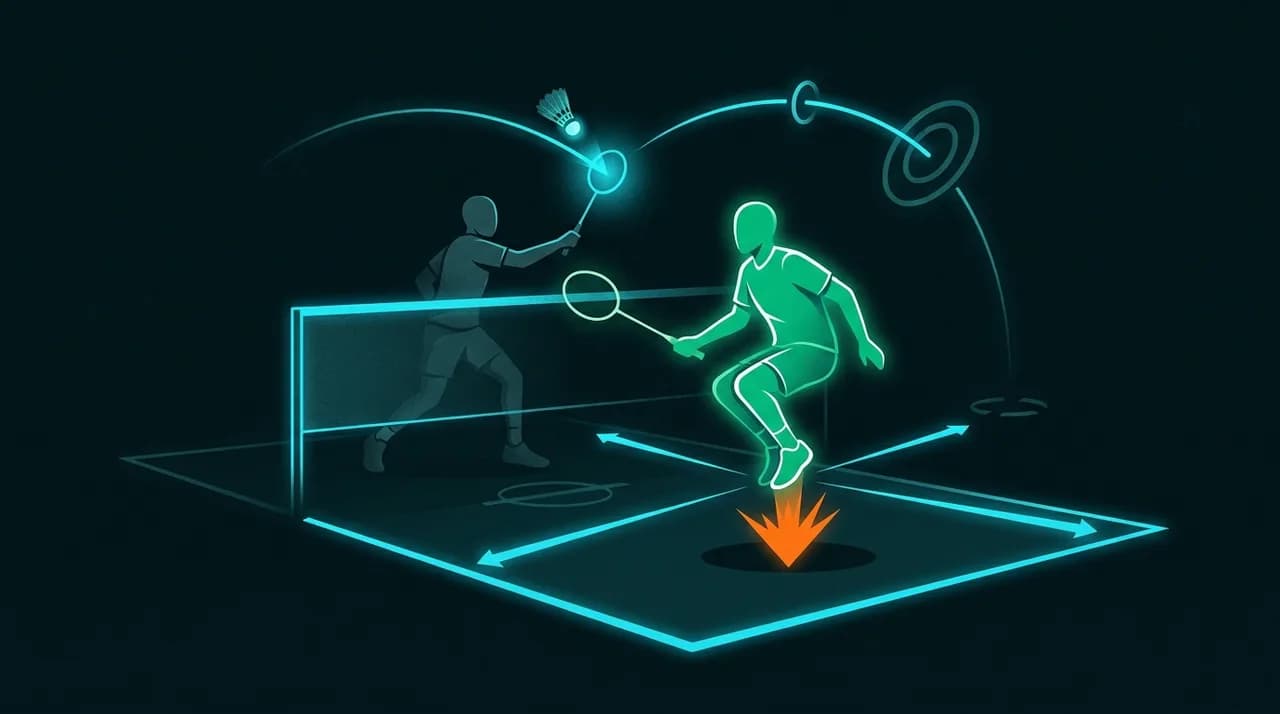
Footwork, or movement, is everything that happens between two shots: reading the play, the push-off, the movement toward the shuttlecock, hitting in balance, and returning toward the center. Its main objective is to get behind the shuttle early enough to have a full choice of shots. A late player only has one possible shot, often a high clear; an early player has three. The singles court is covered in one or two chassé steps toward the rear and a lunge toward the front, provided you leave at the right moment. That moment is the split step, the small pre-hop that triggers right as your opponent hits and puts you on your toes the moment the shuttle departs. Everything else, chassés, lunges, rotations, flows from this start. A late split step is rarely recovered.
Moving forward, moving backward, and the recovery
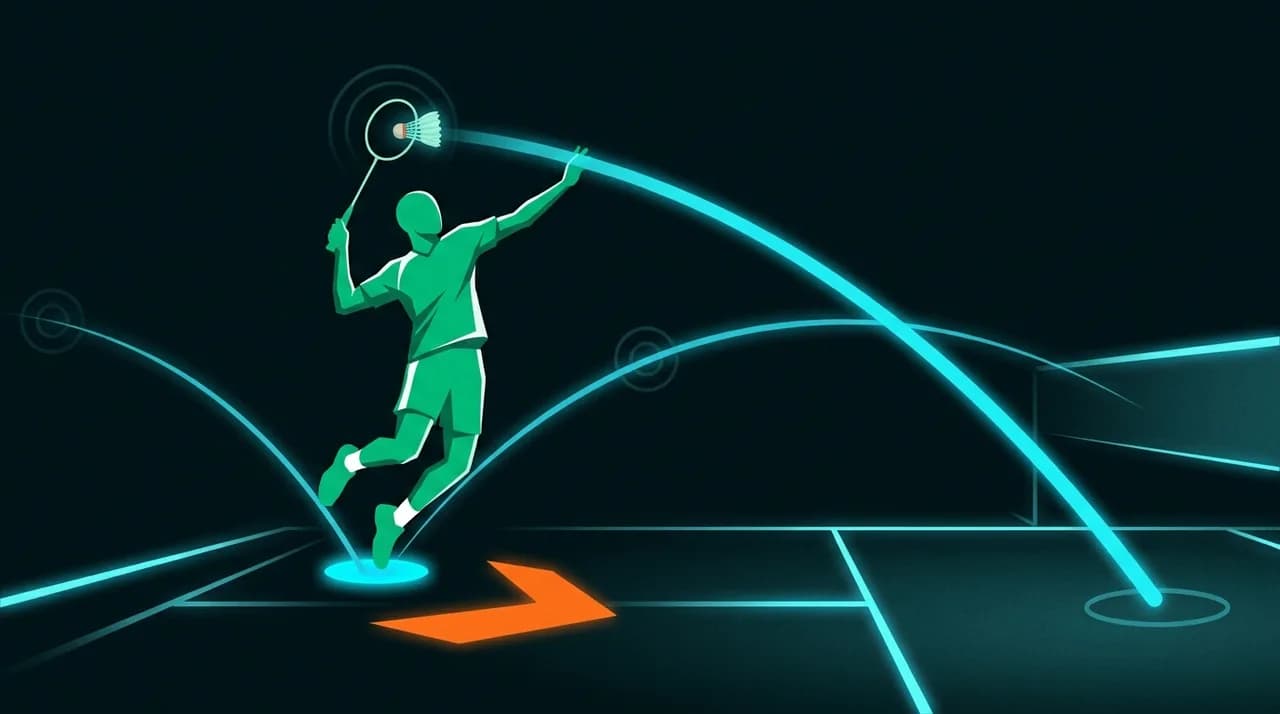
Moving forward, the last step is a lunge: the racket-side foot lands in front, toes toward the shuttle, knee above the foot, upright torso, and racket already extended. Moving backward, you start by pivoting the hips, two chassés until you are behind the shuttle, then hit with the racket-side foot coming forward upon landing. On the deep backhand, the body turns back to the net. Returning to the center is not returning to the geometric middle: it aims for the point that best covers the opponent's likely shots, a bit further forward after a clear, a bit further back after a drop shot. The next split step is taken at this spot, right before the opponent hits. Watching the shuttle depart rather than the opponent's racket costs a tenth of a second on every shot.
The three errors video shows most often
The first is a missing or mistimed split step. On frame by frame sequences, the feet are flat or the pre-hop ends after the opponent hits; the push-off happens from a standing stop and the entire movement arrives late. The second is lunging on the wrong foot. Moving forward, the non-racket foot lands in front, the arm has to compensate, contact moves backward, and the shuttle goes back high. On video, the toe of the front foot says it all. The third is the lack of recovery to the center. The player admires their shot, stays in the corner where they hit, and the next shuttle goes to the opposite side. On a match sequence, you see it in the player's position at the moment of the opponent's next shot, often two meters from the center.
How to practice it
Without a shuttlecock, on a half-court. A partner points to one of the six zones, two at the net, two at mid-court, two at the back, and you go there from the center with the corresponding footwork, simulate the hit, return to the center, and take a split step before the next signal. Ten movements per set, three sets, focusing on balance during the hit rather than speed. Film from the front or three-quarters view, feet visible, to see the split step and the lunging foot. The training path "Split step: synchronization and push-off" works on the start, and "Racket-side foot hit and oriented stance recovery" works on the recovery after hitting; each tracks the sets you submit.
What video analysis gives you on your footwork
You submit a rally, a drill, or a match sequence, filmed from the front or three-quarters view with feet in the frame. The analysis timestamps each shot and describes what it sees before and after: presence and timing of the split step, lunging foot, balance at contact, recovery to the center. It gives you a correction for each detected flaw, with the exact moment to watch it. On a match sequence, it identifies the points lost by being late to the shuttle, those where the movement, not the stroke, decided the outcome.