
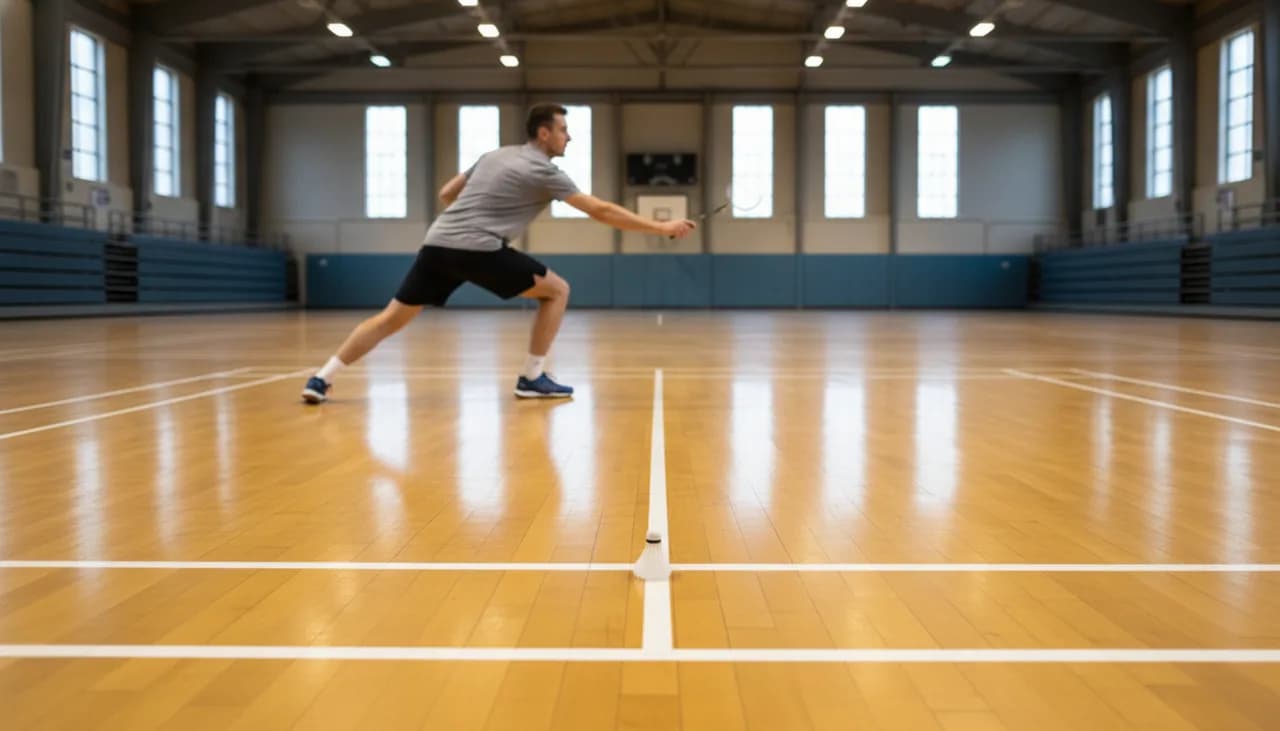
Badminton warm-up: complete 20-minute routine
A solid badminton warm-up in 4 phases of 5 min: mobility, cardio, shadow, mini-rallies. Ready to go before every training session or match.
A badminton warm-up is what separates a catastrophic first point from a solid training session. In 20 structured minutes, you prepare your cardio system, your joints, and your footwork for the specific demands of the sport: lateral accelerations, deep lunges, overhead shots, changes of direction. Without this work, you play the first ten minutes under-performing and expose yourself to a calf strain or shoulder tendinitis.
Key Takeaways
- 4-phase routine of 5 minutes each: joint mobilization, progressive cardio, shadow + footwork, mini-rallies
- Dynamic mobility only before play — static stretches reduce muscle explosiveness
- Shadow work activates trajectory reading and split-step before the first shuttlecock
- Mini-rallies finalize the warm-up with controlled shots (clear, drop, defense)
- Minimum floor: 12 minutes if you're short on time, never less
Why a Badminton Warm-Up is Non-Negotiable
Badminton is one of the most cardio-pulmonarily demanding racket sports. In singles, rallies regularly exceed twenty shots, with phases of effort close to the anaerobic threshold. If you start the session without having raised your body temperature and opened your rib cage, your body takes eight to twelve minutes to compensate — that's lost time on game quality.
Three areas of the body are particularly exposed if you neglect the warm-up. First, the ankles, constantly stressed by changes of direction: lateral sprains are the #1 injury in racket sports. Next, the calves and hamstrings, which absorb deep lunges and explosive starts. And finally, the shoulder, whose rotator cuff must be prepared before any powerful smash or clear — without preparation, the supraspinatus tendon works cold, and tendinitis won't wait long.
Beyond the risk of injury, there's also immediate performance. An unwarmed-up nervous system has degraded reaction time on a drive or short serve. You play the first few rallies half a second late — which is enough to lose the first set of a close match 3-0. To delve into the physiology of effort in sport, the article échauffement (sport) on Wikipedia FR provides a good general framework on cardiovascular and neuromuscular effects.
Badminton Warm-Up: The Typical 20-Minute Routine
The 4×5 minute structure is deliberately sequenced: you go from general to specific, and from low intensity to game intensity. No phase should be skipped. If you only have 15 minutes, shorten each phase to 3-4 minutes, but keep all phases present.
The standard breakdown:
- Phase 1 — Joint Mobilization: open shoulders, wrists, hips, ankles
- Phase 2 — Progressive Cardio: gradually raise heart rate
- Phase 3 — Shadow and Footwork: activate footwork and split-step
- Phase 4 — Mini-Rallies and First Shots: adjust touch before the first point
This progression respects a simple principle: the body must be prepared from the deepest (joints) to the most specific (racket movements). Reversing the order — for example, starting with smashes before warming up the shoulder — guarantees a tendon issue in the medium term.
Phase 1 — Joint Mobilization (5 min)
You start with the most used joints in badminton: shoulders, wrists, hips, ankles, torso. The goal is not maximum amplitude, but to send blood into the joint capsules and awaken proprioceptive receptors.
The typical routine:
- Shoulder circles, arms extended, forward then backward — 15 repetitions per direction
- Wrist rotations with hands clasped — 15 in each direction
- Squeezing/releasing the grip with racket in hand — 20 repetitions
- Standing hip circles, hands on hips — 10 per direction
- Alternating forward lunges without load, opening the pelvis — 8 per leg
- Suspended ankle circles — 15 per foot, per direction
- Torso rotations with crossed arms — 10 per side
You work in dynamic mobility only. No static stretching held for more than 5 seconds — this modality temporarily degrades explosive strength and contraction speed, which is the opposite of what you want before a match. Static stretches of 20-30 seconds are for cool-down, not before the first shuttlecock.
If you feel a particularly stiff joint (wrist, shoulder), add 30 specific seconds to that area before moving on. Better 6 minutes of well-done mobility than 5 minutes rushed.
Phase 2 — Progressive Cardio for Badminton Warm-Up (5 min)
You raise your heart rate in stages, without starting with a sprint. The numerical goal: reach 65-75% of your max heart rate by the end of the phase. If you do this at 90% from the start, you'll deplete your glycogen before the first point.
Minute-by-minute breakdown:
- Minute 1: very light jogging in place, gentle butt kicks
- Minute 2: moderate pace jump rope, about 60-80 jumps/minute
- Minute 3: progressive high knees, accelerating in the last 20 seconds
- Minute 4: dynamic butt kicks + crossed arms overhead
- Minute 5: lateral skipping with chasse steps, 5-6 meters back and forth, which directly prepares for badminton footwork
If you don't have a jump rope, replace it with 1 minute of faster jogging in place. The important thing is the progressive increase in cardio, not the exact exercise. If you're lightly sweating at the end of the phase, you're in the right place. If you're still completely cold, extend to 6 minutes.
Small warning sign: if you feel chest pain or disproportionate shortness of breath in phase 2, you're starting too strong or you're not fit to play. Stop and honestly assess your form for the day.
Phase 3 — Shadow and Footwork for Badminton Warm-Up (5 min)
You move into specific movements. Shadow work consists of replicating badminton footwork and shots without a shuttlecock or opponent. This is the most neglected phase by amateur players — and the most profitable. If you want to delve deeper into footwork, the dedicated article déplacements badminton details the complete cycle.
The typical routine:
- Minute 1: split-step + movement to the front right corner of the court, return to center
- Minute 2: same thing to the front left corner
- Minute 3: full cycle — front right, back right, front left, back left
- Minute 4: shadow smash at the back, then shadow drop shot at the net, alternating
- Minute 5: shadow defense + lift, short lateral movements
Focus on the quality of the split-step rather than pure speed: short jump, feet off the ground when the imaginary opponent hits, stable landing. This is the time to wire the coordination before the first point. The course split-step et synchronisation dissects the exact timing if you want to refine this movement.
For footwork, keep in mind that the recovery step after each shot is what brings you back ready for the next shot. The course pied de frappe et reprise d'appuis explains why the foot placed at the moment of impact must already prepare for the rebound. During shadow work, exaggerate these recoveries — you deliberately overcorrect to integrate the correct movement.
Phase 4 — Mini-Rallies to Finalize the Badminton Warm-Up (5 min)
With a partner on the court, you finish the warm-up with controlled shots. Objective: hit slow, long shots, without competitive intent. You're looking for touch, not to win a rally.
Typical breakdown:
- Minute 1: gently drive exchange in the middle of the court, at 40% power
- Minute 2: forehand clears deep-to-deep, full and high shots
- Minute 3: backhand clears deep-to-deep, monitoring arm preparation and forearm rotation
- Minute 4: cross-court drop shots at the net, without commitment, just touch
- Minute 5: one partner smashes at 60% power, the other defends with soft blocks
This progression follows the same logic as the previous phases: you go from calm to match intensity. If you want to structure your arm preparation and shot more precisely, the article technique de frappe badminton covers the fundamentals of the overhead stroke.
If you're playing alone, you can replace this phase with hitting against a wall 4-5 meters away: drives, defensive shots, serves. You won't get the same sensory feedback as with a partner, but the movement awakens. You can also do 3 minutes of short serves and 2 minutes of long serves, which also prepares you to respect les règles du service au badminton on the day of an official match.
Common Badminton Warm-Up Mistakes to Avoid
Four mistakes systematically recur, especially in amateur clubs or at the start of a rushed session.
Skipping Joint Mobility to Go Straight Onto the Court
This is the mistake of the late player who tells themselves they'll "warm up by playing." Except your shoulder takes 3 to 4 minutes to activate the rotator cuff. Without this preparation, the first smash puts stress on a cold tendon, and supraspinatus tendinitis sets in over several sessions. Five minutes of mobility will never cost you as much as tendinitis that keeps you out for three weeks.
Doing Static Stretches Before Play
Holding a calf stretch for 30 seconds temporarily decreases explosive strength and contraction speed — this is documented in sports physiology literature. This is exactly the opposite of what you want before a match that starts with accelerations. Save static stretching for the cool-down, after the last point.
Starting Mini-Rallies at Full Power
A rally at 90% power from the first shuttlecock puts you in the cardio red zone and risks a cold muscle strain. The simple rule: 50% power for the first two minutes of phase 4, then 70%. If you're playing an official match right after, do a final minute at match intensity — but after the four minutes of progression.
Rushing the Cardio Phase and Going Straight to Hitting
Without a warm cardio system, your reaction time on a drive or short serve is degraded. You play under-performing for the first eight to ten rallies and accumulate a delay that you'll struggle to catch up in a close set. Phase 2 is not optional, even if you feel "already warm."
Frequently Asked Questions
What is the minimum duration for a badminton warm-up?
The minimum is 12 minutes: 3 minutes of mobilization, 3 minutes of cardio, 3 minutes of shadow, 3 minutes of mini-rallies. Below this threshold, effectiveness drops sharply, and the risk of injury increases. If you truly only have 8 minutes, do 3 minutes of mobility + 5 minutes of progressive cardio, and start your session by playing the first 5 points at moderate intensity.
Can you warm up without a partner for phase 4?
Yes. You replace mini-rallies with 5 minutes of hitting against a wall or juggling with the racket — keeping the shuttlecock in the air with forehand, backhand, alternating, slice. You can also chain short and long serves targeted at specific zones. The goal is to awaken touch and arm preparation, not necessarily to play against someone.
How to adapt the warm-up in cold weather in an unheated gym?
Extend the cardio phase to 7-8 minutes instead of 5. Keep an extra layer of clothing (sweatshirt, wristbands, high socks) for the first 10 minutes, removing it gradually. Do not exceed 60% power before having 20-25 minutes of cumulative effort. Cold muscles strain much faster.
Should the warm-up be different for competition versus training?
In competition, add 5 to 10 minutes before the match. The tension raises your heart rate even before playing, but your "official" cardio warm-up should be longer to stabilize your rhythm before the first point. Keep the same 4-phase sequence, but intensify phase 3 (shadow) with more split-steps and deep lunges to absorb mental stress through physical effort.
When should I incorporate static stretches into my session?
After effort, within 10 minutes following the last point — not before. Hold for 20 to 30 seconds per muscle, with calm breathing. You work on flexibility with cold muscles, which improves joint range of motion in the long term without degrading your explosiveness for the day. Target calves, hamstrings, quadriceps, glutes, back muscles, and shoulder cuff.
A well-done badminton warm-up changes the feeling of the first ten points: your footwork is clean, your reaction time is set, your stroke comes out smoothly. If you want to check that your split-step and shoulder preparation are solid from the first shuttlecock, upload a 30-second video to BadmintonPeak — the AI analysis dissects your stroke-foot synchronization, arm preparation, and recovery steps, and tells you exactly what's off in your first rallies.