
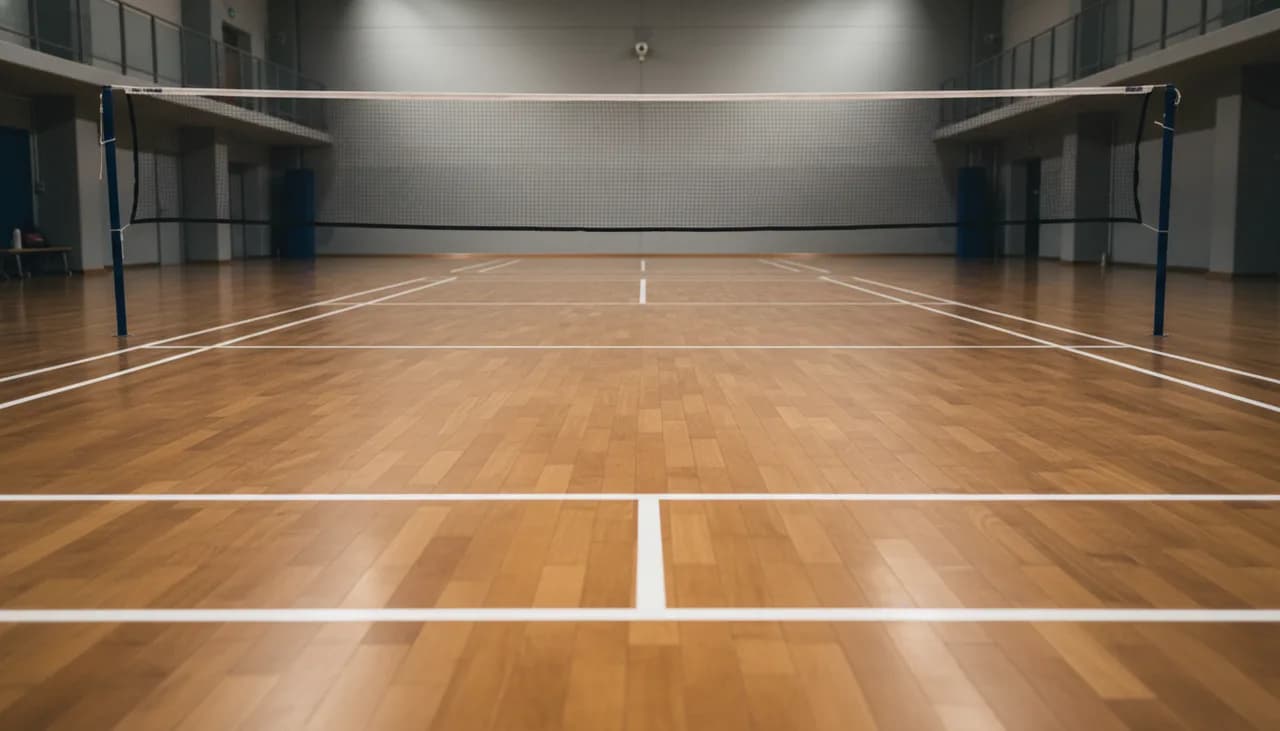
Badminton Courts: Official Dimensions, Net, and BWF Markings
All regulation badminton courts measure 13.40 × 6.10 m for doubles. We break down the BWF dimensions, net height, and court markings.
All official badminton courts follow the same BWF dimensions: 13.40 m long, 6.10 m wide for doubles, with a net 1.55 m high at the posts. These figures come from the Laws of Badminton published by the Badminton World Federation and apply to all international competitions, from the Sudirman Cup to the smallest affiliated tournament. Whether you play at a club, in a school gym, or are marking out a court at home, everything starts with these standardized dimensions.
Key takeaways
- An official badminton court measures 13.40 m by 6.10 m, covering 81.74 m² including the service areas.
- The net is 1.55 m high at the posts and 1.524 m at the center — it sags intentionally by 26 mm.
- In singles, the playing width is 5.18 m; in doubles, it's 6.10 m (the two side alleys become in).
- Lines are 40 mm wide, painted white or yellow, and are part of the area they delimit.
- The recommended vertical clearance is 9 m above the court, without any obstacles.
Badminton Courts: Official BWF Dimensions
The Badminton World Federation sets the dimensions of a badminton court in the Statutes Section 5.1 — Laws of Badminton. The reference is unique for singles and doubles: a rectangle 13.40 m long by 6.10 m wide, divided into two halves by a central net. The diagonals must measure 14.72 m, with a tolerance of plus or minus 4 cm. This figure helps the tournament controller verify that it's a true rectangle and not a deformed parallelogram.
The court is marked on a flat, horizontal surface, without local deformation. The BWF recommends a specific badminton sports flooring (blue PVC like Yonex Synthetic, sports parquet, or removable mat). Raw concrete, tile, or synthetic grass floors are acceptable for leisure but are prohibited in official competitions. The reasons: sole grip, deformation upon jumping, and acoustic feedback from the floor which helps hear the shuttlecock strike.
The posts supporting the net are placed on the side lines of the doubles alley. They are 1.55 m high. If playing singles on a court that doesn't have doubles markings, the posts must still remain at the doubles alley position — otherwise, the net sags, and the service area is incorrect. This is a very common mistake in multi-purpose gyms.
Badminton Court Dimensions for Singles
In singles, the playing area is 5.18 m wide by 13.40 m long. The two side alleys (the 46 cm strips on each side of the court) are out — a shuttlecock landing there is a fault. This is one of the first rules to grasp to avoid being caught out: a shuttlecock that seems good in doubles becomes out in singles, and vice versa.
The back boundary line at 13.40 m from the net serves as the long service line in singles. There is no intermediate line 0.76 m from the back, as in doubles. For service, the shuttlecock must therefore cross the short service line (1.98 m from the net) and land before the back boundary line, in the diagonally opposite square. A service area that is 4.72 m deep by approximately 2.59 m wide — this is the legal target.
In terms of length, a player's half-court in singles measures 6.70 m from the net to the back boundary line. This distance is essential to internalize for calibrating defensive clears: a clear that doesn't reach the last two meters of the court allows the opponent to regain the initiative. If you want to work on this precision, the course Construction - recentrer les trajectoires de fond targets exactly this area.
Badminton Court Dimensions for Doubles
In doubles, the side alley becomes part of the playing area: the width increases to a full 6.10 m. However, the service area is narrowed in depth — there is a long service line 0.76 m from the back boundary line, used only for service. For service in doubles, the shuttlecock must therefore land between the short service line (1.98 m from the net) and this long service line (12.64 m from the net). Beyond that, it's a fault, even if the shuttlecock lands on the back boundary line.
During the rally, however, the entire depth of the court becomes good again. The long service line has no value after the service. This is a nuance that causes beginners to lose points: they believe that a shuttlecock landing between the long service line and the back boundary line is out in doubles. False — it is only out if the service itself causes it.
In terms of width, each of the two side alleys measures 46 cm. This is not insignificant: in doubles, these 46 cm on each side change the entire strategy of placement and coverage. The defensive pair must cover 92 cm more than in singles. To concretely understand how this extra surface modifies movements and roles, our article on badminton movement details doubles coverage patterns.
Net Height on a Badminton Court
The net of a badminton court measures 1.55 m high at the posts and 1.524 m at the center. This 26 mm differential is not a measurement error: it comes from the fact that the net is taut but not stretched, so it sags slightly in the middle under its own weight. The cable at the top of the net is stretched by the two posts and passes over the middle, but the weight of the net (with its 7.5 cm white top band) pulls it downwards.
Concretely, this means that the central area of the court is the most accessible for low shots (drives, kills, counter-attacks) because the net is lower there. Experienced players exploit this detail: they often aim their drives just above the middle of the net, where the margin is maximal. Conversely, a shot attempted at the very edge of the net must pass over the full 1.55 m — less margin, more risk of hitting it.
The net itself is 0.76 m high (from the top cable to the taut bottom cord) and is made of dark mesh 15 to 20 mm. The white band at the top (where the cable passes) is mandatory and must be 75 mm wide. The net must be taut enough so that there is no space between the net and the post — many amateur clubs neglect this tension, and we see shuttlecocks passing underneath or to the side, which creates silly disputes.
Marking a Badminton Court: Lines, Colors, Materials
All lines on a badminton court measure 40 mm wide (4 cm) and are painted white or yellow. The color depends on the floor: on a light sports parquet, yellow is often used for contrast; on blue PVC coatings like Yonex, it's white. A line is part of the area it delimits — a shuttlecock landing on the line is good, whether it's on the back boundary line, side line, or service line.
The main lines are:
- The back boundary line 6.70 m from the net on each side.
- The sidelines for doubles 3.05 m from the center.
- The sidelines for singles 2.59 m from the center.
- The center line which separates the two service squares.
- The short service line 1.98 m from the net.
- The long service line for doubles 5.94 m from the net.
BWF courts use standardized materials. The official competition mat is a sports PVC coating at least 4.5 mm thick, with a granular non-slip surface. At the club level, sports parquet (oak or beech, on joists) remains the reference for dedicated gyms. In multi-sports facilities, mixed badminton/basketball/volleyball floors are accepted, but the grip is less good, and joint fatigue increases with repeated shuffle steps.
Marking a Badminton Court in a Gym, Club, or Garden
If you need to mark a court in a multi-purpose gym or at home, here are the minimum dimensions to respect to keep it playable. For a full doubles court: allow at least 15 m × 8 m of floor space (the actual court plus 80 cm of clearance on each side and 80 cm behind each back boundary line). Vertical clearance must be a minimum of 7 m, ideally 9 m as recommended by the BWF — below that, defensive clears hit the ceiling, and play becomes impossible.
For temporary marking, common solutions are Trace-Line sports adhesive, wide gym tape rolls, or removable line kits sold by Yonex and Victor. EPS federations also distribute tracing plans to stick to the floor for school sessions. If you have an outdoor court or a large garage, complete portable kits (posts + net + adhesive lines) can be found for around 80 € at entry-level. Be careful of wind outdoors: feather shuttlecocks become impractical beyond 8-10 km/h, so prioritize nylon or play indoors.
For schools and structures that want to train their students beyond simple marking, our How it Works page explains how to dissect a match recorded on a smartphone from a marked court. This is useful for checking if players respect service areas and cover the depth of the court correctly. To go further on service rules (often misunderstood), our guide on badminton service rules details the most frequent faults.
Frequently Asked Questions
What is the official size of a badminton court?
An official badminton court measures 13.40 m long by 6.10 m wide (for doubles). In singles, the playing area is reduced to 5.18 m wide — the two side alleys of 46 cm each become out. The total surface area is 81.74 m² in doubles, compared to 69.41 m² in singles. These dimensions are defined by the Badminton World Federation and are identical worldwide.
What is the height of the net in badminton?
The badminton net measures 1.55 m at the posts and 1.524 m at the center of the court. The 26 mm difference comes from the natural sag of the net under its own weight, which is intentional and codified by the BWF. This height is the same for singles, doubles, mixed, men, and women — there is no adaptation by category.
What is the difference between a singles and doubles court?
The main difference is the playing width: 5.18 m in singles versus 6.10 m in doubles. The side alleys of 46 cm on each side are in for doubles, out for singles. For service, the area is also deeper in singles (up to the back boundary line) than in doubles (where a long service line 0.76 m from the back limits the depth of the service).
What is the service area in doubles?
In doubles, the service area is a rectangle bounded by the short service line (1.98 m from the net), the long service line for doubles (12.64 m from the net, or 0.76 m from the back boundary line), the center line, and the doubles sideline. The served shuttlecock must land in the diagonally opposite square. Outside of service, during a rally, the entire court is playable up to the back boundary line.
What clearance is needed around a badminton court?
The BWF recommends a vertical clearance of at least 9 m above the court — without obstacles (beams, lights, fans). Laterally, at least 80 cm should be allowed between the sideline and the nearest wall, ideally 1.50 m to allow for recovery movements. Behind the back boundary line, 2 m is recommended. Below these margins, play significantly degrades, especially for defensive clears and drop shots at the end of a run.
If you want to analyze what you do on your half of the court — placement, zone coverage, service returns — upload a 30-second video to BadmintonPeak and receive a step-by-step analysis of your movements, shots, and tactical choices.
For the complete official reference of dimensions and rules, consult the BWF Statutes where the Laws of Badminton are updated every Olympic cycle.