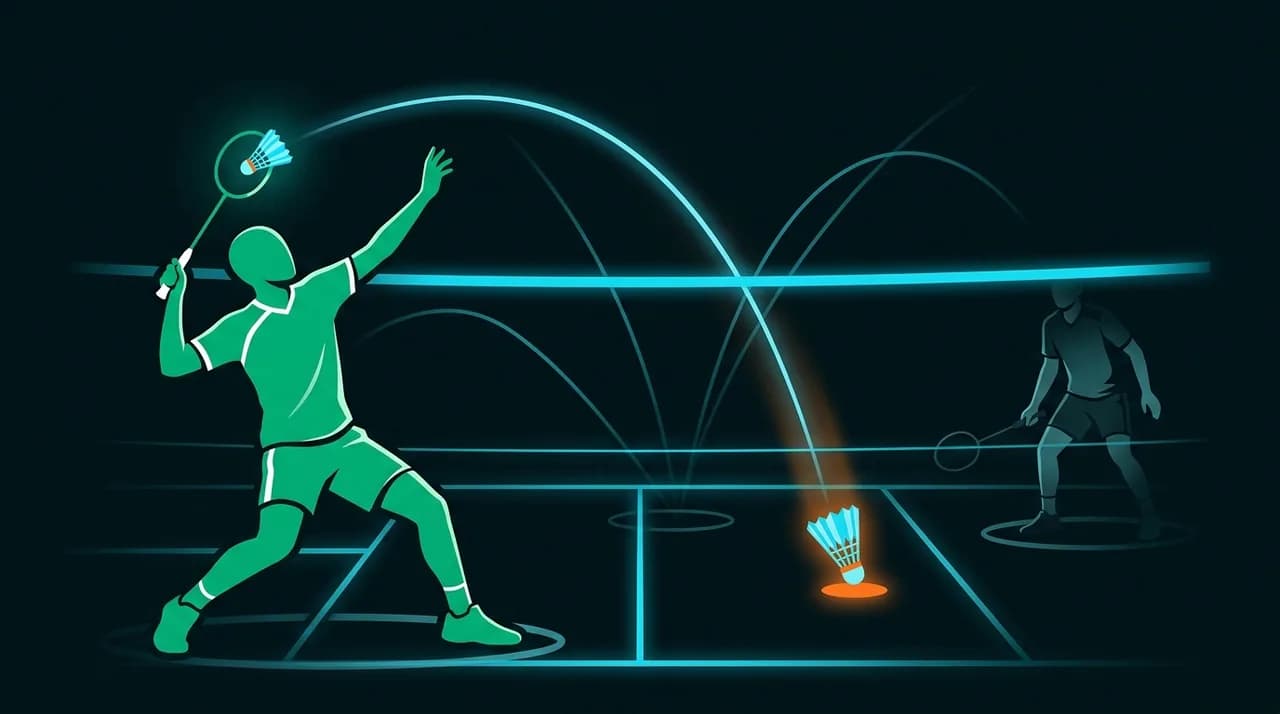
What a drop shot is and what it should do
The drop shot is an overhead stroke played from the rearcourt with the exact same preparation as a clear or a smash, but where the shuttlecock falls just behind the opponent's net. Its goal is to move the opponent forward and force them to play a low shuttlecock, meaning they have to lift. Its effectiveness relies on two things. First, the preparation must be identical to that of a smash right up until the last moment, otherwise your opponent will anticipate the shot before you hit it. Second, the trajectory must drop early: a drop shot that travels upward before coming down gives the opponent time to catch it at tape height and kill it. The net spin or spinning net shot (counter drop) is the other member of the family, played at the net off an opponent's drop shot by returning the shuttle as tight as possible. Both shots are won with accuracy, not speed.
When to use it
A drop shot is played when your opponent is anchored in the back or retreating, especially after two clears that made them work backward. It is difficult to play well when you are late to the shuttle: a low contact point produces a drop shot that is too long, landing midcourt, which is the easiest shot to punish in badminton. The straight drop shot, along the line, is the safest option; the crosscourt drop shot opens up the angle but takes longer to arrive and requires a tighter preparation to remain disguised. Slicing the shuttle, by brushing it on the side, speeds up its descent and confuses the opponent's reading of the shot, at the cost of being harder to control. At the net, choose a counter drop when your opponent has just played short and stays low: returning it tight forces them to lift again, giving you a high shuttle on the next shot.
The three most common mistakes shown on video
The first mistake is a telegraphed preparation. The arm slows down before impact, the shoulder does not pull back as far as it would for a smash, and the opponent has already moved forward by the time the shuttle leaves the racket. On video, we compare the image of your smash setup with your drop shot setup: if they differ, your drop shot is readable. The second mistake is taking the shuttle too low, after it has passed its peak height. The contact point moves backward, the trajectory goes upward, and the drop shot arrives at net tape level where it gets killed. The third mistake is hitting the counter drop instead of gently placing it. The wrist snaps, the shuttle flies across and lands a meter away from the net, right in range of a net rush. At the net, your racket should move toward the shuttle and stop almost upon impact; on video, the follow-through of the arm after impact tells the whole story.
How to practice it
From the rearcourt, a partner or feeder sends you high shuttles. You alternate between a clear and a drop shot using the exact same preparation, aiming for the zone between the net and the opponent's short service line for the drop shot. Out of ten drop shots, count how many land in this zone. Once you consistently hit seven out of ten, add footwork from the center before each hit. At the net, have low shuttles fed to you and play counter drops, aiming for the 30-centimeter band right behind the net, with your racket moving forward and stopping at impact. Film from the side, at hip height, to check your contact height and follow-through amplitude. The training program "Drop shot: placing the shuttle behind the net" breaks down this exercise step-by-step and tracks every set you send into the target area.
What video analysis gives you on a drop shot
You upload a rally, an exercise, or a match sequence, filmed from the side or from behind. The analysis identifies your drop shots and counter drops, timestamps them, and describes what it sees: preparation compared to your other rearcourt shots, contact height, landing zone, and what the opponent was able to do on the following shot. It provides a correction for each detected flaw, indicating the exact timestamp to watch. On a practice set, it counts your repetitions and explains what differs between the drop shots that land short and those that float into the midcourt.