
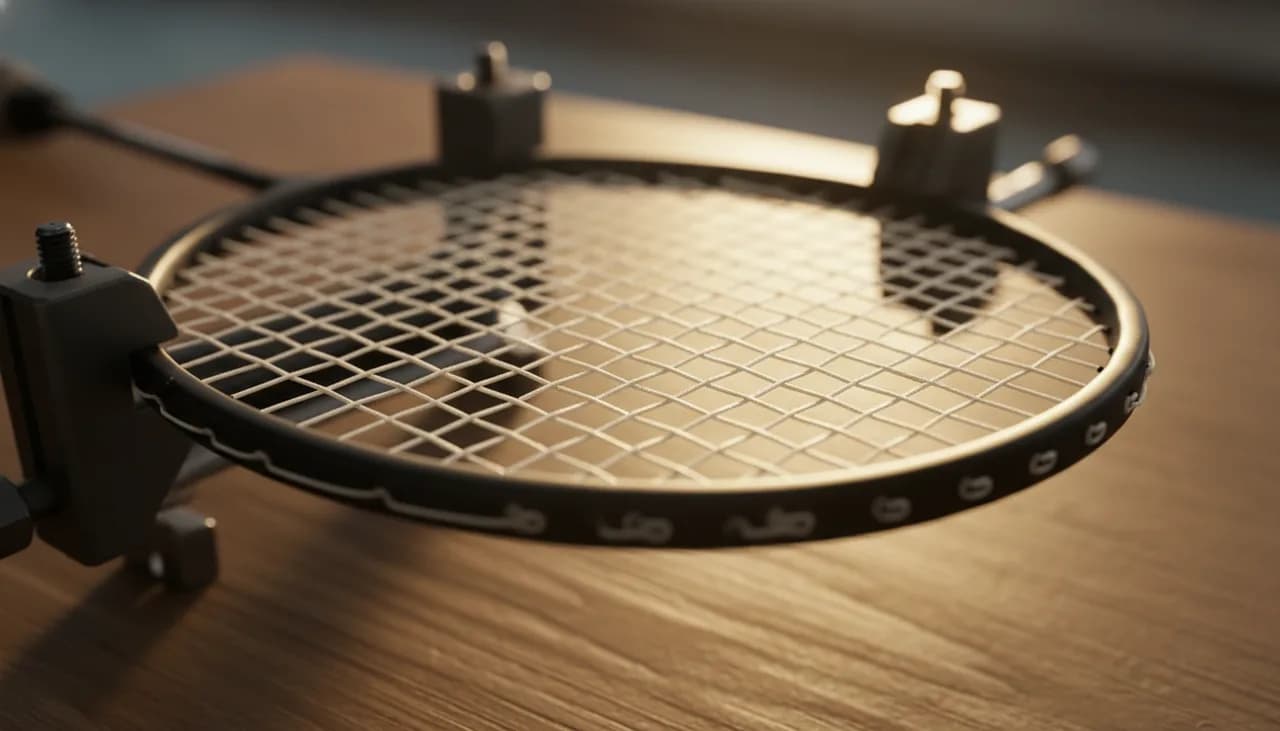
Badminton Racket String: Tension, Material, and Replacement Frequency
Everything you need to know about badminton racket stringing: kg, nylon vs multifilament, diameter, and when to restring. The guide to choosing well.
Choosing the right badminton racket string for your level changes your power, control, and playing comfort—often more than the racket itself. Yet most amateur players keep the factory string for months, unaware that it’s probably too thick, too loose, and unsuitable for their style. This guide covers the essentials: tension in kg, materials, diameter, replacement frequency, and how to choose according to your level.
Key Takeaways
- Badminton string tension is measured in kilograms, generally between 9 and 15 kg depending on the player's level.
- The higher the tension, the more control you gain but lose power due to the trampoline effect.
- Multifilament performs better than mono nylon but breaks faster—it's the classic compromise between feel and durability.
- Recommended replacement frequency: as many times per year as you play hours per week. Play 4h/week? Restring 4 times/year.
- A broken or loose string costs you points: unpredictable trajectory, loss of precision, increased wrist fatigue.
Badminton Racket String: Why It Changes Everything
A badminton racket string transmits the energy from your shot to the shuttlecock. The tighter it is, the less it deforms on impact—meaning less “trampoline” effect, more precision, but less added power. Conversely, a flexible string absorbs shock and returns more energy, which extends clears effortlessly. The whole job is to find the right balance for your level and style.
The string is the most neglected element by amateur players. Most keep the factory pre-string—often a generic nylon strung at 9-10 kg—for a year or more. The result: tension gradually drops (a string loses between 15 and 25% of its tension in the first few days after stringing), fibers loosen, and shots become imprecise without you even realizing it.
To delve deeper into the fundamentals of hitting, our guide on badminton hitting technique explains how racket-shuttlecock contact works. And if you want to understand how to generate power on overhead shots, the complete smash guide details the biomechanical chain. The string is the final link in this chain—it can accelerate or kill all the power you generate.
Badminton Racket String Tension (kg)
Badminton racket string tension is expressed in kilograms (kg) or pounds (lbs, where 1 kg ≈ 2.2 lbs). It is the force exerted by the tensioned string on the racket frame. The higher it is, the harder the stringer “pulled” on each string during installation.
Here are the indicative ranges by level:
- 9-10 kg: beginners, casual players. Maximum trampoline effect, the shuttlecock flies far effortlessly. High tolerance for off-center shots.
- 10-11 kg: regular recreational players (1-2 times/week), all-around profile. Good power/control balance.
- 11-12 kg: advanced intermediate (3+ hours/week, club). Control takes over, drop shots become more precise.
- 12-13 kg: regional competition, technical players. Requires a clean hit—an off-center shot sounds bad and breaks faster.
- 13-15 kg: high level, national players and above. Reserved for very precise shots and strong wrists.
- 15+ kg: very rare, except for pros with the muscle mass and technique to absorb vibrations without pain.
Many players increase tension too early out of pride. This is counterproductive: at 13 kg without the technique, you lose power, comfort, and break your string every month. Stick to a comfortable tension where you win points, not one that flatters your ego.
Tension naturally drops over time. Expect a loss of 15 to 25% in the first 24-72 hours after stringing (“stabilization”), then 0.5 to 1 kg per month of regular play. A string strung at 11 kg in April will be at a real 9-10 kg in September—the equivalent of returning to beginner mode.
String Materials: Nylon, Multifilament, Synthetic Gut
Badminton racket strings are classified into three main families based on their structure:
Nylon monofilament (mono): a single solid nylon thread. Very durable, inexpensive (5-12 €), but stiff feel and limited energy return. This is the typical string for factory pre-strings and entry-level rackets. Suitable for beginners who hit hard and want a durable string.
Nylon multifilament (multi): a main thread surrounded by hundreds of fine fibers, sometimes 1500+ filaments. Excellent energy return, soft and precise feel, but lower durability—expect 30-50% less lifespan compared to mono. The benchmark for intermediate and advanced players. Common brands: Yonex BG-66 Ultimax, Yonex Aerobite, Li-Ning No. 1.
High-end synthetic gut: a multifilament variant with a reinforced central fiber (often polyester or Vectran). Combines the durability of mono and the feel of multi, but the price increases (15-25 € for the string alone, excluding installation). Reserved for competitors who want comfort without restringing every 3 weeks.
The nylon vs. multifilament debate boils down to a compromise: durability vs. feel. If you play once a week, mono is sufficient. If you play 3-5 times a week and are looking to improve technically, switch to multifilament—the difference in hitting is immediate, especially on drop shots and wrist play near the net.
Badminton Racket String Diameter
The diameter of a badminton racket string is measured in millimeters, generally between 0.60 and 0.75 mm. The thinner it is, the more precise and powerful the shot—but the shorter the lifespan.
Standard diameters:
- 0.60-0.65 mm: very thin, maximum feel, minimum durability. The string of pros, who change it every 2-3 weeks in competition. Examples: Yonex BG-66 Ultimax (0.65 mm), Yonex Aerobite Boost (0.61 mm).
- 0.65-0.70 mm: comfort/durability compromise, this is the reference range for the majority of intermediate and advanced players. Examples: Yonex BG-65 (0.70 mm), Yonex BG-80 (0.68 mm).
- 0.70-0.75 mm: maximum durability, more diffuse feel. Entry-level and recreational strings. Well suited for players who hit hard and break strings often.
A thin string “grips” the shuttlecock better on impact, which improves the precision of short trajectories and gives more wrist responsiveness. But it vibrates more and loses tension faster. If you're a beginner and break your string every month, only reduce the diameter once you've stabilized your technique.
Badminton Racket String Replacement Frequency
The golden rule, validated by most coaches and professional stringers: restring your racket as many times per year as you play hours per week. Do you play 3 hours a week? Restring 3 times a year. 5 hours a week? Restring 5 times a year. This rule applies regardless of breakage—a string that hasn't broken is not necessarily in playing condition.
Signs that it's time to restring:
- String discolors or whitens in the hitting zone (sweet spot): internal fibers are damaged, the string is dry and loses tension.
- “Soft” feeling on impact: you feel like you're playing in a net. Tension has dropped by several kg.
- Degraded precision: your drop shots fall too short or too long for no apparent reason, your clears lack depth.
- Dull hitting sound: a taut string sounds “clear” and “crisp.” A worn string sounds “muffled.”
- String slides: vertical and horizontal strings move with each hit and you have to manually put them back in place between points.
Many players wait for breakage to restring. This is late: the string had already lost 30-40% of its tension before giving way. Prevention is better than cure, especially if you want to progress without material hindrance.
To understand which shots put the most strain on your string, take a look at the badminton service rules—short, precise serves require a fresh string. And for those training on a home court or in PE, our guide to court dimensions covers the basics of marking.
How to Choose Your Badminton Racket String According to Your Style
Beyond technical data, string choice depends on how you play. Typical profiles:
The defender / counter-attacker. You play low, absorb shots, seek to neutralize opponent attacks, then counter-attack. You need a string that returns energy on lifts and defensive clears, without requiring too much effort. Recommendation: multifilament 0.68-0.70 mm strung at 10-11 kg. Good durability/feel compromise.
The attacker / smasher. You aim to finish points overhead, with smashes and drives. You need a string that gives you control on powerful shots—a string that's too loose sends shuttlecocks anywhere on attack. Recommendation: multifilament 0.65-0.68 mm strung at 11-12 kg if you are advanced, 10-11 kg if you are still progressing.
The net player / technical player. You rely on drop shots, net shots, and variations near the net. You need precision and feel. Recommendation: thin multifilament 0.61-0.65 mm strung at 11-12 kg. You'll change it more often but your touch will be optimal.
The all-around / club player. You do a bit of everything, you play 2-3 times a week recreationally or in regional interclub matches. You want a setup that lasts and doesn't limit you. Recommendation: multifilament 0.68 mm (like Yonex BG-65 or BG-80) strung at 10-11 kg. This is the most common combo in French clubs for good reasons.
The beginner. Keep the factory pre-string for the first year, unless it breaks. Once you play regularly and no longer break your strings every month, switch to a 0.70 mm multifilament at 10 kg. You'll feel the difference without breaking the bank.
Badminton Racket String: Factory Pre-string or Custom
When you buy a new racket, it comes with a factory string—a basic nylon, often strung around 9-10 kg. This is rarely suitable for regular use beyond occasional recreation. Two options:
- Keep the pre-string: OK if you're a beginner or play less than once a week. You'll change it when it breaks or when you feel the softness.
- Restring immediately: recommended from intermediate level. You choose your string (material, diameter) and tension. Expect 8-15 € for the string + 10-15 € for installation at a professional stringer.
Stringing by a professional stringer (club, specialized store) is always preferable to home stringing or at a supermarket: a 2-clamp vertical/horizontal stringing machine maintains real tension, whereas a low-end machine loses 1-2 kg as soon as it's unmounted. Ask your stringer what brand of machine they use—Babolat, Yonex, and Eagnas are among the professional brands.
For official technical details on badminton equipment, the BWF maintains a register of material specifications available online.
Frequently Asked Questions
What tension for a badminton beginner?
For a beginner, aim for a tension of 9 to 10 kg. This is what most new rackets come with as factory pre-string. This range maximizes the trampoline effect, so you don't have to hit hard to send the shuttlecock far. Higher tension would require a cleaner technique that you don't have yet.
How long does a badminton racket string last?
The lifespan depends on playing frequency and the quality of your hit. For a recreational player (1-2 times/week), a string lasts 4-6 months before needing replacement. For a regular player (3-5 times/week), count 6-12 weeks. For a competitor, 2-4 weeks. The rule “X hours/week = X restrings/year” remains a good approximation.
What is the difference between nylon and multifilament?
Nylon monofilament is a single solid thread, very durable but with a stiff feel. Multifilament is composed of hundreds of fine fibers intertwined around a core, which gives superior energy return, a softer hit, and more precision—at the cost of reduced durability (30-50% less). Multifilament is the benchmark for anyone wanting to progress technically.
Why does my string always break in the same place?
If your string consistently breaks on the upper edge or bottom of the sweet spot, it's probably because you're not centering your shots. Either you're hitting too high on the racket (tip shots), or too low (frame). Work on the position of your hit on the sweet spot—this is what quality of hit technical analyses measure. If you regularly break at the central crossing, it's more a sign of a string at the end of its life breaking under chronic tension.
Can I string my racket myself?
Technically yes, but practically no. Badminton stringing requires a 2-clamp vertical/horizontal machine to maintain uniform tension and a precise stringing pattern (alternating with compensation at the knots). A professional machine costs 800-3000 €. The investment is only profitable if you string 30-40 rackets per month. It's better to go to a professional stringer—expect 10-15 € for installation, it's cost-effective and the quality is incomparable.
If you want to check that your hitting technique makes good use of your current string, upload a 30-second video to BadmintonPeak and receive a step-by-step analysis of your stroke, timing, and impact point on the racket.