
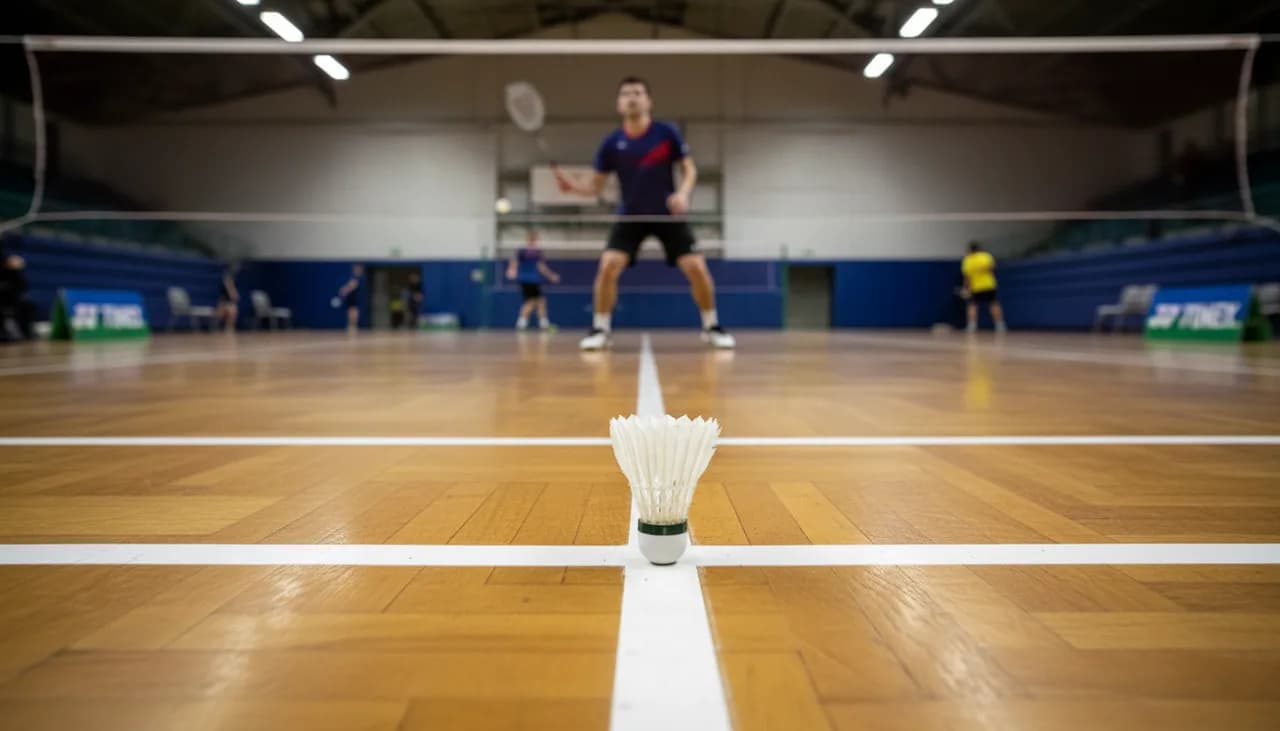
Badminton Service Rule: Complete Guide (Singles, Doubles, Height)
Badminton service rule explained clearly: 1.15m height, singles and doubles zones, common faults. You'll know exactly when the umpire will raise their arm.
The badminton service rule makes even experienced players lose points every weekend. Contact height, foot position, racket orientation, valid zone: it only takes one detail for the umpire to raise their arm and call fault. This guide covers the official BWF regulations (Laws of Badminton) and translates them into concrete benchmarks, for singles and doubles, with exact zones and the most frequent faults in competition.
The Essentials in 5 Points
- The badminton service rule is based on 4 universal principles: shuttlecock height ≤ 1.15 m, racket head pointed downwards, contact on the base of the shuttlecock, feet placed in the service box.
- In singles, you serve from the right if your score is even, from the left if it's odd. The valid box is narrow and deep.
- In doubles, the service box is short and wide. Only one service per team per rally since the rally point rule.
- In mixed doubles, the server changes sides with each point won while serving, but never changes partners' sides.
- The 8 most reported service faults almost all concern the height or orientation of the racket.
Badminton Service Rule: The 4 Universal BWF Principles
The badminton service rule is defined by the Laws of Badminton published by the Badminton World Federation. Regardless of the format (singles, doubles, mixed), every legal service must simultaneously meet four conditions, controlled at the precise moment of contact between the racket and the shuttlecock.
First principle: height. The shuttlecock must be struck at a height less than or equal to 1.15 m measured from the court surface. This 1.15 m rule, introduced in 2018 at the BWF Annual General Meeting, replaces the old wording “below the server's lowest rib” which depended on the player's physique. It applies in international competition and has been adopted by almost all national federations, including the FFBaD.
Second principle: racket orientation. At the moment of contact, the entire racket head must be clearly directed downwards, below the hand holding the handle. This is sometimes called “the racket eating the ground.” A horizontal racket head or one pointed forward constitutes a fault.
Third principle: contact on the base of the shuttlecock. The server must hit the base (the cork) first, not the feathers. Contact that starts with the edge of the feathers is a fault, even if it is imperceptible at real speed.
Fourth principle: feet. Both feet must remain in contact with the ground from the start of the movement until contact between the racket and the shuttlecock. No foot should touch a line of the service box or step out of it. You are not allowed to jump, slide, or lift a heel during the stroke. Both the server and receiver must be positioned in their diagonally opposite service boxes.
In addition to these four principles, there is a requirement for continuity: once the service motion has begun, you are no longer allowed to stop, feint, or hesitate. This is sometimes called the “anti-feint rule.” The service must be a fluid and continuous movement.
Badminton Service Height: The 1.15 m Rule Explained
The badminton service height is probably the rule that raises the most questions. Before 2018, the BWF used the following wording: the shuttlecock had to be struck below the server's lowest floating rib. In practice, this definition created inequalities: a 1.90 m player could serve much higher than a 1.65 m player, and umpires had to visually estimate an invisible body reference.
Since March 6, 2018, the rule has been clarified: the height of the shuttlecock at the moment of contact must never exceed 1.15 m from the ground. This is an absolute measurement, independent of the player's height. For control, the BWF uses a device called a Service Judge Device on the international circuit: a laser sensor placed at 1.15 m projects a virtual plane above the service box. If the shuttlecock is hit above this plane, the system signals a fault.
In clubs and national competitions, this device does not exist. It is the service judge, sitting at the side of the net, who visually assesses the height. A reliable mnemonic: at 1.15 m, the shuttlecock reaches approximately the navel level of an average adult (1.75 m). If you feel your stroke starts at sternum level, you are too high. Modern legal short flick serves are actually struck very low, at hip height, to minimize the risk of fault.
To practice serving low without losing accuracy, the course Short Serve MS Zone 0-1 offers a progression on mastering the impact point in men's singles.
Badminton Singles Service Rule: Zones, Sides, Tactics
In singles, the badminton service rule first determines from which half-court you serve. The principle is simple: even score, you serve from the right; odd score, you serve from the left. At 0-0, the first server therefore starts from the right. If you score the next point, your score becomes 1, and you serve from the left. The same logic applies to your opponent when they regain service.
The service zone in singles is narrow and deep. Laterally, it is delimited by the center line and the singles sideline. Longitudinally, it starts at the short service line (1.98 m from the net) and extends to the back line of the court. The diagonally opposite valid box has exactly the same dimensions. For a service to be valid, the shuttlecock must land inside this box, including the lines.
Three tactical choices are available to you in singles:
- The long high serve: you send the shuttlecock high and deep to make it land as close as possible to the back line. Standard for men, it forces the receiver to move to the back of the court. This is the most used serve in men's singles. To delve deeper, see Long Tense Serve MS Zone 4-5.
- The short serve: you place the shuttlecock just after the short service line. Mainly used in women's singles and juniors, it deprives the opponent of a powerful shot and sets up a neutral rally.
- The flick serve: a variation of the short serve. You adopt the same stance as for a short serve, then quickly lift the shuttlecock towards the back. It is a weapon with a surprise effect.
The course Short or Long Serve: Precision compares the two options and offers drills to alternate them intelligently.
Badminton Doubles Service Rule: Why It's Different
The badminton service rule in doubles differs on two major points compared to singles: the valid zone and the rhythm imposed by the rally point.
The service zone in doubles is short and wide. Longitudinally, it stops at the doubles long service line, located 76 cm in front of the back line of the court. Laterally, it extends to the doubles sidelines, which is 46 cm more on each side than in singles. Result: you serve into a rectangle that is significantly wider but significantly less deep. A service that is too long in doubles, even by 30 cm, is a fault.
This geometry dictates tactics. The short serve is ultra-dominant in doubles: it accounts for more than 90% of serves in professional competition. You aim to place the shuttlecock just after the short service line, as close to the net as possible, to prevent an attacking return. The courses Short Serve Z0-Z1 Precision and Doubles Service Strategic Zones cover the desired impact zones and post-service sequences.
The flick serve completes the arsenal: same posture as the short serve, but a stroke that lifts the shuttlecock over the receiver. When used well, it punishes opponents who position themselves too close to the short service line.
Regarding scoring, the mechanics are identical to singles: even score, the server serves from the right; odd score, from the left. But in doubles, since the adoption of the rally point in 2006, each team is only allowed one service per rally. When the serving team loses the point, service immediately passes to the other team. No more second serves as before 2006.
Another subtlety: in doubles, only the server changes sides when their team wins a point while serving. Their partner remains in place. It's not an exchange of positions, it's a displacement of the server only.
Mixed Badminton Service: The Rule That Changes Everything
Mixed doubles applies the same badminton service rule as classic doubles for zones and height, but adds a dimension: male-female rotation. At 0-0, the serving team chooses who starts. Let's say it's the man, on the right. If the team wins the point, the man moves to the left to serve the next point. If the team loses the point, service passes to the opponent, and no one rotates in the losing team.
When the team regains service later in the set, the partner who is on the side corresponding to the score (even on the right, odd on the left) becomes the server. If the woman is on the right side when her team's score is even, she serves, not the man. This is the source of most confusion in the first years of practice: you don't “inherit” the service, you serve from the side that corresponds to the score.
Tactically, in mixed, the woman often positions herself in front and the man behind. This influences the choice of service: the woman will favor precise short serves, the man will alternate short and flick depending on the receiver's placement. Mastering the short serve remains central, because it prevents the opponent from taking control at the net.
Badminton Service Rule: The 8 Most Frequent Faults
Out of 100 services judged fault in federal competition, more than 90% concern the eight reasons below. Learn to recognize them in yourself to correct them.
- Height greater than 1.15 m. The most reported. You start your stroke too high, racket at chest height, and contact is made above the limit plane. Solution: start the racket at hip height.
- Racket head not pointed downwards. At contact, the racket head is horizontal or pointed forward. Often caused by wrist tension. Solution: relax your wrist and let gravity tilt the head.
- Contact on the feathers rather than the base. You approach the shuttlecock at an angle, and the racket first touches the feathers. Solution: align the racket's trajectory with the shuttlecock's axis.
- Foot on a service box line. You go over the center line or the short service line by a centimeter. Solution: move your front foot slightly forward into the box, and mentally mark the lines when positioning.
- Foot lifting during the stroke. You rise onto your toes or make a mini-jump. Solution: anchor your weight on both heels until contact.
- Serving from the wrong box. You serve from the right when your score is odd (or vice versa). Solution: get into the habit of looking at the scoreboard between each rally.
- Shuttlecock landing outside the box. In doubles, the shuttlecock lands just behind the doubles long service line. In singles, it lands in the doubles zone (outside the singles lines). Solution: choose your target zone before serving and do basket drills to memorize it.
- Non-continuous movement (feint). You start your stroke, pause to observe the receiver's reaction, then accelerate. This is a fault, even if the receiver has already moved. Solution: execute the stroke in one continuous motion.
These faults are not reserved for beginners. On the PRO circuit, several top 20 world players are faulted regularly, usually on the height criterion. If you play in federal competition and a service judge is present, expect strict control — French officiating is generally recognized as rigorous on services.
How to Improve Your Badminton Serve
Reading the badminton service rule is not enough: you have to incorporate it into your stroke. Three concrete levers.
First lever: record your serve on camera. Film yourself in profile, 3 meters from your short service line. Hit 10 serves. Watch the video frame by frame at the moment of contact. You will spot in a few minutes whether you are serving above or below 1.15 m. This is exactly the type of analysis for which BadmintonPeak dissects your stroke frame by frame: you upload 30 seconds of service, and the AI gives you the contact height, racket angle, and movement stability.
Second lever: basket drill. Place a rope stretched at 1.15 m from the ground, just in front of your service zone. Do a series of 30 short serves, passing just under the rope. Measure the percentage of serves that land in the square meter just after the short service line. This is the basic exercise for all doubles training.
Third lever: vary intentionally. When you master the precise short serve, add the flick. A good average in doubles competition: 80% short serves, 20% flick serves, with a ratio that adjusts according to the receiver. The course Short Serve Sequences S3-S5 covers post-service transitions, which is what distinguishes a good server from an excellent server.
For more structured stroke work, AI video analysis is more effective than a mirror or a coach watching from afar: you see the exact height, frame by frame, and you can compare a series done a month ago with your series today. It's also an excellent complement to coach advice, because you arrive at the session with numbers instead of vague impressions. And if you want to refine your technique beyond the serve, the article Smash Technique: Complete Guide follows the same frame-by-frame analysis logic applied to the attacking stroke.
Frequently Asked Questions
What is the maximum height allowed for a badminton serve?
The maximum height is 1.15 m measured from the court surface at the moment the racket touches the shuttlecock. This rule, set by the BWF in 2018, replaces the old criterion “below the server's lowest rib.” It applies in international and national competition. Above 1.15 m, the service judge signals a fault and the point is lost.
What is the difference between the service zone in singles and doubles?
In singles, the service zone is narrow (between the center line and the singles sideline) and deep (up to the back line of the court). In doubles, the zone is wide (up to the doubles sidelines) but short (stops 76 cm before the back line, at the doubles long service line). You therefore serve into a wider but shallower rectangle in doubles, which makes a long serve practically impossible and favors short and flick serves.
Who serves first in badminton?
The first server is determined by a draw at the start of the match, most often by a shuttlecock toss or a coin flip. The winning team chooses whether to serve, receive, or choose the side of the court. At 0-0, the server always starts from the right service box. Service then alternates according to the even/odd rule and points won.
Can you feint on a badminton serve?
No. Once the service motion has begun, the stroke must be continuous until contact with the shuttlecock. You are not allowed to stop, intentionally slow down, or make a false movement to deceive the receiver. This is the service continuity rule. Feinting at the moment of impact (hiding the racket's orientation until the last moment) remains permitted — what is forbidden is the interruption.
Is the backhand serve allowed in badminton?
Yes, the backhand serve is completely legal and is even the dominant technique in modern doubles. You place the racket at hip height, head pointed downwards, and push the shuttlecock backhand with a short stroke. All usual constraints apply: height ≤ 1.15 m, racket pointed downwards, feet on the ground, continuous movement. The backhand serve allows for more effective masking of the short or flick choice.
You now know the badminton service rule in detail. The real differentiator, from here, is execution: the exact height of your contact, the precision of your landing point, the consistency of your stroke over 100 consecutive serves. To measure this objectively, analyze a 30-second video of your serves on BadmintonPeak: you will see frame by frame where you stand against the BWF criteria, and you will know exactly what to correct before your next match.