
Badminton Back Pain: Lower Back, Smash, and Core Strength
Back pain in badminton comes from smashing, repeated lunges, and a lack of core strength. Here are the mechanisms involved and what truly solves the problem.
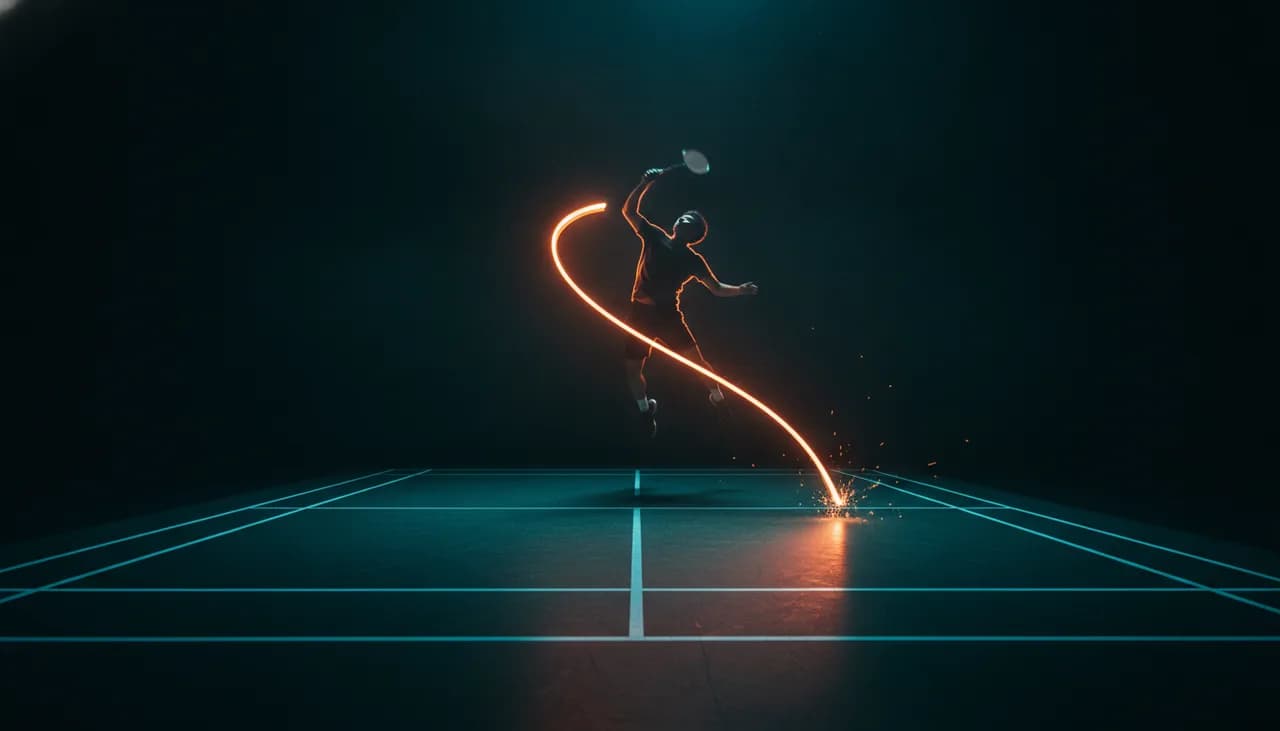
Back pain in badminton almost always occurs in the same place, the lower back, and for the same reason: a smash executed with an arched back without the torso providing any support. The sport combines repeated hyperextension, rapid rotations, and violent braking, three stresses that the lumbar spine alone cannot absorb.
Key takeaways
- The affected area is the lower back in the vast majority of cases.
- The smash involves hyperextension followed by rapid flexion, the most demanding sequence in the sport.
- Insufficient core strength transfers work that belongs to the deep abdominal muscles to the lumbar spine.
- Repeated lunges without cushioning load the pelvis and spine with each foot strike.
- Pain radiating down the leg goes beyond simple overload and requires medical advice.
Back pain in badminton: why the smash is to blame
The smash is by far the most demanding movement in badminton for the lumbar spine.
The complete sequence involves three costly phases. First, hyperextension: the player arches their back, shoulders back, pelvis forward, to cock the arm and gain height. Then, an explosive flexion of the torso forward, which transfers force to the racket. Finally, a landing, often on one leg, during which the back absorbs the shock.
Repeated forty or fifty times per match, this sequence stresses the posterior structures of the spine to an amplitude close to their limit. For a player whose torso lacks stability, each smash becomes an uncontrolled rocking motion.
The jump smash exacerbates the mechanism. The landing adds a load of several times the body weight, absorbed in a very short time. It's the movement that club players most readily copy from professionals, and the one for which they are least physically prepared. Our guide to smash technique details the alignment that limits this strain.
Back pain in badminton: lunges, the invisible strain
The smash is visible, lunges are not, yet they represent a much higher volume.
A player performs dozens of forward lunges per match, towards the net, with a complete brake on the front leg. Each lunge produces a pelvic tilt that the deep muscles must control. When they don't, the lumbar spine takes the brunt.
Two technical flaws amplify the problem. A lunge that is too long, which forces you to lean to reach the shuttlecock, places the back in flexion under load. A lunge without cushioning, with a knee that doesn't bend enough, transmits the shock directly upwards.
Asymmetry also matters. Most players perform almost all their lunges with the same leg, the one on the side of their dominant hand. This unilateral repetition creates a progressive imbalance in the pelvic musculature, which eventually results in pain on only one side. Movement training normally includes lunges on both sides for this reason.
Back pain in badminton: core strength deficit
This is the underlying cause, explaining why two players performing the same movements don't have the same back.
The torso functions like a box. When the deep abdominal muscles, obliques, and spinal muscles work together, they create rigidity that protects the spine during rapid movements. When this box is absent, every rotation and extension directly impacts the vertebral segments.
The often misunderstood point is that the core strength useful for badminton is not that of static three-minute plank series. The sport demands the ability to resist rotation and extension during a rapid movement, not to hold a static position. Anti-rotation exercises, side planks, and unstable support work are more transferable.
Our core and strengthening program specifically builds this quality, with short sessions that can be done alongside club slots.
A simple benchmark to assess your own level: if you cannot hold a side plank for forty-five seconds on each side without your pelvis sagging, your torso is not protecting your back during a smash.
Other frequent causes
Three factors complete the picture and are easily corrected.
Absent or incomplete warm-up. Many players arrive late and go straight onto the court. The first clears are then performed with a cold back, at maximum amplitude. Our warm-up routine provides for a gradual activation of the torso before overhead shots.
Prolonged sitting during the day. A player who spends eight hours sitting arrives at the gym with shortened hip flexors, which accentuates lumbar arching at rest and during a smash. This is a silent and very common cause among adult practitioners.
Lack of hip and shoulder mobility. When the hip doesn't open and the shoulder doesn't lift, the back compensates by arching more. Working on these two areas mechanically reduces the demand on the lumbar spine. Our article on stretching covers this mobility.
Back pain: warning signs
Most back pain in badminton players is due to muscle overload and subsides in a few days with reduced load. Certain signs fall outside this scope.
Pain radiating down the buttock or leg, especially if it follows a specific path, suggests nerve involvement rather than muscle.
Tingling, numbness, or loss of strength in a lower limb requires immediate consultation.
Sudden onset pain during a smash or lunge, with immediate blockage, requires examination before any return to play.
Night pain that wakes you up and doesn't subside in any position has nothing to do with post-match muscle soreness.
The Haute Autorité de santé also reminds us that imaging is not justified as a first-line intervention for common low back pain, and that maintaining activity yields better results than strict rest.
Recovery and prevention
The reflex of complete bed rest is what prolongs low back pain the most. Staying active, while adapting intensity, leads to faster recovery.
The return-to-play protocol follows the same principle as for other locations. Start with slow rallies without smashing or deep lunges. Gradually reintroduce net play, then overhead shots. Save the jump smash for last, once everything else is pain-free.
In parallel, two areas of work are worth more than any passive treatment. Core strengthening, three short sessions per week, is enough to change the game in one to two months. Hip mobility, a few minutes a day, reduces compensatory arching.
General principles for getting back into shape after a break are detailed in our article on returning to badminton, and other common sports injuries in our prevention guide.
Asymmetry, a fundamental problem in badminton
Badminton is one of the most asymmetrical sports there is. A right-handed player always cocks from the same side, always turns in the same direction, and performs the vast majority of their lunges with the same foot.
Over a season, this repetition builds a measurable imbalance. Rotators on one side become stronger and shorter than those on the other, the pelvis subtly shifts, and the lumbar spine constantly compensates for this orientation.
Correction does not require equipment. It involves introducing work on the non-dominant side: lunges performed with the other leg, torso rotations in both directions, balanced side planks. A few minutes at the end of a session are sufficient, provided you are consistent.
This is also why a complementary symmetrical sport, such as swimming or running, protects a badminton player's back much more than isolated lumbar work.
Frequently Asked Questions
Is badminton bad for your back?
Not inherently. It's an asymmetrical sport with repeated extensions, which exposes an unprepared back. A player who regularly strengthens their core and warms up completely can play without problems long-term.
Should you stop playing badminton if you have back pain?
Rarely completely. Reducing intensity, eliminating jump smashes and deep lunges, and maintaining moderate activity yields better results than complete cessation. Pain radiating down the leg is an exception and requires consultation.
What core exercises are most useful for badminton?
Anti-rotation core exercises and side planks are more transferable than the classic front plank. The sport requires resisting rotational and extensional forces during rapid movement, not holding a static position.
Why do I only have pain on one side?
Because badminton is highly asymmetrical. The majority of lunges and rotations are performed on the same side, that of the dominant hand, which creates a progressive muscular imbalance around the pelvis.
Is a lumbar belt useful?
It can provide temporary relief but does not address the cause and weakens the deep musculature if worn regularly. Torso strengthening is the only lasting solution.
A painful back often tells a story about smash technique and lunge quality. Film a full set from three-quarters back, send it to BadmintonPeak, and observe what your pelvis does when you cock your arm.