
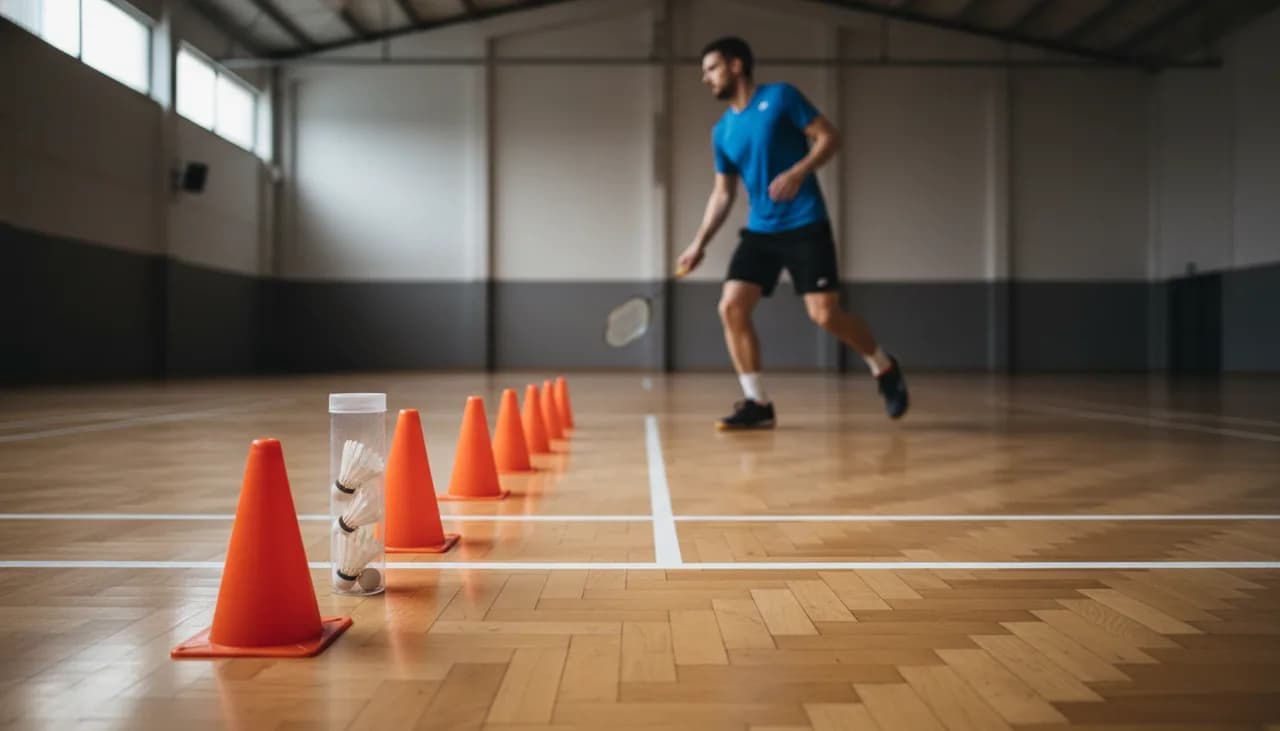
Badminton Injury: Preventing Sprains, Tendinitis, and Knee Issues
Badminton injuries mainly affect the ankle, shoulder, and knee. Here's how to prevent them and react quickly when they happen.
Badminton injuries mainly affect three areas: the ankle, shoulder, and knee. Badminton is often seen as a non-contact sport, and therefore harmless. This is false. Repeated lunges, explosive changes of direction, and thousands of overhead shots put your joints under severe strain. The good news: the vast majority of these issues are preventable with a few simple habits.
Key takeaways
- The three most common badminton injuries are ankle sprains, shoulder tendinitis, and patellofemoral pain syndrome (knee).
- The number one cause is almost never bad luck: it's a rushed warm-up, unsuitable shoes, or muscle imbalance.
- Prevention relies on three pillars: preparing the body, strengthening fragile areas, and taking care of your equipment.
- In case of acute injury, the RICE protocol (Rest, Ice, Compression, Elevation) limits damage in the first 48 hours.
The most common badminton injuries
Badminton combines movements that few other sports link together: deep forward lunges, jump smashes, sudden stops, and very fast shoulder rotations. Each rally requires you to accelerate, stop abruptly, then move in another direction. It is precisely these changes in rhythm that cause most injuries.
Three joints bear the brunt of the load. The ankle absorbs footwork and braking. The shoulder suffers from the repetition of overhead shots (clears, smashes). The knee absorbs lunges and jump landings. Together, these areas account for the majority of game stoppages among amateur players and competitors alike.
We must distinguish between two types. Traumatic injury occurs during a specific action: you twist your ankle, you feel a jolt in your shoulder. Overuse injury, on the other hand, develops slowly due to repetitions and insufficient recovery: this is the typical case of tendinitis. Beginners tend to get injured due to poorly controlled footwork and lack of core strength; competitors, due to training volume and accumulated fatigue.
An important point: most of these injuries are not isolated accidents. They are overuse injuries or due to poor preparation. You can therefore act on them proactively, unlike an unpredictable impact. This is the whole point of knowing the risk areas: you know where to focus your attention before pain appears.
Ankle sprain: the #1 badminton injury
Ankle sprain is by far the most common badminton injury. It most often occurs upon landing from a jump or during a stop with poorly placed footwork, when the foot twists inward. An sprain corresponds to a stretch or tear of the ligaments that stabilize the joint.
Risk factors are well-known: worn shoes or shoes not suitable for indoor sports, a slippery floor, an ankle already weakened by a previous sprain, and especially insufficient warm-up. A cold ankle has poorer proprioception, meaning a reduced ability to correct a slipping foot.
To prevent it, start with your equipment. Real badminton (or indoor) shoes offer a rubber sole that grips the court and lateral support you'll never get with running shoes. Then work on the quality of your footwork: good footwork reduces unbalanced positions. Our guide on badminton movement details the footwork patterns that keep you stable. Finally, incorporate proprioception exercises (balancing on one foot, working on an unstable cushion) into your routine: they strengthen the ankle's stabilization reflexes.
If you've already had a sprain, wearing an ankle brace during recovery and specific strengthening are highly recommended: an already twisted ankle easily re-injures itself until it is fully rehabilitated.
Shoulder tendinitis in badminton
The shoulder is the second major victim. The smash and clear movements reproduce a very demanding high arm swing for the rotator cuff, the group of muscles that stabilize the head of the humerus. Repeated hundreds of times per session, this movement can trigger tendinitis: a painful inflammation of the tendon.
The typical warning sign is pain on the top or front of the shoulder, which first appears during exertion then settles even at rest. Many players let it linger by playing despite the discomfort. This is the mistake not to make: ignored tendinitis worsens and can keep you off the courts for several weeks.
Prevention involves muscle balance. Hitting the shuttlecock heavily stresses the front muscles; therefore, the muscles at the back of the shoulder and shoulder blades must be strengthened to compensate. A specific shoulder warm-up before playing is non-negotiable: a few progressive rotations and shots of increasing intensity prepare the tendon. Our badminton warm-up routine includes this joint preparation.
Also monitor your technique. A poorly executed smash, where you compensate for a lack of core strength with raw shoulder effort, multiplies the strain on the tendon. Filming and analyzing your technique helps identify these flaws: this is exactly what BadmintonPeak's video analysis features allow.
Knee and patellofemoral pain syndrome: the competitor's badminton injury
The knee is the third risk area, and it is often the badminton injury of the player who trains a lot. Patellofemoral pain syndrome (pain at the front of the knee, under or around the kneecap) comes from the repetition of lunges and squats under load. The patellar tendon and cartilage absorb impact with each forward lunge and jump landing.
The pain is insidious: it first appears when going down stairs or after a long session, then during play. It often indicates an imbalance between the quadriceps and hamstrings, or a lack of ankle and hip mobility that shifts the strain to the knee.
To prevent it, strengthening the quadriceps and glutes is central: a knee stabilized by strong muscles better absorbs lunges. Also work on the flexibility of the posterior chains. Good general physical condition changes everything here: an enduring and strong core maintains better posture at the end of a match, when fatigue degrades footwork and increases strain on the joint.
Finally, pay attention to training volume. Suddenly increasing the number of sessions is a classic cause of knee pain: the load must progress gradually to allow the tendons to adapt.
Preventing badminton injuries: warm-up, strengthening, equipment
Badminton injury prevention relies on three complementary pillars. None are sufficient alone, but together they eliminate the vast majority of preventable issues.
First pillar, warm-up. Never start playing cold. Five to ten minutes of progressive warm-up (light jogging, joint mobilizations, a few lunges, shots of increasing intensity) raise muscle temperature and awaken proprioception. It is the most cost-effective prevention measure, and the most often neglected.
Second pillar, strengthening. A balanced body gets injured less. Ankle (proprioception), shoulder (posterior muscles and rotator cuff), knee, and core (quadriceps, glutes, core strength) deserve regular work, even light, twice a week. You don't need a gym: bodyweight is enough to start.
Third pillar, equipment and recovery. Indoor shoes in good condition, a racket with a non-slip grip, a string adapted to your level so you don't strain your arm, and especially rest between intense sessions. Recovery is not wasted time: it's when the body rebuilds and strengthens itself.
One last often forgotten lever: technique. Many overuse injuries come from a movement that compensates for a flaw. The better you move, the less you force unnecessarily. Analyzing your own technique is also a form of prevention.
What to do in case of acute injury
Despite everything, an injury can happen. The first 48 hours are crucial. The reflex to know is the RICE protocol: Rest, Ice, Compression, Elevation.
Stop playing immediately, it's non-negotiable: continuing on a painful ankle or knee worsens the injury. Apply ice (wrapped in a cloth, never directly on the skin) in cycles of fifteen to twenty minutes to limit swelling and pain. Elevate the affected limb to reduce edema, and compress moderately with a bandage if you have one.
Avoid heat, alcohol, and vigorous massage in the first few days: they promote inflammation. Do not resume until pain and swelling have significantly subsided, and resume gradually.
When to consult? Intense pain, a joint that can no longer bear body weight, significant swelling, or pain that persists beyond a few days require the advice of a doctor or sports physiotherapist. An early diagnosis is better than a poorly treated injury that becomes chronic.
Frequently asked questions
What is the most common badminton injury?
Ankle sprain is the most common badminton injury. It mainly occurs upon landing from a jump or during a stop with poorly placed footwork. Adapted indoor shoes and good footwork significantly reduce the risk.
Is badminton dangerous for the knees?
Badminton puts a lot of strain on the knees through lunges and jumps, but it is not inherently dangerous. The risk mainly comes from too rapid an increase in training volume and a lack of muscle strengthening. Strong quadriceps and gradual progression protect the joint.
Should you warm up before playing badminton?
Yes, systematically. A five to ten-minute warm-up prepares muscles, tendons, and balance reflexes. It is the most effective prevention measure against sprains and tendinitis, and it costs almost nothing.
How to avoid shoulder tendinitis in badminton?
Strengthen the muscles at the back of the shoulder and shoulder blades to compensate for the intense work of hitting, warm up your shoulder before playing, and refine your smash technique. At the slightest sign of persistent pain, ease off before tendinitis sets in.
How long to rest after an ankle sprain?
It depends on the severity. A minor sprain often requires one to two weeks before a cautious return; a more severe sprain may require several weeks and rehabilitation. Only resume when pain and swelling have disappeared, and wear an ankle brace during the first sessions.
A large part of overuse injuries comes from a movement that compensates for a technical flaw. If you want to see what your smash or footwork truly hides, upload a 30-second video to BadmintonPeak and receive a detailed analysis of your technique. Don't have an account yet? Create one for free and start with the first free step.