
Elbow Pain in Badminton: Epicondylitis, Causes, and Return to Play
Elbow pain in badminton rarely comes from the elbow itself. Here's how to recognize epicondylitis, what triggers it, and how to return to play without relapse.
Elbow pain in badminton almost always sets in the same way: a diffuse discomfort after the session, which disappears with sleep, then returns earlier each week, until the day when turning a doorknob hurts. At this stage, the structure is already irritated for a long time, and recovery will be longer than the injury itself.
Key takeaways
- Elbow pain in badminton most often affects the outer side, at the lateral epicondyle.
- It rarely comes from a single movement, but from a repetition of micro-stresses on the wrist extensor tendons.
- A grip that is too thin, strings that are too tight, and a tense grip are the three most common material factors.
- Rest alone is not enough: an untrained tendon becomes painful again as soon as play resumes.
- Cold pain, upon waking or outside of sports, requires medical advice before any return to play.
Elbow pain in badminton: where it is located and what it means
The elbow is not a joint that produces force in badminton. It transmits. Power comes from the legs, trunk, and shoulder, it travels through the arm and ends in a forearm rotation and a wrist snap. The elbow undergoes this passage without generating it.
When pain appears, in the vast majority of cases, it is located on the outer side, at the bony point you feel when bending your arm. This is the lateral epicondyle, the insertion point of the muscles that extend the wrist and fingers. The irritation of these insertions is called lateral epicondylitis, popularized under the misleading name of tennis elbow.
Pain on the inner side, near the little finger, corresponds to another condition, epitrochleitis. It is rarer in badminton and more often linked to very closed smash movements or poorly aligned backhand shots.
The sign that distinguishes simple fatigue from an established tendinopathy is simple. Muscle fatigue is diffuse, subsides in two days, and does not exist outside of sports. Tendinopathy is localized, awakens upon palpation of a specific point, and hinders ordinary movements like pouring a bottle or turning a key.
What really triggers the pain
Three families of causes almost always combine.
Tension. A player who constantly grips their racket keeps the extensors under tension throughout the session. The correct movement alternates relaxation and a brief squeeze at impact. A permanent full-force grip multiplies the load on the insertions without adding anything to the shot.
Sudden volume. The tendon adapts slowly, much more slowly than the muscle. Going from two to four sessions per week, or doing a three-day training camp after a month off, exceeds the adaptation capacity. The September return to play is by far the period that causes the most painful elbows.
Backhand technique. A backhand hit with a straight arm, without forearm rotation, transfers most of the shock to the extensors. This is the movement that most often triggers the first pain. Our article on backhand in badminton details the rotation mechanism that protects the elbow.
To these three causes is added an often-neglected factor: general fatigue. A tired player compensates with their arm for what they no longer do with their legs. The elbow pays for the lack of movement.
Elbow pain and equipment: grip and stringing
Equipment is never the sole cause, but it determines the margin your elbow has.
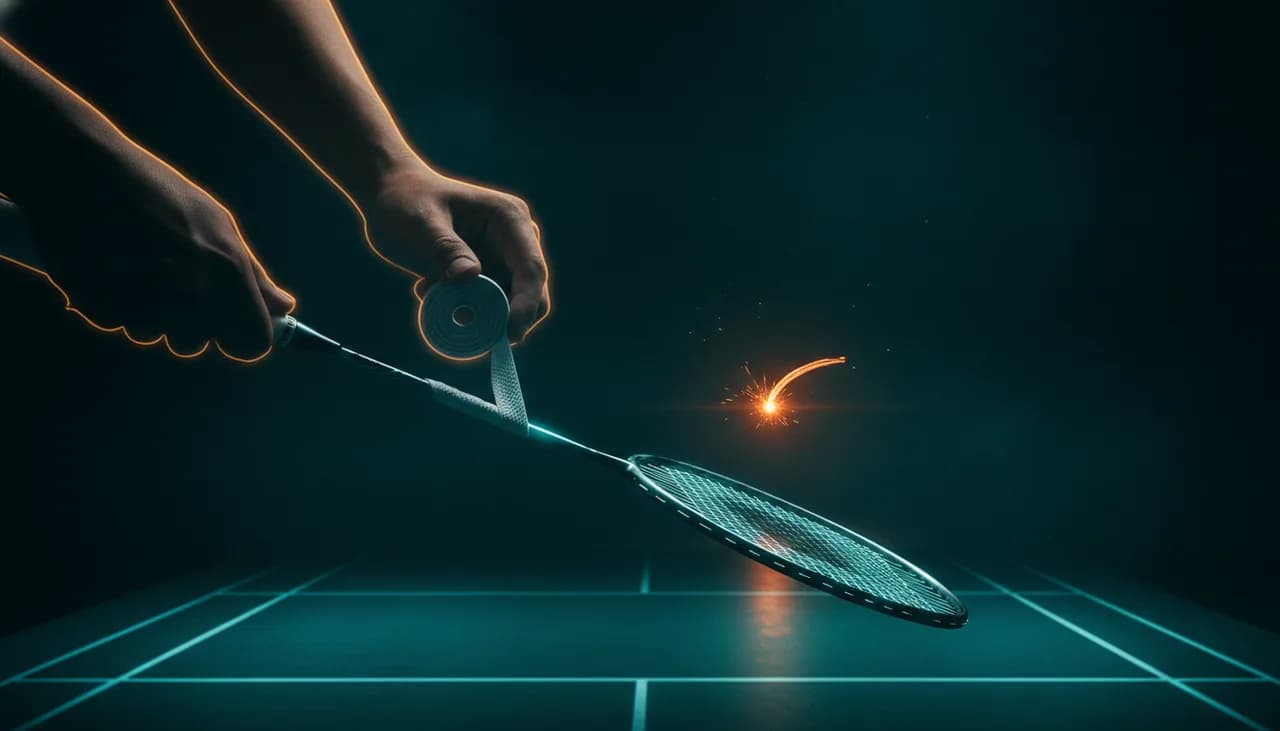
Grip diameter. A grip that is too thin forces you to grip harder to hold the racket, which increases the permanent tension on the extensors. Many club players use a thinner handle than what would suit them, out of habit or because the racket came that way. Adding an overgrip, or switching to a thicker replacement grip, immediately reduces the strain. The complete method is in our guide to racket grip.
String tension. Tighter strings deform less and therefore transmit more vibrations to the arm. For a club player, dropping two kilos often resolves initial discomfort without costing anything in real performance. The relationship between tension, feel, and comfort is discussed in our article on racket stringing.
Racket balance. A head-heavy racket increases the torque to absorb with each shot. A player with a sensitive elbow benefits from switching to a more neutral balance, even if it means losing a little raw power. Balance profiles are explained in the guide to choosing your racket.
A common-sense remark: changing all three parameters at the same time does not allow you to know which one worked. Modify one element, play three sessions, observe.
Elbow pain in badminton: what to do as soon as it appears
The reflex to continue by gritting your teeth is what turns a two-week discomfort into a six-month problem.
Reduce without stopping. Complete cessation is rarely the right answer. A tendon that is no longer stressed loses its load capacity and becomes painful again as soon as play resumes. The right approach is to reduce volume and intensity, first eliminating what hurts: smashes, powerful backhands, fast mid-court play.
Keep the lower body active. Footwork, core strengthening, and leg work can continue normally. This is even the best time to catch up, as the lack of movement is one of the causes. Our core strengthening and conditioning program works without stressing the elbow.
Cold after, not before. Applying cold for fifteen minutes after the session calms the inflammatory reaction. Doing it before playing masks the pain and allows you to exceed the limit without realizing it.
Eccentric strengthening. This is the tool with the best documented effectiveness for epicondyle tendinopathies. The principle is to load the tendon during the lengthening phase, slowly, with a light load. A physiotherapist can build this protocol in one consultation.
When to consult, and what to say
Three signals require immediate medical advice: pain present at rest or at night, objective loss of strength with objects slipping, pain that persists for more than three weeks despite reduced load.
What really helps the practitioner are precise facts. Exactly since when. On which movements. How many sessions per week before onset. What change in equipment or rhythm preceded it. A player who arrives with “my elbow has been hurting for some time” leaves with anti-inflammatories. A player who arrives with “external pain appeared three weeks after going from two to four sessions, present only on backhands” leaves with a plan.
The word epicondylitis also covers several realities, from simple insertion irritation to deeper lesions. Only a clinical examination can decide, and imaging is not systematically useful. The Haute Autorité de santé also reminds us that imaging is not required as a first-line treatment for uncomplicated tendinopathy.
Resuming without relapse
Relapse is the rule rather than the exception, because the disappearance of pain largely precedes tendon healing.
The principle of resuming play involves three steps. First, resume slow exchanges at the back of the court, without smashing or powerful backhands, in short sessions. Then reintroduce intensity, keeping the volume low. Finally, increase the volume, once the intensity is tolerated.
A useful benchmark: discomfort during warm-up that disappears while playing is acceptable at the beginning of recovery. Pain that increases during the session, or that returns stronger the next day, means that the step was too high.
This gradual approach also applies to any return to play after a break, injury or not. The principles are detailed in our article on resuming badminton, and other frequent locations in our guide to injury prevention.
Frequently Asked Questions
Can you continue to play with elbow pain?
Often yes, provided you reduce the volume and eliminate painful movements. Complete cessation weakens the tendon and makes recovery more difficult. However, pain present at rest or at night requires a stop and medical advice.
How long does epicondylitis last in badminton?
A few weeks if caught early and the load is adapted. Several months if the player continued without changing anything. The duration depends much more on the early management than on the initial intensity of the pain.
Does an elbow brace help?
A compression band placed below the elbow can relieve pain by changing the support point of the tendons. It is mechanical relief, not a treatment. It does not exempt you from strengthening or correcting what caused the pain.
Should you change your racket when you have elbow pain?
Not first. Start by thickening the grip and lowering the string tension, two reversible and inexpensive actions. A change of racket to a more neutral balance can then be discussed if the discomfort persists despite these adjustments.
Does elbow pain always come from the backhand?
No, but the backhand hit with a straight arm and without forearm rotation is the most frequent trigger for club players. Very closed smashes and permanent tension on the handle produce the same type of stress.
Epicondyle pain almost always tells a story about a movement. Film two minutes of your backhands and smashes, send the video to BadmintonPeak, and see what your forearm is actually doing at impact.