
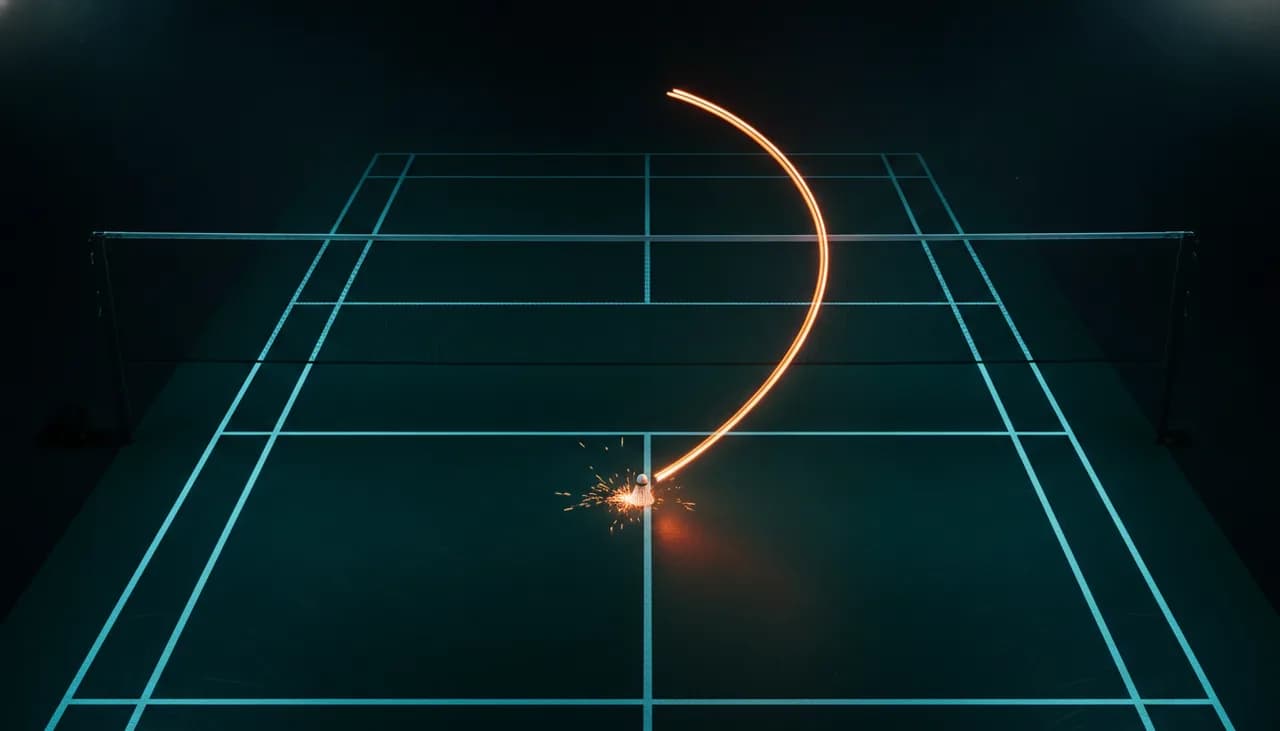
Badminton Smash Speed: World Records and How to Measure Yours
Badminton Smash Speed: World Record Reaches 565 km/h. Why the Shuttlecock Decelerates So Quickly, What Creates Speed, and How to Measure Your Own.
Badminton smash speed surpasses that of any other racket shot: the official world record climbs to 565 km/h, measured at the exact moment of impact. The figure is impressive, but it hides a nuance that most players ignore—a shuttlecock leaving at 565 km/h never arrives at that speed on the other side of the net, far from it.
And above all, speed isn't gained by lifting weights. It comes from precise mechanics that you can work on, film, and, today, measure from a simple video.
The Essentials
- World record under test conditions: 565 km/h (Satwiksairaj Rankireddy, 2023). Official competition record: 426 km/h (Mads Pieler Kolding, 2017). Two very distinct categories.
- These speeds are measured at impact. The shuttlecock decelerates faster than any other sports projectile: it arrives on the opponent's side at a fraction of its initial speed.
- Speed comes from the kinetic chain and forearm pronation, not brute force. A light player can smash faster than a poorly coordinated giant.
- Pure speed alone doesn't win the point: angle, placement, and variation matter just as much.
- You can measure your smash speed from a video. The BadmintonPeak Smash Challenge does it for free.
World Records for Badminton Smash Speed
The world record for the fastest hit by a man belongs to India's Satwiksairaj Rankireddy, with a smash measured at 565 km/h on April 14, 2023, at the Yonex factory in Soka, Japan. The measurement was taken by an ultra-high-speed camera capable of 40,000 frames per second, which captures the shuttlecock's speed just after contact with the string bed. This record broke that of Malaysia's Tan Boon Heong, 493 km/h in 2013. On the same day, Malaysia's Pearly Tan became the first female record holder, at 438 km/h.
Beware of the trap: these figures are achieved under test conditions, not in a match. A dedicated setup, the best racket, optimized stringing, a single objective—to hit as hard as possible without worrying about placing the shuttlecock within the court. It's a laboratory exercise, not a game point.
In competition, the story is different. The official record for the fastest hit in a match goes to Denmark's Mads Pieler Kolding, at 426 km/h in 2017 during a tournament in India. He surpassed Lee Chong Wei's 408 km/h set in 2015 in Hong Kong. The difference from the 565 km/h test record shows how much constraining a smash to stay within court limits, under pressure, costs in pure speed.
To put these values in perspective: the highest top speed ever recorded for a Formula 1 car is around 397 km/h, and the fastest tennis serve peaks at 263 km/h. The badminton shuttlecock is indeed the fastest projectile of all racket sports. You can verify these records on the Guinness World Records website.
Why the Shuttlecock Loses Speed So Quickly
While the shuttlecock is the fastest projectile at impact, it is also the one that slows down the fastest in the world. The reason lies in its shape. Its conical skirt, made of feathers or plastic, creates enormous aerodynamic drag—incomparable to a tennis or golf ball. This drag slows the shuttlecock as soon as it leaves the string bed, and the braking increases with speed.
Direct consequence: a smash launched at over 400 km/h at impact loses a massive amount of its speed in a fraction of a second. The shuttlecock arrives on the opponent's side at a much lower speed—often less than half its initial value, sometimes much less on a smash from the back of the court. This is exactly why records are measured at the moment of contact: it's the only moment the figure reaches its maximum.
Therefore, two things that everyone confuses must be distinguished. The initial speed, measured at impact, is that of the records. The perceived speed, the one that truly matters in the rally, is the speed of the shuttlecock when it reaches your opponent. It is much lower—but since the distance to cover is short, it still leaves very little reaction time.
This physics has an important practical implication. Trying to hit as hard as possible is useless if the shuttlecock decelerates before becoming dangerous. What makes a smash unplayable is the combination of speed over the first few meters and the downward angle. The braking skirt also stabilizes the shuttlecock: it always reorients with the cork forward, which makes its trajectory readable but its braking abrupt.
What Really Makes a Smash Fast
The speed of a smash doesn't come from the biceps. It comes from a kinetic chain: a sequence where each body segment transfers its energy to the next, from the ground to the wrist. The order is rigid—legs, pelvis, torso, shoulder, elbow, forearm, wrist. If a link arrives too early or is missing, energy no longer accumulates; it dissipates. This is the principle of a whip: the handle moves slowly, the tip cracks very quickly.
This explains why a light, well-coordinated player smashes harder than a giant who hits “with just the arm.” The tall player who only uses their shoulder recruits only one segment. The smaller player who links their entire body multiplies speed at each joint. The most impressive hitters on the circuit, like Viktor Axelsen, don't hit harder muscularly than others: they synchronize better.
The true final accelerator is forearm pronation—this rotation that moves the palm from “skyward” to “groundward” just before impact. It's neither an isolated wrist flick nor a push of the arm. Without pronation, you push the shuttlecock instead of whipping it, and you lose most of your potential speed.
Three concrete consequences. First, timing takes precedence over force: the hit must follow the torso rotation, never precede it. Second, the grip remains loose until the last moment—a tense hand blocks pronation. Finally, speed is built over months of coordination, not with equipment purchases. For segment-by-segment details, our complete guide to smash technique dissects each phase, and the article on hitting technique lays the common foundations for all overhead shots.
Pure Speed or Precision: What Wins the Point
A record smash doesn't win a match. In a real situation, a perfectly placed 250 km/h smash almost always beats a 350 km/h smash sent to the center of the body, where the opponent returns it without moving. Speed is only one of three levers of attack, along with angle and placement.
The downward angle is often more decisive than kilometers per hour. A very fast but flat smash is easily blocked by a simple counter; a slightly less powerful smash that dips towards the feet forces a defensive lift, and that's where you follow up. Working on this angle is more valuable for most players than gaining 10 km/h. The course on the downward angle smash specifically targets this parameter.
Placement does the rest. Aiming for a line, a dead angle, or the body at the right moment disorganizes the opponent more surely than raw speed. The best attackers don't always hit at full power: they vary. A full-power smash, then a slower brushed smash, then a drop shot—it's the change of pace that breaks the defense, not the speed meter. This game of variation aligns with that of feint and deception.
At the club level, seeking maximum speed with every shot is costly: loss of control, unforced errors, accelerated fatigue. A smash you control at 80% of your power, well-placed and repeatable throughout a match, scores more points than a record smash that goes into the net one out of three times. Speed is an asset, not an objective in itself.
How to Measure Your Smash Speed
Records were measured with ultra-high-speed cameras at 40,000 frames per second and laboratory radars. Nothing accessible in a sports hall. Speed radars exist, but they are expensive, rare in clubs, and require precise placement and calibration to give a reliable figure. In practice, almost all players have no simple way to know how fast they smash.
The truly accessible method is video analysis. From a video of your smash, one can estimate the shuttlecock's speed by tracking its movement frame by frame: we know the court dimensions, we know the camera's frames per second, all that remains is to measure the distance traveled between two frames. Done manually, it's tedious and imprecise. Automated, it becomes a very concrete tracking tool.
This is exactly what the BadmintonPeak Smash Challenge does. You film your smash, send the video, and the analysis estimates your shuttlecock's speed, then positions you relative to other participants. It's free and open until August 31, 2026. It's the simplest way to put a number on your hit and track your progress.
An honest clarification: an estimate from a smartphone video is not a laboratory measurement. A phone's frame rate (often 30 or 60 frames per second) limits precision at extreme speeds—a very fast shuttlecock isn't perfectly sampled at 30 frames per second. The result is therefore not a certified figure accurate to the unit, but a solid and comparable estimate, ideal for ranking yourself and measuring your progress month to month. Join the Smash Challenge to find out your smash speed.
How to Gain Speed on Your Smash
Now that you know where speed comes from, here's where to focus your efforts—in order of impact. Equipment comes last, contrary to what most players believe.
First, the kinetic chain. Work on the legs-pelvis-torso-arm sequence rather than arm muscle building. A pushing back foot, a rotating pelvis, a projecting shoulder: this is where racket head speed is created. Forearm pronation is repeated empty-handed, palm up then down, until it's automated before integrating it into the full stroke.
Next, the grip and contact point. A loose grip frees pronation; a tense hand blocks it completely. Our article on racket grip and holds details the universal grip and release at impact. For contact, aim to hit high and in front: a shuttlecock hit too low or overhead goes flat and loses its angle.
Equipment plays a marginal role. A slightly head-heavy racket favors hitting speed, and string tension influences restitution: tighter for control and precision for experienced players, looser for a catapult effect for beginners. The article on stringing and tension explains how to choose correctly. But no stringing will compensate for a broken kinetic chain.
Finally, film yourself and measure. This is the loop that accelerates everything else: without objective feedback, you correct blindly. A profile video reveals your flaws in preparation, contact, and pronation in thirty seconds. Combine it with a speed measurement, and you'll know exactly if your work is paying off.
Frequently Asked Questions
What is the speed of a badminton smash
It depends enormously on the level. For a good club player, a well-executed smash is around 200 to 260 km/h at impact. For male pros, match speed is most often between 300 and 400 km/h. The record under test conditions reaches 565 km/h. These values are all measured at the moment of contact, before the shuttlecock decelerates.
What is the world record for badminton smash speed
The official record for the fastest hit by a man is 565 km/h, set by Satwiksairaj Rankireddy in 2023 under test conditions. For women, it is 438 km/h (Pearly Tan, 2023). In official competition, the men's record is 426 km/h (Mads Pieler Kolding, 2017). Test and competition records are two distinct categories.
Why doesn't the shuttlecock go 565 km/h across the net
Because the shuttlecock decelerates faster than any other sports projectile. Its conical skirt creates enormous aerodynamic drag that slows it down as soon as it leaves the string bed. A smash measured at over 400 km/h at impact arrives on the opponent's side at a fraction of that speed. The record figure corresponds to the initial speed, not the arrival speed.
Can you measure your smash speed with a phone
Yes, through video analysis. From a video of your smash, a tool can estimate the shuttlecock's speed by tracking its movement frame by frame, based on the known court dimensions. The BadmintonPeak Smash Challenge performs this calculation for free. Precision remains limited by the phone's frame rate, but the result is reliable for positioning yourself and tracking your progress.
How to increase your smash speed quickly
There are no equipment shortcuts. Speed comes from the kinetic chain and forearm pronation, which are built over several months of technical work. Focus on the legs-pelvis-torso-arm sequence, a loose grip, a high and front contact point, and film yourself regularly to check your corrections. Arm strengthening alone provides almost nothing.
A smash's speed isn't guessed by feel; it's measured. The BadmintonPeak Smash Challenge estimates your smash speed from a simple video, for free, until August 31, 2026. And if you want to understand why your smash is plateauing, analyze a video of your game on BadmintonPeak: you get detailed feedback on your kinetic chain, contact point, and pronation, rep by rep.