
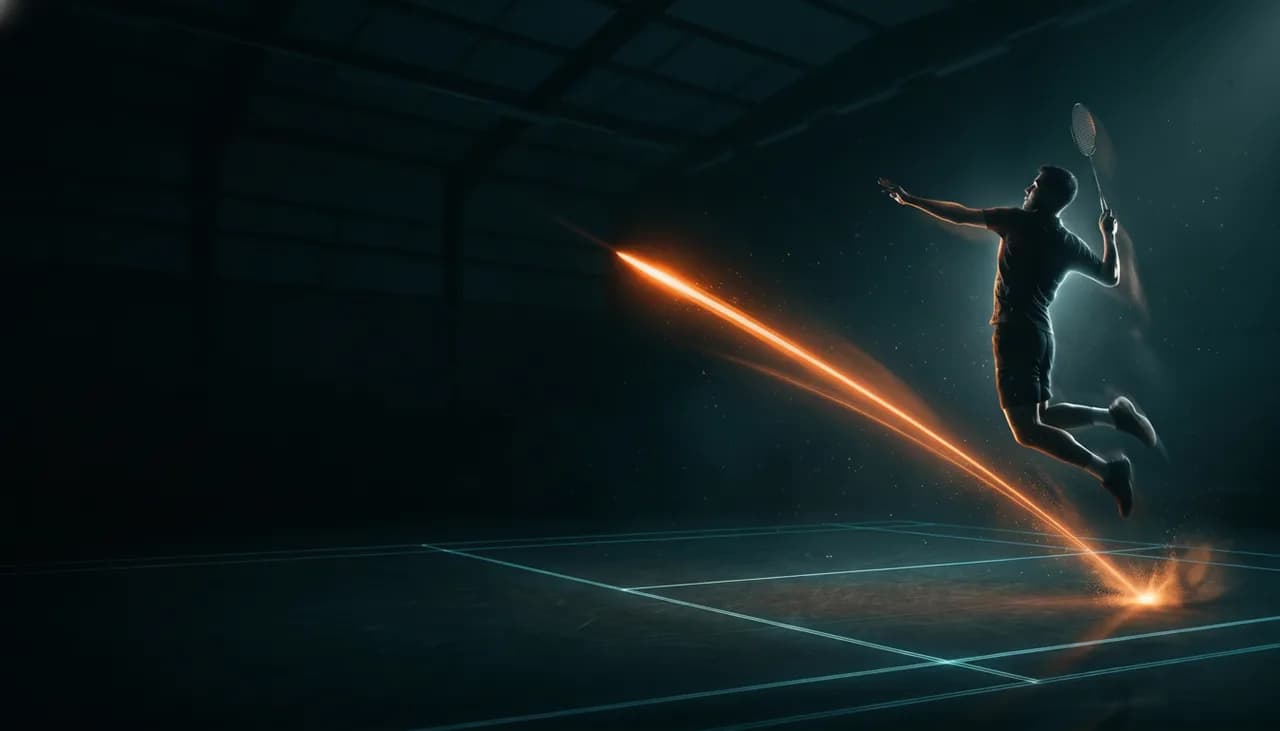
Smash Challenge 2026: Measure Your Smash Speed and Climb the Summer Leaderboard
The Smash Challenge is open all summer: film your smash, the AI measures its speed in km/h and analyzes your technique, and you rank against other players. Free, until August 31st.
You've probably estimated the speed of your smash by feel—"it went hard"—without ever being able to put a number on it. The Smash Challenge solves this: you film your smash, BadmintonPeak's AI measures its speed in km/h, analyzes your technique, and registers you on the summer leaderboard. It's free, open to all levels, and runs until August 31, 2026, on the challenge page.
The Essentials
- The Principle: Film a series of smashes; the AI measures shuttlecock speed and evaluates your technique.
- What You Receive: Your speed in km/h, a title based on your performance, and a technical analysis of your smash—what makes you gain or lose km/h.
- The Leaderboard: A summer leaderboard where each new attempt can improve your record.
- Free, no special equipment: a phone, a shuttlecock, a court.
- Until August 31, 2026—and your record is kept; a new attempt can only improve it.
What Exactly is the Smash Challenge?
It's a community challenge open to all players, from recreational to competitive. You sign up with one click from the challenge page, film your attempt following the framing instructions, and send it. A few minutes later, you receive two things: your speed in km/h—the number everyone wants to know—and an analysis of your technique that tells you precisely where your smash gains and loses power.
Each player keeps their best attempt on the leaderboard. You can re-attempt regularly (measured attempts are capped per 24 hours, so the challenge is about technique, not volume): correct one point of your technique, re-film, and watch the number go up.
To give you some context: among professionals, the fastest smashes exceed 400 km/h initial shuttlecock speed—the competition record officially recognized by Guinness World Records is 426 km/h, set by Mads Pieler Kolding in 2017. Don't worry: on the Smash Challenge leaderboard, we're playing among normal humans.
How the AI Measures Your Smash Speed
No radar, no sensor on the racket: just your video. BadmintonPeak's analysis engine tracks the shuttlecock frame by frame in your sequence, reconstructs its trajectory to the scale of the court, and deduces the speed at the start of the hit. In parallel, the AI observes your technique like a coach would: arm preparation, torso rotation, contact point, weight transfer—the fundamentals detailed in our complete smash guide.
It's this dual feedback that makes the challenge interesting beyond just the number: two players at 180 km/h almost never have the same areas for improvement. One loses speed due to a contact point that's too low, the other due to incomplete rotation. The analysis tells you which one you are.
A framing tip that changes everything: place your phone stably (tripod or bench), in landscape mode, with the entire court visible. The clearer the shuttlecock's trajectory, the more reliable the measurement.
Participate in Three Steps
- Join the challenge on badmintonpeak.com/fr/defi/defi-smash-2026—registration is free and immediate.
- Film your attempt: a series of smashes following the displayed instructions (framing, distance, number of hits). Ideally, a partner serves you high shuttlecocks—and a proper warm-up before hitting hard.
- Send and discover your result: your speed, your title, your technique analysis, and your rank on the leaderboard.
The easiest way to film at the gym: the BadmintonPeak mobile app, available on the App Store and Google Play. You film, you send, and the notification arrives while you're putting away the shuttlecocks.
Five Levers to Gain km/h Before the End of Summer
The Smash Challenge lasts until August 31: plenty of time to work on your technique between attempts. The levers that pay off fastest:
- Hit at the highest point. Every centimeter gained on the contact point opens the angle and releases speed. This is the number one flaw of smashes that "push" instead of snapping—review the basic hitting technique if your contact is in front of your shoulder.
- Speed comes from the ground up. Footwork, hip rotation, then torso, then arm: a fast smash is a chain, not just a wrist flick. If your legs arrive late under the shuttlecock, work on your movement to the back of the court.
- Relax your arm between hits. A tense arm is a slow arm. The final forearm pronation—the "whip"—requires a relaxed grip until the last moment.
- Save energy for the attempt. Speed drops quickly with fatigue: place your attempt at the beginning of your session, after warming up, not after an hour of matches. Physical preparation gains km/h at the end of a series.
- Read your analysis before re-attempting. Each attempt gives you a technique diagnosis: correct ONE point, not five, and re-film. It's the short loop—measure, correct, re-measure—that makes the record climb.
The Summer Leaderboard
The leaderboard is public on the challenge page: your best speed, your title, your rank. Each attempt can improve your record—never degrade it—and the ranking moves all summer with new measurements. If someone overtakes you, you'll know: it's up to you to reclaim your spot before August 31.
You can also directly challenge a club partner: send them your result, and they'll want to do better—that's the idea. The smash is the most spectacular shot in badminton; it's even better when there's a number to beat.
FAQ
Is the Smash Challenge really free?▾
Yes. Registration and challenge attempts are free, including with a STARTER account. You just need a BadmintonPeak account (free, no credit card required).
What equipment is needed to participate?▾
A phone that films, a court, a racket, and shuttlecocks. A tripod helps for stable framing, but a bench or bag will do. No radar or sensor: measurement is done entirely by video analysis.
How many attempts can I make?▾
You can re-attempt all summer—with a cap on measured attempts per 24 hours to keep the challenge fair. Only your BEST attempt counts for the ranking: no attempt can lower your record.
Is the speed measurement reliable?▾
The measurement tracks the shuttlecock frame by frame and reconstructs its speed to the scale of the court. Its accuracy depends on the quality of your video: stable framing, entire court visible, legible shuttlecock. Each measurement is accompanied by a confidence index—only reliable measurements enter the ranking.
What happens after August 31?▾
The summer leaderboard is frozen, and results remain viewable in your space. Your technique analysis, however, remains useful long after the challenge: it's a basis for work for the season.