
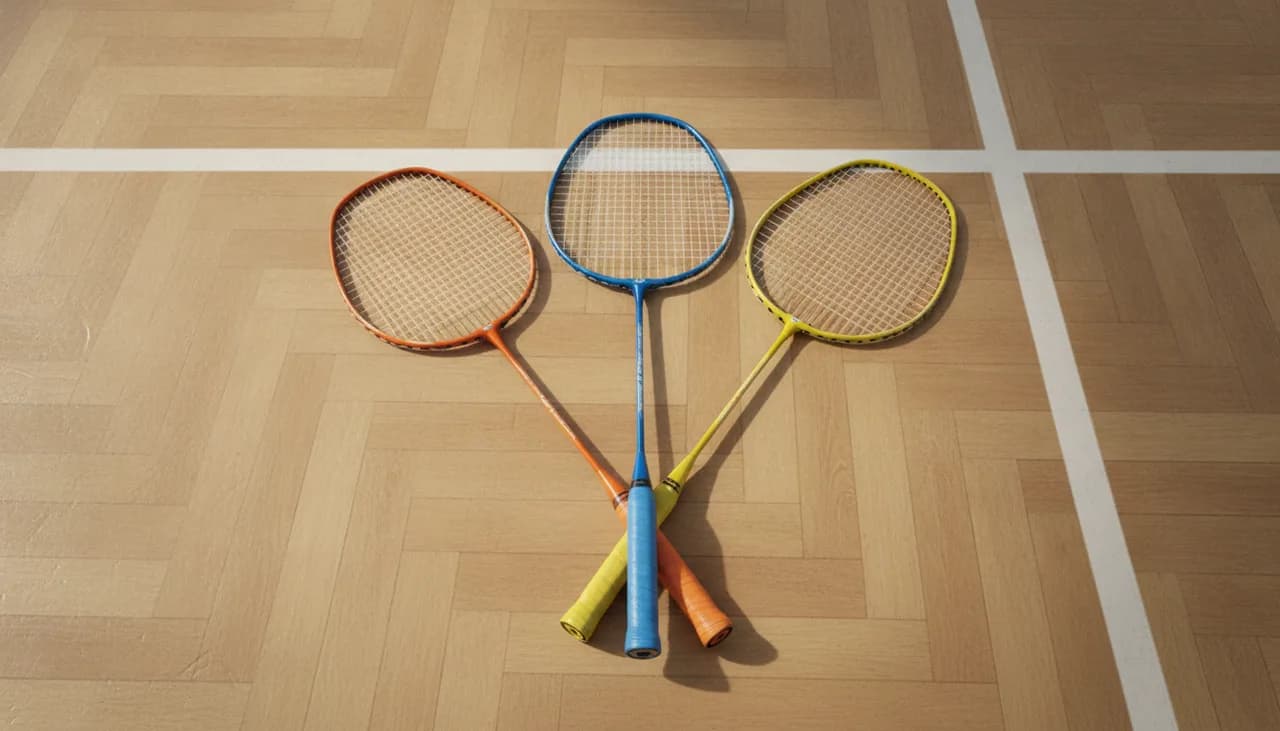
Yonex or Babolat Badminton Racket: The Comparison
Choosing a Yonex or Babolat badminton racket mostly depends on your game. Here's a clear decision framework based on your profile, level, and weaknesses.
Choosing a Yonex or Babolat badminton racket is probably the most common dilemma when upgrading from recreational gear to a proper game racket. Both brands dominate the shelves, you hear all sorts of conflicting advice, and you often end up buying based on gut feeling. The problem is that there’s no such thing as the “best racket” in absolute terms: what exists is the racket that suits your game, your level, and the precise areas where you’re losing points. This article provides a concrete decision-making framework, based on the technical criteria that truly matter, to help you choose between Yonex and Babolat without making a mistake.
Key Takeaways
- The brand matters less than the racket/player match: a poorly chosen Yonex is worse than a Babolat suited to your game.
- Yonex offers a very wide catalog (Astrox, Nanoflare, Arcsaber series) to fine-tune according to your profile; Babolat offers a more restricted choice but is often more accessible in France.
- The real decision criteria: balance (head-heavy / head-light / even balance), weight, shaft flexibility, grip size, and string tension.
- First, diagnose your profile: if you lose at the net, aim for a head-light racket; if you lack power, a head-heavy one; if you’re a beginner, a neutral balance with a flexible shaft.
- A racket doesn't correct technique: analyze your actual game before investing; this is what prevents regretted purchases.
Yonex vs Babolat: Two Racket Philosophies
Yonex is the ultra-dominant equipment manufacturer in global badminton. The majority of professional circuit players use a racket from the brand, and you see this influence in international competitions followed by the BWF. This dominance has a very concrete consequence for you: Yonex segments its catalog into series designed for different playing styles. The Astrox is power-oriented, with a head-heavy balance to support smashing. The Nanoflare aims for speed and fast play, with a lighter head for defense and net play. The Arcsaber focuses on versatility, with an even balance that works well when seeking a compromise. You therefore have a clear framework to guide you towards a family of rackets even before comparing models.
Babolat is another story. The brand is French, historically a tennis specialist, and present in badminton with its Satelite range. The catalog is more restricted than Yonex’s, but that’s not a flaw in itself. Babolat is often more accessible in France, especially in mass retail like Decathlon, and offers solid models for getting into the sport without breaking your budget.
The honest conclusion is that no brand is “better” in absolute terms. Yonex gives you more finesse to adjust your racket to a precise style; Babolat gives you a reliable and often cheaper entry point. The real decision-making work comes down to technical criteria, not the logo.
Technical Criteria of a Badminton Racket
Before comparing two brands, you need to know how to read a racket. Five criteria structure almost every choice.
Balance is the most determining factor. A head-heavy racket concentrates mass towards the head: you gain power and penetration on the smash, but it’s less maneuverable and more tiring in fast rallies. A head-light racket shifts mass towards the handle: you gain hand speed, defense, and net play, at the cost of a less powerful smash. In between, an even balance is the versatile compromise, ideal for beginners or those who play all shots.
Weight is read on the “U” scale: the larger the number, the lighter the racket. Roughly, 3U is around 85-89 g, 4U around 80-84 g, 5U around 75-79 g. 4U is currently the most common standard: light enough to be quick, consistent enough to hit hard.
Grip size follows the “G” scale: a larger number corresponds to a thinner grip. G4 is thicker in hand, G5 or G6 thinner. This isn’t fixed; you can always regrip over it to adjust diameter and comfort.
Shaft flexibility (flex) influences the feel. A stiff shaft transfers energy better when your stroke is fast and complete, thus more for advanced players. A flexible shaft is more forgiving and pardons imperfect strokes, making it recommended for beginners and intermediates.
Finally, string tension dictates control and power. This is a topic in itself, detailed in our guide racket string and tension, and we’ll come back to it below.
Which Badminton Racket for Your Player Profile?
The best starting point isn't the brand; it's diagnosing your own game. Ask yourself one question: where are you losing points?
If you often get caught off guard by speed, struggle with fast mid-court rallies, or lack reactivity at the net, a head-light racket will help you. You regain hand speed, reposition your racket faster, and defend against opponent’s smashes better: this is typically the profile for fast play and doubles.
If, on the contrary, you feel limited offensively, your clears don't reach the back, or your smash lacks weight to finish points, a head-heavy racket provides that power. Be careful, however: raw power is useless without correct technique. If you're unsure about your mechanics, first work on hitting technique before blaming your equipment.
If you're a beginner or an intermediate still developing, the right approach is to aim for an even balance with a flexible shaft. You won't lock your game into a style before you've found it, and the shaft's flexibility forgives still-irregular strokes. You maintain versatility to progress in all phases.
The classic trap is wanting the racket of your favorite pro player. A racket designed for an elite attacker with an explosive stroke is counterproductive in intermediate hands: too stiff, too demanding, it makes you lose consistency what it promises in power. Start from your actual game, not a fantasy about equipment.
Choosing Your Yonex Badminton Racket Wisely
Once your profile is identified, the extensive Yonex catalog becomes an advantage, allowing you to fine-tune precisely. You can match each series to a specific need.
If your diagnosis points to a lack of power, the Astrox series is the logical direction. Designed with a head-heavy balance, it supports offensive play and downward smashes, which is consistent if you're looking to finish points from above. However, a solid stroke is still required: we detail the complete mechanics in our smash guide. A head-heavy racket with poor preparation leads to unnecessary fatigue, not points won.
If you primarily lose in fast phases and at the net, the Nanoflare series specifically targets hand speed. With a lighter head and a profile designed for fast play and defense, it makes you more reactive in short rallies and counter-attacks. It's often an excellent choice in doubles, where reaction speed takes precedence over pure power.
If you're looking for versatility, because you're still a beginner or your game doesn't have a marked weakness, the Arcsaber series focuses on even balance. You have a tool capable of handling all shots, without specializing prematurely.
The Yonex advantage, beyond the series, is the variations: for the same orientation, you'll find different weights (4U, 3U) and different shaft flexibilities. You can aim for an Astrox with a more flexible shaft if you're intermediate, rather than the stiffest version reserved for accomplished strokes. This granularity is the real selling point of a Yonex badminton racket when you know what you're looking for.
Babolat Satelite: The French Entry Point
Babolat doesn't play on the same field as Yonex, and that's perfectly fine. With the Satelite range, the French brand covers most needs of a recreational to intermediate player, without the catalog depth of its competitor. For many players, this is exactly what's needed: no need for fifteen variations for a first proper racket.
The main asset of Babolat is accessibility. The brand has a strong presence in mass retail in France, especially at Decathlon, which means you can often hold the racket in your hand before buying, and prices remain contained. When starting out, testing the balance and weight in-store is worth a lot of technical specifications.
The trade-off is that you'll have less room for refinement. Where Yonex offers several weights and flexes for the same orientation, Babolat's choice is simpler, and thus more limited as your game becomes more precise. This is only a problem if you already have a defined style; for a beginner looking for a versatile and reliable racket without breaking the bank, it's a non-issue.
The right approach: if you're just starting, a balanced and rather flexible Babolat Satelite will help you progress very well, and you can reinvest in a more specialized racket the day you know exactly what you're missing. If you already know that your game requires a precise orientation (a strong attacker, or conversely, an ultra-fast defender), Yonex will give you more levers to meet that need.
Tension, Grip, and Flex: Adjusting Your Badminton Racket
Buying the right racket is half the battle. The other half is adjustment, and this is often where players unknowingly impair their feel.
String tension is the most misunderstood adjustment. For a beginner or intermediate, a tension of about 20 to 24 lbs offers the best compromise: enough control, and especially the trampoline effect that gives you power without effort. Going up to 26 lbs or more only makes sense for an advanced player with an explosive stroke, capable of generating their own racket head speed. Stringing too high with a still-developing stroke is the classic mistake: you lose power, your arm works harder, and you weaken the string. Everything is detailed in our dedicated guide to racket stringing, which you should read before giving instructions to the stringer.
Grip is adjusted for comfort. A grip that's too thin makes your hand tense, while one that's too thick limits wrist speed. You can always adjust by applying an overgrip: application, choice, and maintenance are explained in the racket grip guide. A well-adjusted grip means free precision.
Shaft flex, as we've seen, depends on your level: flexible for forgiveness as you progress, stiff for energy transfer when your stroke is fast and complete.
And don't forget that the racket is just one piece of your equipment. Good footwork changes your game as much as a good racket: if you're slipping or twisting your ankles, look at your badminton shoes first. All our analysis and progression tools are gathered on the features page.
Frequently Asked Questions
Yonex or Babolat, which brand to choose when starting out?
For a true beginner, the brand difference matters little: first aim for an even balance and a flexible shaft, regardless of the brand. Babolat has the advantage of often being more accessible and easier to handle in-store in France. Yonex becomes more interesting when your game becomes more precise and you want to fine-tune.
Should I get a head-heavy or head-light racket?
It depends on where you lose points. If you lack power and smash, a head-heavy racket helps; if you get caught off guard by speed at the net or in defense, a head-light racket is more suitable. When in doubt or if you're a beginner, an even balance remains the safest versatile choice.
What racket weight for an intermediate player?
4U (approximately 80-84 g) is currently the most common and recommended standard for an intermediate. It offers a good balance between maneuverability and consistency in hitting. 3U, which is heavier, is suitable if you prioritize stability and power at the expense of hand speed.
Can you play with a Babolat racket in competition?
Yes, without any problem. Any racket that complies with the rules, regardless of the brand, can be used in official competitions. The choice between Babolat and Yonex is a matter of suitability for your game and budget, not legality. For the basics of the sport, you can consult the Wikipedia – Badminton page.
What tension should I string my first racket at?
For a first racket as a beginner or intermediate, stay within a range of about 20 to 24 lbs. This gives you the most power without forcing, thanks to the trampoline effect of the string. Reserve higher tensions for when your stroke is explosive and complete, otherwise you risk losing power.
Analyze Your Game Before Buying
The best equipment advice is to start from your actual game, not a technical spec sheet. Before investing in a head-heavy racket because you “want to smash harder,” first check if it’s really your power that’s lacking, or your placement, preparation, or court coverage. Film one of your matches and analyze your video with BadmintonPeak: you’ll objectively see where you’re losing points, what racket profile matches your game, and you’ll make the right choice between Yonex and Babolat knowingly rather than by gut feeling.