
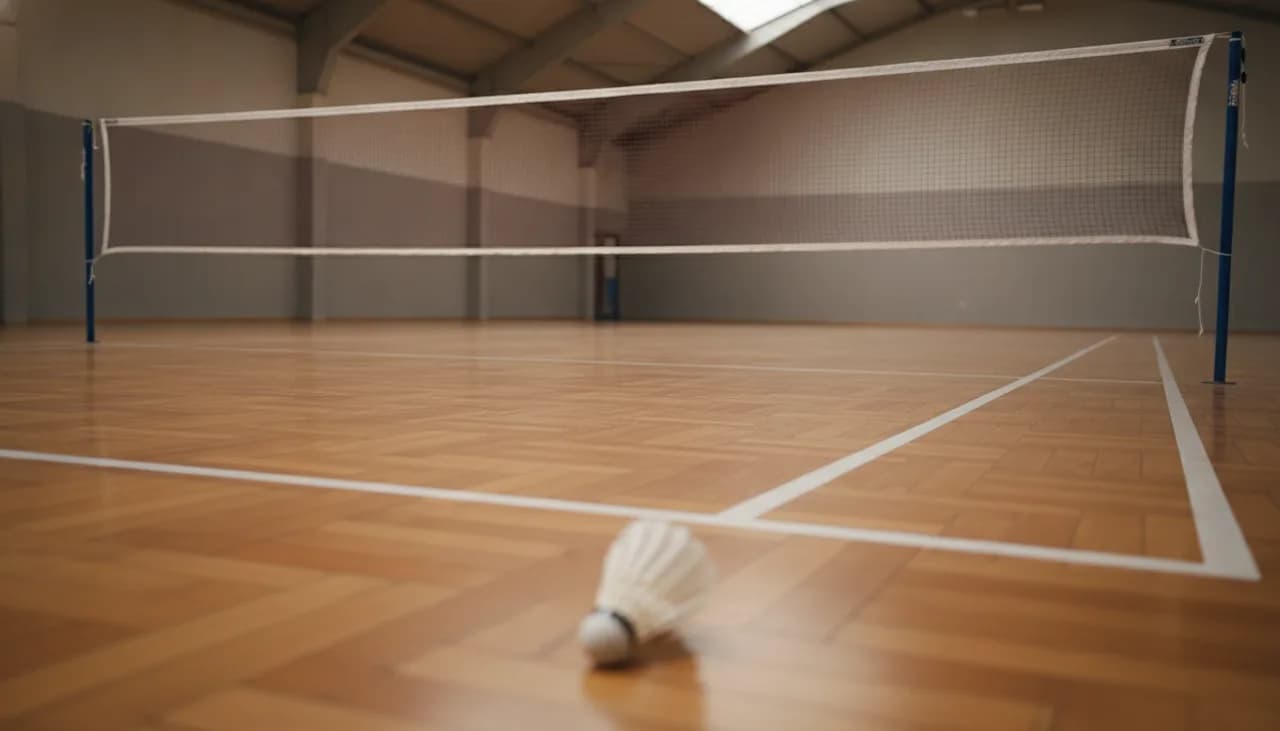
Outdoor or Indoor Badminton Net: Which to Choose?
An outdoor badminton net isn't chosen the same way as a gym model. Materials, wind resistance, dimensions, budget: the complete buying guide.
Choosing an outdoor badminton net is completely different from buying a gym net, and that's the first mistake beginners make. A net designed for the garden, patio, or beach must withstand sun, rain, and especially wind, whereas a club net only needs a flat surface and calm air. So, equipment perfect for indoors becomes unusable outdoors, and vice-versa. This guide compares the two families point by point—materials, fastening, stability, dimensions, budget—so you can choose according to your actual use, without paying for unnecessary features.
Key Takeaways
- An outdoor badminton net prioritizes weather resistance (UV-treated mesh) and wind stability (weights or stakes), not height precision.
- An indoor badminton net focuses on tension, fine mesh, and precise height adjustment, but cannot withstand UV rays or rain.
- Outdoors, beyond 8-10 km/h of wind, a feather shuttlecock becomes unplayable: you switch to a nylon shuttlecock, which changes everything.
- Many garden kits are shorter and lower than the standard (1.55 m at the posts)—check this if you want to play "like the real thing."
- The right starting criterion: competition/club or leisure/garden/beach? Everything else follows from that.
Outdoor vs. Indoor Badminton Net: The Real Difference
The fundamental difference isn't the price or the brand; it's the environment for which the net was designed. An indoor badminton net lives in a gym: flat floor, no wind, no sun, stable temperature. Its posts rest on a weighted base or are fixed to the floor, its mesh is fine, a tension cable keeps the top band straight, and on club models, the height is adjustable to the centimeter. Everything is optimized for precision and durability in a protected setting.
An outdoor badminton net, on the other hand, must survive hostile conditions. The structure is more robust, the mesh is UV-treated, and the fastening is designed to resist wind—either by stakes driven into the ground or by a base filled with sand or water. These kits are often sold ready to transport: telescopic posts, net, and carrying bag in a single set. The trade-off: they generally sacrifice fine adjustment and sometimes official dimensions in favor of quick setup.
Concretely, an indoor net placed in your garden will fall over at the slightest gust, and its mesh will weaken after a few exposures to sun and humidity. Conversely, an outdoor kit works in a gym, but you pay for unnecessary robustness and portability there, losing out on height precision. Identifying your primary playing field before buying helps you avoid these two dead ends.
Materials and Resistance: Why an Outdoor Badminton Net Lasts Outdoors
The mesh material separates a net that lasts from one that disintegrates in a season. Outdoors, manufacturers use polyethylene (PE) or UV-treated nylon. Without this treatment, sunlight gradually breaks down the fibers: the net yellows, hardens, then frays. An indoor badminton net doesn't have this treatment because it doesn't need it—and that's precisely why you shouldn't leave it outside permanently.
Beyond the mesh, look at the top band. On a good net, it's doubled and reinforced, sometimes with a cable or strap that maintains tension. This is what takes the most stress when the shuttlecock brushes against it and when the wind pulls on it; a thin, unreinforced band quickly loosens, and the net eventually sags in the middle.
The posts also matter. In clubs, they are often made of stable, heavy metal. For outdoor leisure, you mostly find telescopic posts made of lightweight steel or aluminum, which are easier to transport but more susceptible to bending in the wind. A common compromise: hollow posts that can be weighted by anchoring them to a base filled with sand or water.
Finally, think about storage. Even with UV treatment, a net left outside all year round ages faster than a net brought in after each session: disassembling it and storing it dry significantly extends its lifespan. This is also why portability (carrying bag, tool-free assembly) is a real criterion and not a gimmick.
Fastening and Wind Stability of the Outdoor Badminton Net
Outdoors, stability is the number one criterion, ahead of mesh quality. A beautiful net that falls over at the first breeze is useless. Two main families of fastening exist, and the right choice depends on your ground.
Stake fastening (like tent pegs) involves anchors connected by guy ropes that tension and stabilize the structure. This is effective on grass or soft ground, where the stakes grip well. On a concrete patio or hard ground, it's impossible to drive anything in: you then need a weighted base, bases that you fill with sand or water to anchor the posts by weight. Many modern kits combine both approaches to adapt to multiple surfaces.
Wind dictates the rest of the experience. Beyond approximately 8 to 10 km/h, a feather shuttlecock becomes impractical: it drifts, slows down, and breaks. This is why outdoor badminton is most often played with nylon (plastic) shuttlecocks, which are heavier and more resistant to gusts. This detail changes how you use your net: you are no longer in a logic of millimeter precision like in indoor competition, but in a logic of robust recreational play. Therefore, there's no need to aim for an ultra-tight, tournament-quality net to hit plastic shuttlecocks in the garden on a windy Sunday.
For beach badminton, sand offers no solid grip for classic stakes: the weighted base (often filled with sand on site) becomes the preferred solution. If you're unsure about your playing surface, first look at how the net anchors before looking at the mesh.
Dimensions and Compliance: Does Your Badminton Net Meet the Standard?
This is the most frequent pitfall of consumer kits. A regulation badminton net measures 1.55 m high at the posts and 1.524 m at the center, over a court width of 6.10 m for doubles. These measurements come from the Laws of Badminton published by the BWF, and they define an "official" court. However, many garden kits are shorter in width and sometimes lower than the standard, to fit into a small space and be set up quickly.
For recreational play with friends, this is not a problem: you adapt your court to the available space. But if your goal is to train to improve and replicate the club experience, aim for official measurements. A net that is too low distorts net play and flat trajectories; a court that is too narrow distorts your positioning. You develop bad habits that you will have to correct when returning to the gym.
Before buying, read the technical specifications: height at the posts, height at the center, and net width. If the seller is vague about these three figures, be wary. For full details on regulatory heights and tolerances, we've written a dedicated guide on badminton net height and official dimensions. And if you want to mark out a real court at home, the guide to badminton court dimensions covers all BWF measurements, including service lines.
Once your court is set up to the correct dimensions, it's worth following good practices: the badminton service rules and the complete rules help you avoid approximations that turn a serious game into beach play.
How to Choose Your Badminton Net According to Your Use
The best way to avoid mistakes is to start with your use, not the product. Ask yourself one question: where and how will you play most often?
If you play in competition or at a club, you won't be buying the net anyway—it's provided by the venue. But if you want to train seriously at home, in a garage, or a covered space, opt for an indoor-type net with adjustable height and good tension: you prioritize measurement precision and the quality of the top band.
If your use is leisure, garden, or beach, an outdoor net is essential. You prioritize, in order: stability (fastening adapted to your ground), weather resistance (UV-treated mesh, reinforced band), ease of assembly and transport, then dimension compliance if you care about it. A portable kit with telescopic posts, a weighted base or stakes, and a carrying bag covers most recreational needs.
The most common case is mixed use: a bit of garden in the summer, a bit of indoor play in the winter. In this case, get a robust outdoor net—it will also work indoors—and accept a slight loss in fine adjustment. The reverse, an indoor net used outdoors, won't hold up due to UV rays and wind.
The right tool is the one that matches your actual practice, not the one with the best product sheet. This is exactly the same logic as for improving: if you want to see how we help players analyze their game regardless of their level, take a look at how it works.
Budget and Brands: Where to Buy a Badminton Net
The badminton net market is divided into two worlds. On one side, high-end specialized brands like Yonex and Victor, which mainly supply club and competition equipment. On the other, large sports retailers—Decathlon, Intersport, and equivalents—which offer entry- and mid-range leisure-oriented kits, often as a complete net + posts + bag set.
Without quoting specific prices (they vary by model, country, and period), the logic is simple: the higher the range, the more you pay for tension, material durability, and dimension compliance. For occasional garden play, a mass-market kit does the job perfectly. For regular and demanding use, specialized equipment avoids having to buy a new saggy net or bent posts every year.
Some benchmarks before checking out. Check the three key dimensions (post height, center height, width). Compare the fastening system to your actual ground. Read if the mesh is advertised as UV-treated. And check what's included: some "complete" sets omit stakes or the weighting base, which then need to be purchased separately.
Final advice: don't over-equip. A beginner playing in their garden doesn't need a tournament-level net, and a club player doesn't need a beach kit. The best purchase is the one that matches your current practice, even if you upgrade later.
Frequently Asked Questions
Can an indoor badminton net be used outdoors?
Occasionally yes, but it's a bad idea in the long run. An indoor net has no UV treatment: exposed to sun and rain, it weakens and frays quickly. Its fastening is also not designed for wind, so it will fall over at the slightest gust.
What is the height of an outdoor badminton net?
To play "like the real thing," aim for official measurements: 1.55 m at the posts and 1.524 m at the center. Many garden kits are intentionally lower and shorter to fit into a small space, so always check the technical specifications before buying.
How do you secure an outdoor badminton net so it withstands the wind?
It all depends on your ground. On grass or soil, stakes with tensioned guy ropes provide good anchoring. On concrete, patio, or sand, you need a weighted base that you fill with sand or water to anchor the posts by weight.
Can you play with a feather shuttlecock outdoors?
Beyond approximately 8 to 10 km/h of wind, no: a feather shuttlecock drifts and becomes unplayable. That's why outdoor badminton is most often played with nylon shuttlecocks, which are heavier and more resistant to gusts. In perfectly calm weather, feather is still possible but rare.
Which net should I choose for beach badminton?
On sand, classic stakes don't grip: opt for a kit with a weighted base, filled with sand on site. Prioritize a lightweight and easy-to-transport structure, and play with plastic shuttlecocks to cope with the seaside wind.
Once your court is set up to the correct dimensions, real progress comes from playing—and from how you analyze it. Film a session, see where you lose points, and work on your corrections using a detailed video analysis of your game. This is the natural complement to good equipment: the net provides the framework, and analysis tells you how to progress within it.