
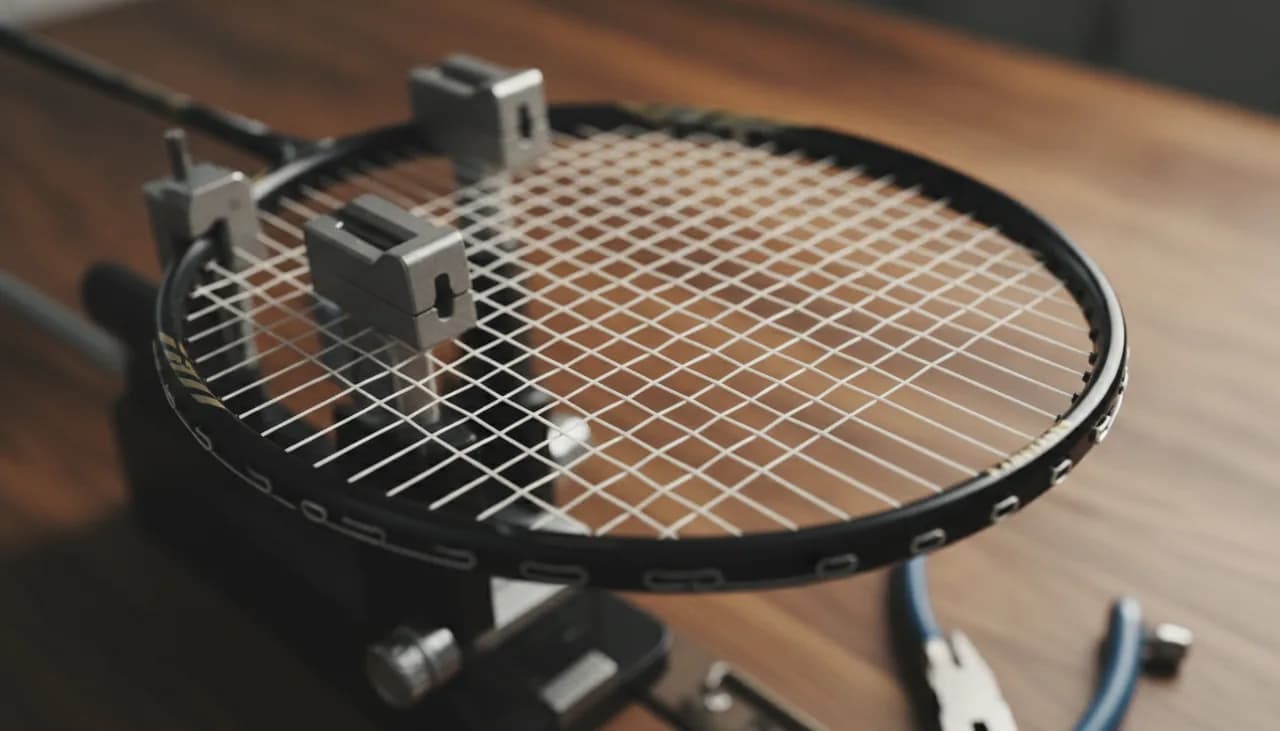
Badminton Racket Cover: Protect and Maintain Your Gear
A badminton racket cover protects your frame from impacts and your string from heat. We'll see which bag to choose based on the number of rackets you need to carry.
A badminton racket cover isn't just for transporting your gear: it protects a thin carbon frame from impacts and your string from temperature variations. A badminton racket weighs less than 100 grams, and its graphite frame is surprisingly fragile—a misplaced knock in a general sports bag is enough to crack it. This guide covers the types of protection, helps you choose based on the number of rackets you carry, and explains the direct link between your cover and your string's lifespan.
Key Takeaways
- Three families of protection exist: the simple cover (sheath), the thermo bag (thermobag), and the badminton backpack.
- A racket's graphite frame is fragile: an impact in a general bag can crack it without you noticing immediately.
- Heat is the main enemy: a car trunk in direct sunlight softens the string and causes its tension to drop.
- Choose your bag based on the number of rackets to carry (from 1 to 12) and the presence of a thermo compartment.
- Good protection and stable temperature storage extend the lifespan of the string and frame.
Types of Badminton Racket Covers and Bags
There are three main families of protection, from the simplest to the most complete, and each meets a specific need.
The simple cover (sheath). This is the most basic sleeve, often provided with a mid-range racket. It protects a single racket from dust and micro-scratches, is lightweight, and fits anywhere. However, it offers no real thermal protection and poorly absorbs shocks: it's cosmetic protection, not true transport security. Perfect for storing your racket at home or slipping it into an already rigid large bag.
The thermo bag (thermobag or insulated racket bag). This is the standard format for club players. Its insulated compartment limits temperature variations, useful when you leave your bag in a car in summer or winter. Depending on the model, it holds several rackets—often 6, sometimes 9 or even 12—plus your shoes and accessories. To be preferred as soon as you own several rackets and play regularly.
The badminton backpack. A daily format, it generally carries 2 to 6 rackets with a separate shoe compartment. More compact than the thermobag, it suits club players who travel on foot, by bike, or by public transport. Thermal protection varies by model: some include an insulating lining, others do not.
Regarding brands, you'll find Yonex and Victor in the specialized segment, as well as mass-market distributors like Decathlon or Intersport for more accessible models. Before choosing your protection, it's good to know which racket you're protecting: our comparison of Yonex and Babolat rackets helps you situate your equipment.
Why Protect Your Badminton Racket
A badminton racket is a precision object disguised as a mundane accessory. Its frame is thin, hollow, and made of graphite or carbon for lightness and rigidity. This construction makes it responsive on impact but also vulnerable: a lateral shock, a fall on a hard corner, or compression in an overloaded bag can crack it. A crack isn't always immediately visible—it weakens the structure, and the racket eventually breaks cleanly, often in the middle of a match.
Badminton remains the fastest racket sport in the world, and the BWF governs competition equipment specifications. The more performing and lighter the frame, the more sensitive it is to mistreatment. This is exactly why a dedicated cover or bag is not a luxury but an insurance.
The second, more insidious enemy is temperature. Heat softens the structure and affects string tension: left for several hours in a car trunk in direct sunlight, a racket's string loses tension and can even deform. Cold poses the opposite problem: it makes the frame more brittle, and thus more susceptible to impacts.
Concretely, protecting your racket means protecting three things: the integrity of the frame against impacts, the stability of string tension against heat, and ultimately your budget. For a player who is progressing and investing in a good racket, this is the basic reflex to acquire early.
Choosing Your Racket Bag Based on the Number of Rackets
The first selection criterion is not the brand or the look, but the number of rackets you actually carry. Everything else follows from that.
A single racket. If you're a beginner or play occasionally for leisure, a simple cover or a small shoulder bag is sufficient. There's no need to burden yourself with a twelve-racket thermobag that you'll never fill. Just check the length: a racket measures about 67 to 68 cm, and some entry-level sheaths are cut too short.
Two to six rackets. This is the case for the regular club player, who often keeps a spare racket and a second strung at a different tension. The badminton backpack is a good compromise here: enough space, practical for daily use, and a separate shoe compartment. This insulated compartment matters more than you might think, both for hygiene and to avoid putting your shoes in contact with the frames. If you haven't optimized this item yet, our guide to choosing your badminton shoes explains why they deserve their own space.
Six to twelve rackets. Here, you move to a thermobag. This is the bag for competitors or those who also carry a partner's equipment. Beyond capacity, it's the insulated compartment that justifies the purchase: it protects all your equipment from thermal shocks during travel.
Beyond the number of rackets, also consider the carrying options (single shoulder strap, double, or backpack format), the presence of a dedicated thermo compartment, and the quality of the zippers. A good bag will accompany you for several seasons: choose it according to your actual use, not a theoretical number of rackets.
Badminton Racket Thermo Cover: Protecting the String
This is the point most players ignore: your cover has a direct impact on the lifespan of your string. A badminton string naturally loses tension over time, and temperature greatly accelerates this phenomenon. The hotter and more unstable the storage environment, the faster the tension drops, and the more you lose precision without even realizing it.
A thermo bag limits these variations. Its insulated compartment doesn't maintain a perfect temperature, but it dampens peaks: the heat of a trunk in mid-summer or the cold of a night in a car penetrates more slowly. Over time, this preserves tension and extends the time before you need to restring. If you want to understand how tension evolves and when to replace your string, our complete guide to badminton racket string details kilograms, materials, and replacement frequency.
Some simple habits complement the protection provided by the thermo cover:
- Never leave your racket in a car parked in the sun longer than necessary. A few hours at 50 °C in a trunk are enough to degrade tension.
- At home, store your racket in a temperate place, away from a radiator, a south-facing window, or a damp garage.
- Avoid brutal thermal shocks. Going from outdoor cold to an overheated hall and then back to cold fatigues the string and frame.
The logic is the same as for all technical equipment: stability prolongs lifespan. A thermo cover isn't magic, but it transforms aggressive storage into acceptable storage, and that makes a difference to the freshness of your string.
Maintaining Your Badminton Racket and String
The cover protects during transport, but regular maintenance does the rest of the work. A few simple actions are enough to keep your racket in playing condition longer.
First reflex: never detension your racket for storage. Contrary to common misconceptions from other sports, you don't loosen the string of a badminton racket between sessions. Tension is part of the racket's balance. You store it strung, as is, in its cover.
Second reflex: clean the handle and grip. Sweat soaks into the grip, making it slippery and accelerating its wear. A clean grip means a better hold and less risk of the racket twisting on impact. When the grip is too worn, it's replaced rather than cleaned indefinitely—our guide on badminton racket grips explains how to apply it and when to change it.
Third reflex: check the grommets. These are the small plastic pieces that protect the string where it passes through the frame. Cracked or missing grommets cause premature breakage. A quick check from time to time avoids unpleasant surprises.
Finally, do not leave your racket strung under high tension in a hot environment for too long. It's the combination of heat plus prolonged tension that causes the most deformation and fatigue. The thermo cover helps, but proper storage remains your best protection.
Equipment maintenance doesn't replace technical work: it's the action that exploits or doesn't exploit your string. BadmintonPeak doesn't string your rackets, but its video analysis shows you if your hit is well-centered on the sweet spot, where the string works best.
Mistakes to Avoid with Your Badminton Racket Cover
Even well-equipped, it's easy to make a few mistakes that negate the benefit of good protection. Here are the most common ones.
Leaving the bag in the car. This is the number one mistake. A thermo cover slows down temperature variations; it doesn't eliminate them. Over several hours in a trunk in direct sunlight, the insulated compartment eventually heats up too. Take your bag out of the car as soon as you get home.
Using a general sports bag. Slipping your racket into an unpadded gym bag, amidst shoes and a water bottle, exposes the frame to impacts: this is exactly the scenario that cracks a carbon frame. If you only have a simple cover, place the racket flat, never jammed under heavy objects.
Neglecting the shoe compartment. Putting indoor shoes in direct contact with rackets poses a double problem: hygiene and the risk of scratching the frame. A separate compartment solves both at once; it's a criterion not to be underestimated when choosing your bag.
Overloading the bag. Stuffing a thermobag to the point of forcing the zipper puts pressure on the frames. Leave some margin and store heavy objects away from the rackets.
Forgetting maintenance under the pretext of having a nice cover. Protection during transport does not exempt you from cleaning the grip, checking the grommets, and monitoring string tension. The cover protects the equipment, maintenance keeps it in good condition.
Avoiding these mistakes costs nothing and significantly extends the life of your equipment. This is what separates the player who buys a new racket every season from the one who keeps theirs in shape for years.
Frequently Asked Questions
How many rackets can a badminton thermo bag hold?
It depends on the model. Badminton thermo bags generally come in capacities of 6, 9, or 12 rackets, in addition to space for shoes and accessories. For a club player, a 6-racket format largely covers needs; higher capacities are for competitors or those who carry shared equipment.
Does a simple cover protect against heat?
No. A simple cover, or sheath, only protects against dust and micro-scratches. It has no insulating lining and therefore offers no real thermal protection. If you want to protect your string from temperature variations, you need a thermo compartment, found on thermobags and some backpacks.
Should you detension your racket when storing it?
No, you never detension a badminton racket for storage. Tension is part of the racket's balance, and manipulating it provides no benefit. You store your racket strung as is in its cover, away from heat and impacts.
Does heat really damage the string?
Yes. Heat accelerates the natural loss of string tension and can, in extreme cases like a car trunk in direct sunlight, soften the structure and deform the frame. Storage at a stable temperature, aided by a thermo cover, preserves tension longer and extends the time between restrings.
What size for a badminton racket cover?
A badminton racket measures approximately 67 to 68 cm in length. Check that your cover or bag accommodates this length without forcing; some entry-level sheaths are cut a bit short. For a multi-racket bag, length is generally not an issue, but look at the number of compartments and their padding.
Once your equipment is protected and maintained, the real gain comes from technique. Upload a 30-second video to BadmintonPeak and receive a step-by-step analysis of your stroke, timing, and impact point on the sweet spot—to make the most of the racket and string you take care to preserve.