
Recentering Trajectories in Rear Court Construction
Apply the great P3 OTTHN principle: recenter trajectories built from the back of the court to close off your space and limit your opponent's angles.
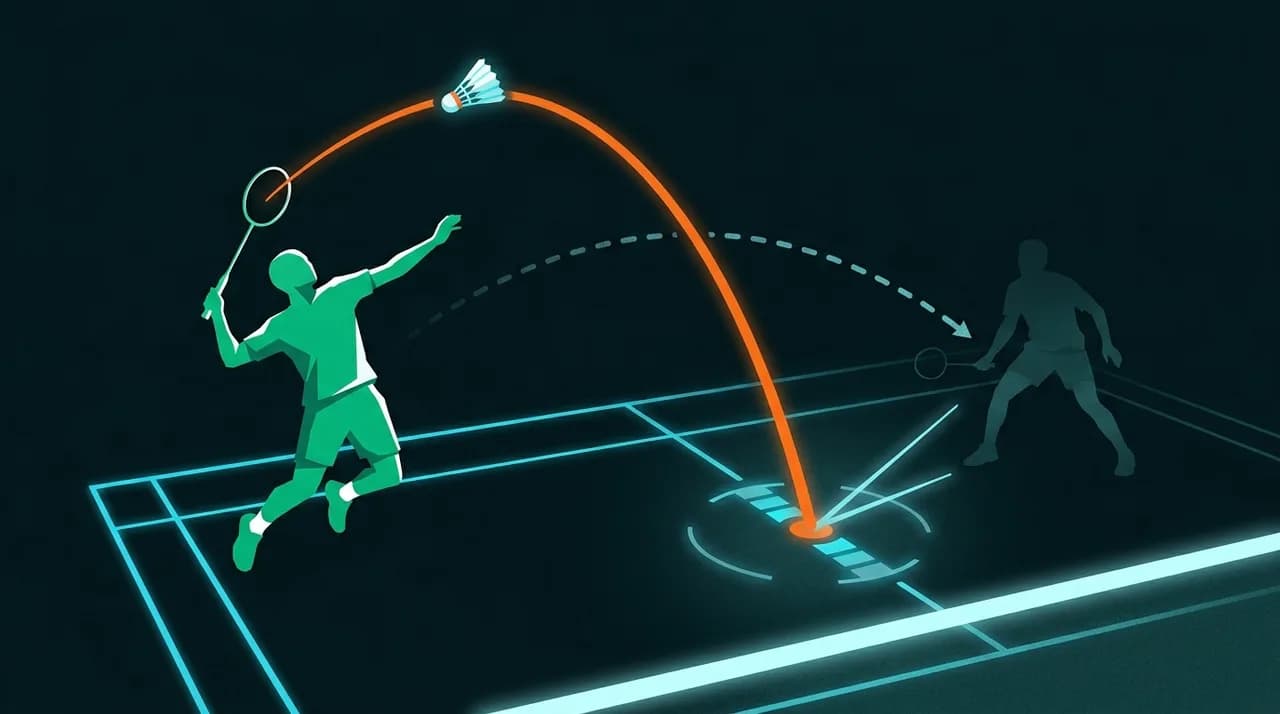
Re-center your clears and lobs from the back of the court to close off your own court and limit your opponent's angled opportunities.
The Context
The great P3 principle of OTTHN states: 'In an unfavorable, neutral, or favorable situation, if I play from the backcourt to build the rally, I recenter my trajectories.' This may seem counter-intuitive (we often learn to 'widen') but it's a major tactical key.
The Concept
Recentering a clear offers several advantages:
- Close off your court: limit the angle available to the opponent.
- Facilitate the next shot: center your recovery.
- Precision with the back line: length matters more than width.
- Less risk: avoid long side faults.
The target is the center of the opponent's half-court, aiming for the back line.
How This Course Is Structured
We work on precision on a central target, then we integrate the rally dimension.
To Go Further
- Play far from the net in neutral — another complementary principle (P4).
- Build in neutral — variation tools.
- 01
Step 1 — Precise Centered Clear
Multi-shuttle1 vs 10–2 min - 02
Step 2 — Bilateral Centered Clear
Multi-shuttle1 vs 10–2 min - 03
Step 3 — Directed Rally, Centered Construction
Directed rally1 vs 10–2 min - 04
Step 4 — Recentering Under Attack Pressure
Conditioned rally1 vs 10–2 min - 05
Step 5 — Themed Match: Strategic Refocusing
Themed match1 vs 10–2 min
Who is this badminton course for?+
This course targets the competitive player refining their game under pressure. The selection of drills, the targeted observables and the AI's feedback tone are calibrated to that level — neither too basic nor too technical.
How long does it take to complete?+
The course is structured in 5 steps of video drills. Total estimated time on-court is around 5 minutes spread across multiple sessions — most users complete it over 2 to 4 weeks at the rate of 1 to 2 sessions per week.
What will I actually learn?+
The course focuses on rally construction, height alternation and pressure patterns. Each step isolates one observable (a measurable aspect of the stroke or movement), films your reps, and the AI scores you with a personalized improvement axis.
Do I need a partner or coach?+
All steps in this course require a partner — either to feed shuttles in a controlled rhythm or to play themed exchanges. The AI replaces the coach's eye for technical feedback — you stay in control of when and how you train.
How much does it cost?+
The first step is free (STARTER plan). Unlocking the rest requires a BASIC subscription at €9/month — unlimited courses, no commitment.