
Forehand Slice: Deceive with Spin
Hit the shuttle diagonally, forehand side, racket face angled inwards, to send the shuttle cross-court and deceive your opponent.
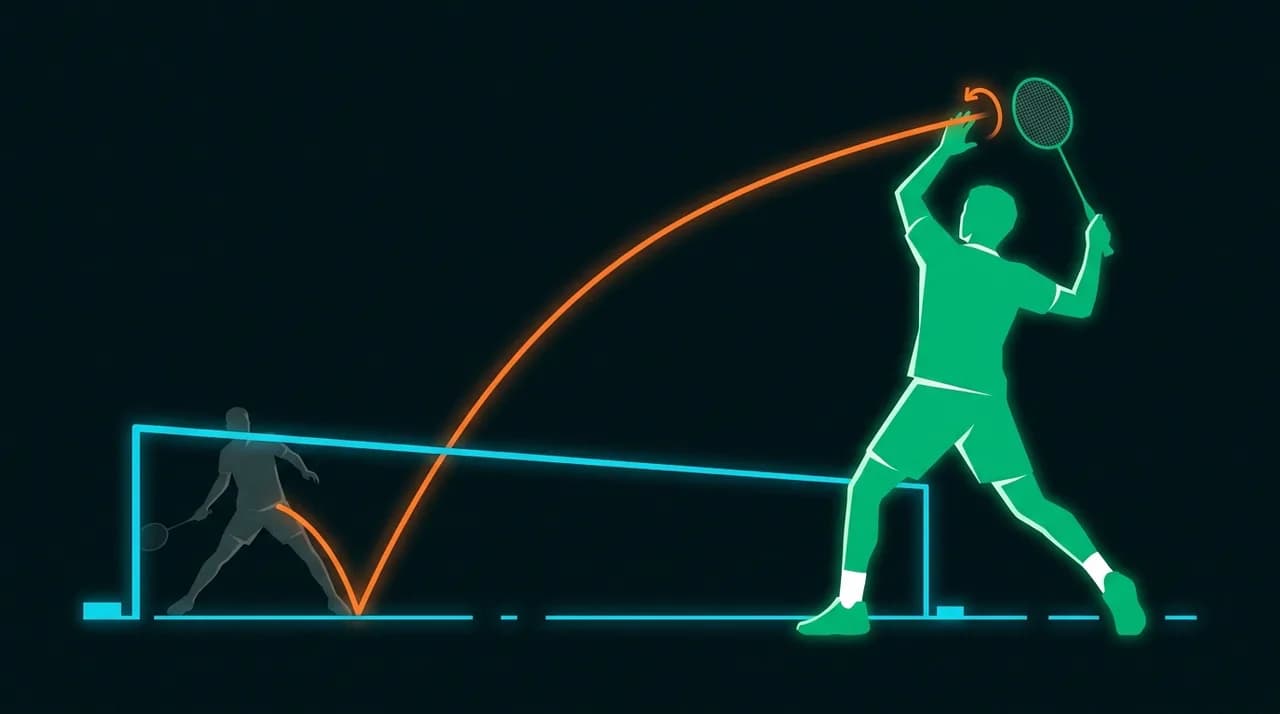
Master the forehand slice (racket face angled inwards) to send the shuttle diagonally cross-court and deceive your opponent with the spin.
The Context
The slice is a forehand shot with spin: the shuttlecock is hit diagonally, with the racket face angled inwards. This sends the shuttlecock on a cross-court diagonal relative to the apparent movement. When well-prepared (with the same preparation as a normal forehand), it deceives the opponent who anticipates one trajectory and receives another.
The Concept
- Racket face angled inwards at the moment of contact.
- Diagonal hit: the racket's movement is not parallel to the shuttlecock's trajectory.
- Preparation identical to a standard forehand: this is what creates the surprise.
The slice comes in two speeds: slow slice (short sliced drop shot) and fast slice (shuttlecock landing behind the service line).
To avoid: hitting flat (no spin, the slice loses its meaning), slicing too hard (loss of control), preparation different from a normal forehand (becomes predictable).
How This Course Is Structured
The course has 4 stages (no useful intermediate variant): slow slice without a target (to feel the contact), sliced drop shot with a target, alternating slow/fast, and in-match application.
To Go Further
- Reverse slice — the inverse of the classic slice, to be paired.
- Varying backcourt shots — to integrate the slice into an indistinguishable preparation.
- 01
Step 1 — Slow Slice Without Target
Multi-shuttle1 vs 10–1 min - 02
Step 2 — Sliced Drop Shot with Target
Multi-shuttle1 vs 10–2 min - 03
Step 3 — Alternate Slow Slice / Fast Slice
Multi-shuttle1 vs 10–2 min - 04
Step 4 — Slice in a Match
Themed match1 vs 10–2 min
Who is this badminton course for?+
This course targets the competitive player refining their game under pressure. The selection of drills, the targeted observables and the AI's feedback tone are calibrated to that level — neither too basic nor too technical.
How long does it take to complete?+
The course is structured in 4 steps of video drills. Total estimated time on-court is around 4 minutes spread across multiple sessions — most users complete it over 2 to 4 weeks at the rate of 1 to 2 sessions per week.
What will I actually learn?+
The course focuses on the technical and tactical foundations: grip, ready position, fundamental strokes and game reading. Each step isolates one observable (a measurable aspect of the stroke or movement), films your reps, and the AI scores you with a personalized improvement axis.
Do I need a partner or coach?+
All steps in this course require a partner — either to feed shuttles in a controlled rhythm or to play themed exchanges. The AI replaces the coach's eye for technical feedback — you stay in control of when and how you train.
How much does it cost?+
The first step is free (STARTER plan). Unlocking the rest requires a BASIC subscription at €9/month — unlimited courses, no commitment.