
Center of Play and Oriented Recovery
Master the concept of the dynamic center of play: reposition yourself not in the geometric center of the court, but in the center of the angles opened up by your own shot.
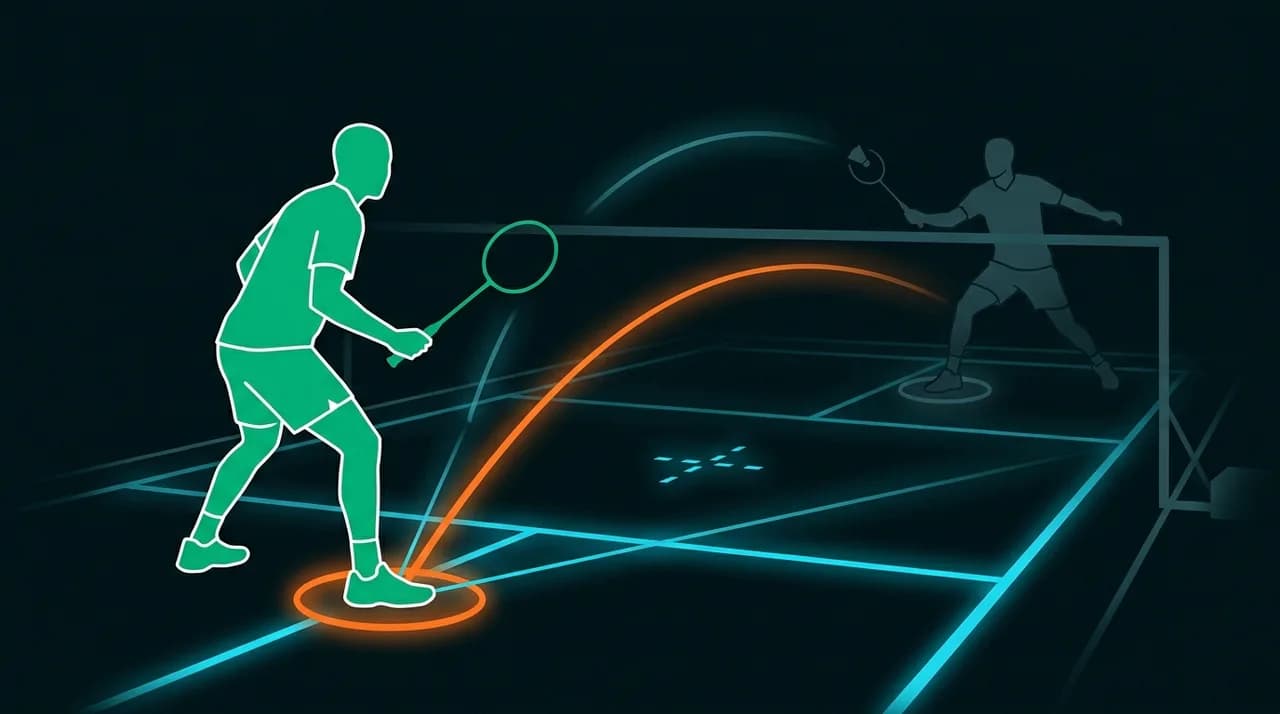
Develop the dynamic center of play: reposition yourself according to the angles opened up by your own shot, not to the automatic geometric center.
The Context
Systematically returning to the geometric center of the court is a common mistake. The correct return position is the one that best covers the angles available to the opponent, considering the sending zone of your own shot. This is called the dynamic center of play.
The Concept
- If I play a shuttlecock deep in the left zone, the opponent primarily has angles to the right (cross-court shots). My return position must therefore be slightly shifted to the right, not to the exact center.
- If I play at the net, the opponent is forced to lift – my return position must anticipate the probable return zone (generally central or opposite).
The center of play is therefore calculated for each shot based on:
- The sending zone (my shuttlecock)
- The open angles (opponent's side)
- The type of shot expected in return
How This Course Is Structured
We work on shadow placement, multi-shuttle drills with oriented return positioning, real play with conscious return positioning, impregnation, and themed matches.
To Go Further
- High/Low Hand Maneuverability — to ensure versatility regardless of the return position.
- Paired Shot in Construction — so as not to betray the return position by the preparation.
- 01
Step 1 — Shadow Replacement by Zone
Multi-shuttle1 vs 10–2 min - 02
Step 2 — Multi-Shuttle with Oriented Recovery
Multi-shuttle1 vs 10–2 min - 03
Step 3 — Systematic Played Replacement
Multi-shuttle played1 vs 10–2 min - 04
Step 4 — Directed Rally Game Center
Directed rally1 vs 10–2 min - 05
Step 5 — Themed Match: Center of Play
Themed match1 vs 10–2 min
Who is this badminton course for?+
This course targets the competitive player refining their game under pressure. The selection of drills, the targeted observables and the AI's feedback tone are calibrated to that level — neither too basic nor too technical.
How long does it take to complete?+
The course is structured in 5 steps of video drills. Total estimated time on-court is around 5 minutes spread across multiple sessions — most users complete it over 2 to 4 weeks at the rate of 1 to 2 sessions per week.
What will I actually learn?+
The course focuses on the technical and tactical foundations: grip, ready position, fundamental strokes and game reading. Each step isolates one observable (a measurable aspect of the stroke or movement), films your reps, and the AI scores you with a personalized improvement axis.
Do I need a partner or coach?+
All steps in this course require a partner — either to feed shuttles in a controlled rhythm or to play themed exchanges. The AI replaces the coach's eye for technical feedback — you stay in control of when and how you train.
How much does it cost?+
This OTTHN course is reserved for PRO subscribers (€39/month). The first step is accessible with a BASIC plan to discover the competitive approach before upgrading.